
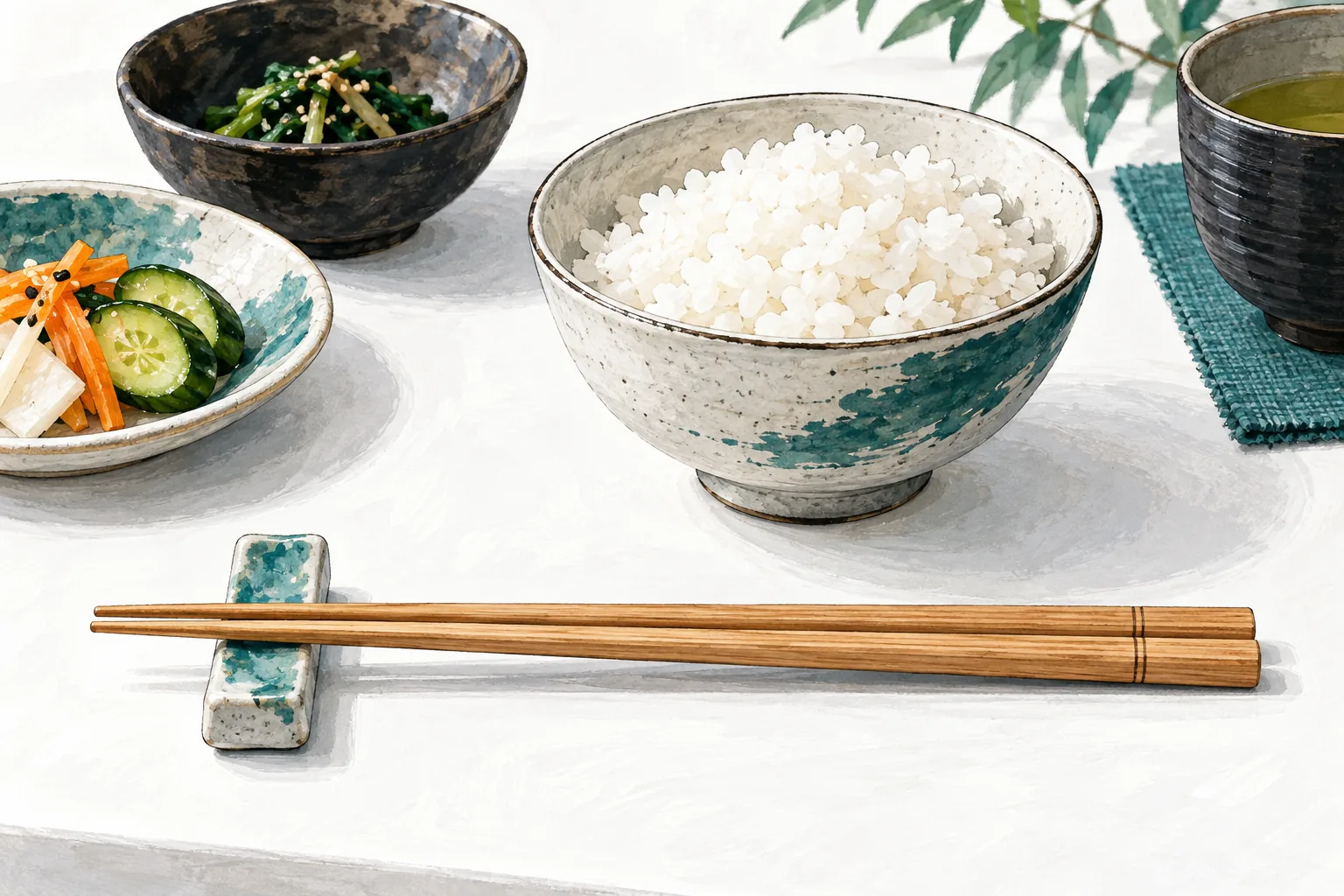
Keep chopsticks out of an upright position in rice, avoid pointing with them, and use the serving utensils provided for shared dishes. Those habits are a useful starting point. Other customs depend on where you are eating: Japanese and Korean table manners, for example, differ over lifting bowls and using a spoon for rice.
This guide separates chopstick etiquette by country, because the setting in front of you matters more than any single rule. The same pair of sticks is handled differently in China, Japan, Korea, Vietnam and Thailand, and two familiar situations cause most of the confusion: a bowl of noodles and a plate of sushi. A family dinner, a restaurant meal and a formal occasion may each carry different expectations, and our guide to shared meals covers how to read a table you have never eaten at before.
Chopstick manners to remember at the table
- Put your chopsticks down when you pause to talk. Pointing at someone with them is discouraged in Chinese and Japanese etiquette.
- Take a piece of food without searching through the shared dish for a preferred bite. Avoid hovering from plate to plate while deciding.
- Move a bowl or plate with your hands. Chopsticks are eating utensils, and should not be used to drag tableware across the table.
- Use the serving chopsticks, spoon or tongs supplied for a communal dish. Transfer food to your own plate before eating it.
- Keep the two eating ends aligned and avoid sucking or noisily licking the sticks.
The World Federation of Chinese Catering Industry’s etiquette guide describes pointing, tapping bowls, hovering over dishes and rummaging through food as poor manners. It also notes that many families take a more relaxed approach to dining today.
How chopsticks differ from country to country
Half of the confusion at an unfamiliar table is the utensil itself. China Daily’s guide to chopstick culture describes Chinese chopsticks as “usually 9 to 10 inches long and rectangular with a blunt end”, a length that reaches a dish set in the middle of the table. Wikipedia’s chopsticks article records Japanese chopsticks as “typically sharp and pointed, in order to dissect fish and seafood”.
Korean chopsticks are the most obvious change. KOCIS, the Korean government’s cultural information service, notes that modern Korean chopsticks and spoons are “usually made of stainless steel”, and that a preserved bronze (yugi) pair on display at the National Museum of Korea dates back to the Goryeo Dynasty. A contributor article on Korea.net adds that the flat, smooth shape takes practice and that the spoon-and-chopstick set is called sujeo; read that page as a reporter piece rather than an official statement of policy.
Stainless steel is heavier than bamboo, conducts heat and gives you less to grip near the tip. None of that means you are holding them wrongly. It is a reason to take the first few minutes slowly, and not a reason to comment on the cutlery.
Why should you avoid standing chopsticks in rice?
In Japan, upright chopsticks in rice recall a funeral offering. Passing food directly between two pairs of chopsticks also has a funeral association. The Embassy of Japan’s food etiquette guide advises against both actions. To give someone food, place it on their plate with a serving utensil instead.
Upright chopsticks are also discouraged in the Chinese catering federation’s guide and in Seoul’s official dining advice. You do not need to remember every explanation to adopt the practical habit: lay chopsticks down neatly when you stop eating.
Chopstick etiquette in China
Avoid tapping your bowl, pointing at people, or picking through a communal dish. Choose the food you intend to take before reaching into the plate. When you need a pause, place the pair neatly on the rest or beside the dish; the Chinese catering federation also describes laying them horizontally on a bowl or plate.
For a shared meal, look for serving utensils before reaching in with your own chopsticks. If the arrangement is unclear, ask the host how people are serving themselves. That question is more useful than assuming that one household’s practice applies everywhere, and our guide to visiting a Chinese home covers the gifts, shoes and questions that come before the food.
Chopstick etiquette in Japan
Use a chopstick rest when one is supplied. Do not spear food, point with the sticks, or pull dishes toward you with them. The Japan National Tourism Organization’s food guide also advises taking food from a communal platter onto your own small plate before eating.
Holding a small bowl closer to your mouth is acceptable in Japanese dining. If you are learning to use chopsticks, keep the lower stick steady and move the upper one with your thumb and fingers. JNTO explains this grip in its food guide. Its customs and manners guidance also says you can ask staff for a different utensil, although a traditional restaurant may not have one available.
Chopstick etiquette for ramen and other noodles
Noodles are the Japanese course where the table is expected to make noise. JNTO’s food etiquette guide states “Do feel free to slurp your noodles”, and its ramen guide is more direct: “Slurping is not impolite and is, in fact, the standard way to eat ramen.” The food guide lists using chopsticks “like a spoon, or a knife and a fork” among the things to avoid, so the sticks lift the noodles and a spoon, if one is provided, handles the rest.
The ramen guide also describes how these shops run. Many have no servers, you buy your order from a ticket machine, and because most shops are small “it is not polite to linger over your bowl”. Work out the machine before you sit down, and be ready to leave when you have finished. The food guide adds “Do try your best to finish all your meal”, a firmer expectation than many visitors anticipate, so a smaller bowl is the safer order.
Sushi: chopsticks, or your hands
At a sushi counter the utensil is optional. JNTO’s sushi guide says chopsticks are “the preferred utensil for eating sushi most of the time, but hands are perfectly acceptable as well, especially at higher-end restaurants”, and its general manners guide puts the same point in one line: sushi “is generally eaten in two ways: with chopsticks or with your hands”.
Dipping matters more than grip. JNTO advises dipping the topping rather than the rice, because rice takes up too much soy sauce and overwhelms the piece, and its general guide adds that wasabi should not be stirred into the shared soy sauce. Pickled ginger is a palate cleanser eaten between orders, not a topping. The usual prohibitions still apply at the counter, which JNTO summarises as “the two biggest no-no’s of chopstick use”: sticking them vertically in a bowl of rice and passing food from chopsticks to chopsticks. For the polite phrasing and bowing that go with the rest of the meal, see our guide to Japanese greetings.
Chopstick etiquette in Korea
A Korean place setting commonly includes both a spoon and chopsticks. VisitKorea explains that the spoon has a central role, including for rice and soup. You do not have to force yourself to eat every part of the meal with chopsticks.
The Seoul Tourism Organization’s etiquette page recommends waiting until the eldest diner begins, using a spoon for rice, and returning utensils to their original position after the meal. Korea’s official table manners guidance says not to lift the soup bowl or hold the spoon and chopsticks together in one hand.
The same official Korean guidance corrects a common exaggeration: stabbing food with chopsticks is unusual, but that does not automatically mean the cook will take it as an insult. Avoid turning practical manners into claims about what every diner will find offensive.
Chopstick etiquette in Vietnam
Vietnamese meals are laid out for sharing, and the chopsticks are only half of the setting. Viet Nam’s national tourism authority describes most meals as “an assortment of shared dishes, with small rice bowls and chopsticks for each diner”, advises passing dishes “with both hands or your right hand (not the left)”, and suggests holding your spoon in your left hand if you are eating soup.
One Vietnamese rule reverses the Japanese one. Where JNTO tells you not to eat directly from a communal platter, the same Vietnamese guidance says to “use chopsticks to pick out the morsels you want directly from the serving plates”. That contradiction is the clearest argument for learning chopstick etiquette by country rather than from a single list. Hospitality comes with the shared table: a host may put the best pieces of a dish into your bowl, and the authority’s advice for a guest who wants to stop eating is to simply repeat politely that they are very full.
Thailand: chopsticks are for the noodles
In Thailand the usual question is whether to ask for chopsticks at all. In an article on the Thai table published in Education About Asia, the anthropologist Michael Herzfeld writes that diners use a “fork to push a little at a time into a spoon held in the right hand”, and that “chopsticks are for noodle stalls and ‘Chinese’ restaurants”. Wikipedia’s article on Thai cuisine describes the same arrangement as the national norm, with a fork in the left hand and a spoon in the right, and states that knives are “not generally used at the table”.
Sticky rice in the north-east changes the utensil again. Herzfeld records that Isaan diners “often eat with the right hand, using the characteristic sticky rice to pick up sometimes quite slippery or soup-drenched morsels of meat, fish, and vegetables”. Shared dishes stay shared, but the serving habit differs from the ones above: Herzfeld describes diners who “avoid pulling the shared dishes of food toward themselves” and who place food on other people’s plates before serving themselves.
Chopstick etiquette when you finish: on the plate or in the bowl?
Use the rest or return them to the position in which they were set. If neither option is obvious, ask the host or server. In Japan, avoid leaving them stuck in food or handing them to another person with food caught between the tips.
Three placements cover most tables. A rest is the safest answer when one is supplied. With nothing to rest on, laying the pair across your own bowl or plate appears in the Chinese catering guide quoted above, and Seoul’s advice is simply to return the utensils to the position they were set in. Vietnam’s tourism authority is more specific and slightly different: “After eating, place your chopsticks next to your bowl, never vertically into the rice.”
Chopstick etiquette after the meal
What happens once the food is gone follows the same country logic. In Japan, finishing what you are served is treated as good manners, and at a small ramen shop the courtesy extends to vacating the seat. In Korea, the spoon and chopsticks go back where they started. In Vietnam, the host may keep offering, and a repeated, unhurried refusal is the expected answer. In China, the catering federation’s guide describes many families as taking a more relaxed approach today, which is worth remembering before you read a formal rule as being broken at a home dinner.
One habit crosses all of these settings: put the chopsticks down before you turn to speak to the person next to you. Sticks held in the air while you talk are the version of the pointing rule that other diners notice first.
What if you drop food or cannot use chopsticks?
Pause, put the utensils down and ask for help or an alternative. Practising beforehand can make the meal easier, but you do not need to perform a difficult grip through the whole dinner. For shared dishes, ask for a serving spoon rather than improvising with a utensil that has been in your mouth.
Related reading
Learn about Huaiyang cuisine and dishes to try or explore the meals and customs associated with traditional Chinese festivals.
