
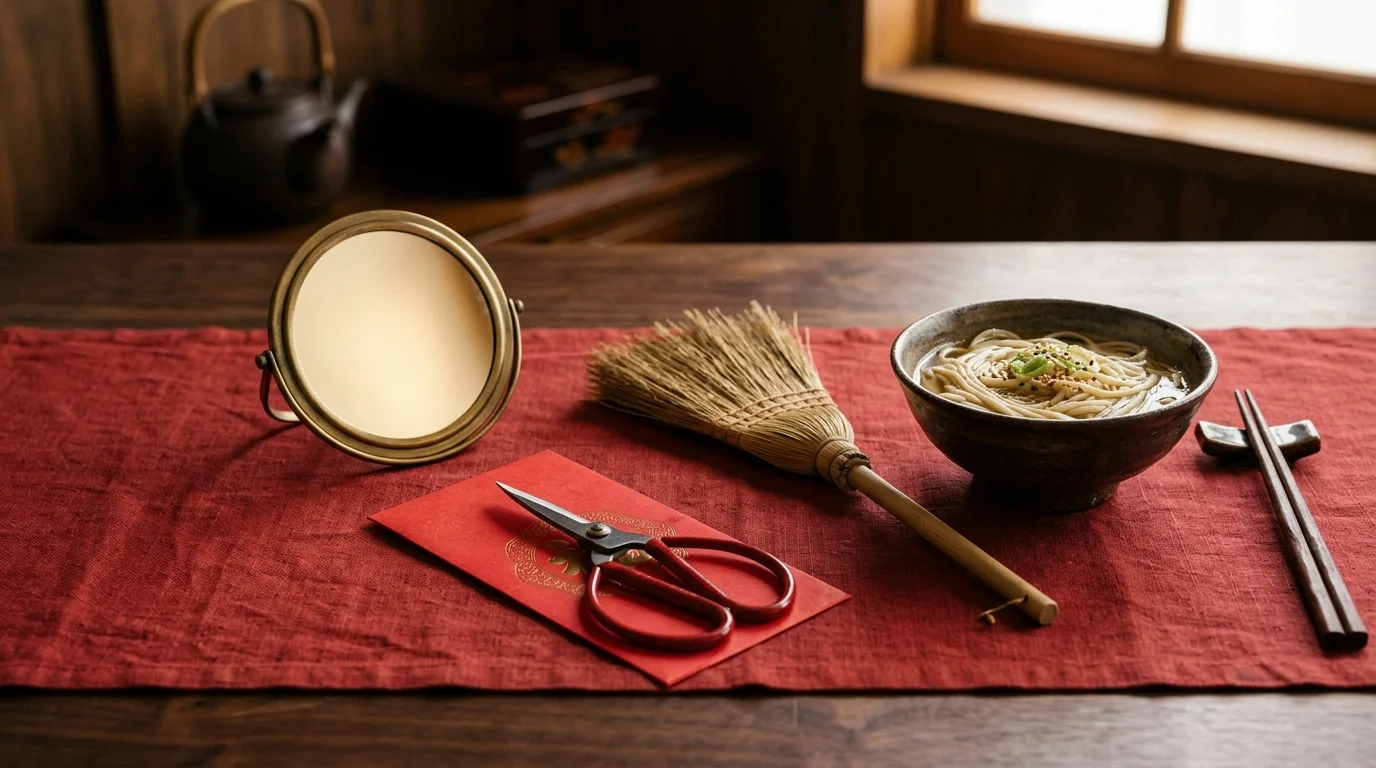
The Chinese New Year taboos are not one superstition but one logic applied many times: the first days of the year are treated as a rehearsal for the rest of it, so whatever you do on them is assumed to be what you will keep doing. That is why the rules cluster around letting things leave (rubbish, water, hair, money, luck), and around words, since a word spoken on the first morning is a word the year is supposed to hear.
Most English lists give you the rule and a shrug. This one gives the rule, the reason the tradition itself gives, and the text the reason appears in, because Chinese scholars have been writing these down since the Han, one Han emperor issued an edict about the killing of animals on the first day, and the record is good enough to date most of the list. For the festival’s shape and dates, start with our guide to Chinese festivals and when Chinese New Year falls in 2027. If you are only ever going to remember three things, they are at the end of this article.
Fifteen taboos, with the reason and the record
| The rule | The stated reason | Where it is recorded |
|---|---|---|
| Do not sweep the floor on New Year’s Day | Sweeping carries the family’s fortune out of the door | 《清嘉录》, a Qing-dynasty record of Suzhou’s year-round customs: “元旦,俗忌扫地、乞火、汲水并针剪” |
| If you must sweep, sweep inward | Sweeping outward expels 如愿, the household spirit who grants whatever you ask her; the family that loses her loses its wealth | Wan for the direction of the broom; 《荆楚岁时记》 quotes 《录异记》 for 如愿 herself and records a rite performed on her |
| Do not take out the rubbish until the fifth day, 破五 | Same reasoning as sweeping, and then the reasoning reverses: on day 5 the accumulated dust is re-read as the symbol of poverty, so throwing it out becomes the point | 《清嘉录》 bans 倾秽 and 瀽粪 on New Year’s Day; the fifth-day lift and the poverty re-reading are both stated by the Confucius Institute for Scotland, and Macau News Agency gives the same day; 《燕京岁时记》, the 1900 Beijing record, names the fifth day 破五 and marks the point the bans lift |
| Do not pour water out or draw well water on day 1, and do not wash on days 1 and 2 | Water leaving the house is wealth leaving the house; in the south the well surface is 井妈’s mirror, which must not be disturbed; and the first two days are the Water God’s birthday, so water is not used at all | 《清嘉录》 (汲水) and Wan for the 井妈照镜 tale; the Confucius Institute for Scotland for the Water God and the ban on washing clothes, hair or bathing on days 1 and 2 |
| Do not use knives, scissors or needles on day 1 | They risk blood, and they can cut through luck, career or descendants, so they are put away the night before | 《清嘉录》 (针剪); Wan for the hiding of 刀剪 on New Year’s Eve |
| Do not kill anything on day 1, and release something instead | Day 1 is the chicken’s own day; blood is a sign of misfortune | 《荆楚岁时记》 (宗懔, Southern Liang, sixth century), which quotes the Wei official 董勋 answering exactly this question; 干宝《搜神记》 for the blood |
| Do not have your hair cut during the first lunar month | 髮 (hair) is a homophone of 發 (prosperity), so cutting it cuts away fortune; scissors were believed to cut luck itself; and the northern saying 正月剃头死舅舅 threatens your maternal uncle | Macau News Agency, which gives all three reasons and labels the uncle saying “a popular Northern Chinese story” |
| Do not say 死、病、穷、亏、丧、终 | The words are heard all year; use a euphemism instead | 《帝京景物略》, a Ming account of the capital, via Wan |
| Do not cry, and do not scold children | A tearful or angry first day forecasts a tearful or angry year | Wan (小孩不准哭); Confucius Institute for Scotland |
| Do not greet someone at their bedside, and do not urge anyone out of bed | Only the sick are visited in bed; being rushed forecasts a year of being rushed | Wan (Sui/Tang onward); Confucius Institute for Scotland |
| Do not eat plain congee on the first morning | Porridge was the food of a poor household; starting the year with it fixes the pattern | Confucius Institute for Scotland; Wan’s version warns against 开水淘饭 on pain of a “porridge life” and wet journeys |
| Settle debts before the festival; do not borrow or lend during it | Debt carried in is debt carried all year | Macau News Agency |
| Do not dress in black or white | They are the colours of mourning; red and gold carry fortune | Macau News Agency |
| Do not give clocks, umbrellas, shoes, pears, candles or mirrors | Homophones: 钟 sounds like the end of a life, 伞 like separation, 鞋 like evil, 梨 like leaving. Candles and mirrors belong to mourning and break easily | Macau News Agency |
| Do not go out on day 4, and do not argue in the kitchen | Day 4 is the Kitchen God’s homecoming; a quarrel in his kitchen disturbs him | Macau News Agency |
That is fifteen rules and one shared mechanism, which is the honest way to read them. Nothing on this list is a set of separate beliefs; it is one idea, that the beginning is a template, applied to brooms, water, blades, words and gifts.
Before the festival: the rules that make the others possible
The prohibitions only work because the house has already been dealt with. The traditional cleaning day is 扫尘日, on the twenty-fourth of the twelfth lunar month, well before New Year’s Eve; Macau News Agency notes that the Chinese word for a jinx, 掃把星, literally means “broom star”, which tells you how deeply the sweeping fear runs. Wan’s account of the day itself makes the pre-work structural rather than tidy-minded: from the Sui and Tang periods onward, 元旦 could not be spent cooking raw rice, 不能以生米蒸饭为炊, because every dish eaten on the first day had to have been cooked as 熟食 before Eve, and 《清嘉录》 lists 乞火, borrowing fire from a neighbour, among the things the first morning must not do. The 1900 Beijing record runs the same ban over several days rather than one: 初五日谓之破五,破五之内不得以生米为炊,妇女不得出门, day five is called 破五, and until it has passed raw rice may not be cooked and women may not go out. So the knives are hidden the night before, the debts are closed out, the food is already cooked, and the practical consequence is that haircuts, cleaning and settling up all belong to the days before the festival.
The first day, hour by hour, and the night before it
The Ming record of the capital, 《帝京景物略》, preserves the day’s texture better than any modern list. In the fifth watch, when the day is not yet light, you may not sneeze while still in bed, illness is the thing being forecast, so if a sneeze is coming you get up and put your clothes on quickly. You may not chat lying down. If someone calls you from outside the gate, do not answer, because a voice at the door in the early morning of the first day is, in the folk phrase, “calling a ghost”. What you must do, once dressed, is go and offer congratulations to elders, relatives and neighbours, and keep every word in the auspicious register.
The sixth-century book is older and more specific about how that morning is built. Day one is 三元之日, the triple beginning, and the household gets up when the rooster crows. First, bamboo is burned in the courtyard to frighten off 山臊, the one-footed mountain thing that gives you chills and fever, per the 《神异经》 passage quoted in the same book. Then the doors are dressed: a chicken painted on paper, or carved in five colours, or moulded in clay, posted on the door; peach boards set in the doorframe, called 仙木; and the two gods 神荼 and 郁垒 drawn on either side, which the book notes are just what everyone now calls door gods. Then the family drinks, youngest first, because the young are gaining a year and the old are losing one, and eats 椒柏酒, 桃汤, 屠苏酒, the five-pungents platter, a ghost-repelling pill worn on the arm, and one egg apiece. The egg is not an oversight: 宗懔 adds that the region gave up eating eggs that morning anyway, because the Liang court abstained from 荤 and Chu custom followed the court.
The rubbish heap has its own story, and it is where the broom taboo gets its teeth. 《荆楚岁时记》 quotes 《录异记》 for it: a merchant named 区明, whose name another edition gives as 欧明, crossed Lake Pengze and was entertained by the lake lord, who asked what gift he wanted. Advised to ask for 如愿, he did, and found she was a young maid who got him anything he asked for, and he grew rich. Then one New Year’s Day 如愿 woke late, the merchant struck her with a stick, and she buried her head in the dung heap and vanished; called back, she never came. His family has been poor ever since. The book’s own note is that northerners of its own time stood by the ash heap, had somebody hit the pile of dung with a stick, and dropped a puppet tied to a string into it, saying 令如愿. One edition places that rite on the first night, the tenth-century encyclopaedia’s extract of the same book places it on the fifteenth. So the broom and the rubbish were never two rules: what you are not supposed to throw out is her.
Staying up on New Year’s Eve, 守岁, has its own set. The text Wan cites for it is 周处’s 《风土记》, a Jin-dynasty record of the Yangtze region: “除夕达旦不眠,谓之守岁.” The Confucius Institute for Scotland gives the same custom its monster, the 祟 that has to be kept awake and watchful, and Macau News Agency relaxes it, staying up until midnight is enough. The folklorist Wan Jianzhong records a Zhejiang legend explaining the watch: a demon that can only be overcome by wine, put to sleep on the thirty-first night, which is why everyone drinks, and why the watchers must not shout, must not look in a mirror, and must not spill lamp oil on the ground: the oil smell would dilute the wine smell and wake it. The legend has outlived its use: Wan’s closing argument is that many of these year-end prohibitions have since been simplified or forgotten, while the vigil itself is still kept.
Why an animal is not killed on its own day
The day-list is the part that generates the rule, and the primary text is more careful than any summary of it. 《荆楚岁时记》 closes its first week with 人日, human day, when the household eats soup made of seven vegetables, cuts coloured silk or gold foil into little figures of people to post on the screen or wear in the hair, exchanges 华胜, and climbs to a height to write poetry. Where the animal days come from is a question the book answers by quoting an older one. The 按 at that passage cites 《问礼俗》, the answers of 董勋, an 议郎 of the Wei state: day one is the chicken, two the dog, three the sheep, four the pig, five the ox, six the horse, seven the human, and whether each of those days is sunny or overcast forecasts that creature’s year. 宗懔 then converts the divination into a prohibition in one sentence: today, no chicken is killed on day one, no dog on day two, no ox on day five, and no punishment is carried out on day seven.
Then he admits the thing he cannot fix. Immediately after that list comes the most honest sentence in the whole literature of these customs: 古乃磔鸡令畏鬼,今则不杀,未知孰是. The ancients slit a chicken so that ghosts would fear it; today nobody kills one on those days; he cannot say which of the two is right. Elsewhere, about a carved-paper custom in the first week whose logic no one has recovered, he writes 此则未喻, he does not understand it, and twice in the human-day entry, about calling the livestock in with grain scattered on the ash and about northerners frying pancakes in the courtyard on the seventh day “to smoke the sky”, he writes 未知所出: no idea where that came from. The killing rite and the ban on killing come out of the same door, and the sixth-century compiler is telling us he cannot decide between them. Wan Jianzhong, writing in 2024, resolves it quietly in favour of the ban. The butchering was never stopped, only rescheduled: Wan notes that on New Year’s Eve you may kill a sheep and hang its head on the door, and 董勋’s answer about killing a chicken at the doorway puts the slit-chicken rite in the twelfth month, when the house is searched for plague. Eve does the killing so that day one does not have to.
The lists people circulate do not agree with each other, and the differences are worth naming before you copy one. 董勋’s answer, printed in the book itself, runs sheep third, pig fourth. Wan’s retelling runs pig third, sheep fourth. Both leave day one with the chicken and day seven with the human, which is where the actual rules come from, so the swap changes nothing anybody does. Macau News Agency’s version is the loosest. It frames the week as the goddess Nüwa creating the animals one per day, which is a different story with the same arithmetic; it drops the fifth day’s ox entirely, so its week runs chicken, dog, pig, sheep, then horse; and it renders 人日 as a day on which “no punishment is dealt out for the killing of an animal”. That is a misreading of 七日不行刑, which means the courts do not execute people on human day. It also inverts the point. Day seven is not a licence to kill; it is the birthday of the human beings doing the killing, and the day the book spends on cut-out figures of people and poems written on a hill.
The positive half of this is more interesting than the ban. Wan records that in many parts of China the first day not only forbids killing but requires 放生, the release of a captured animal, and he gives two origins for it, both of them Han stories, while saying plainly that the two cannot be weighed against each other. In 《孔丛子》 the people of Handan bring a sparrow to the King of Zhao on New Year’s Day with five-coloured silk tied to it; a minister urges the king to fly it free rather than accept a live gift, and he does, on the first day of the first month. In 《三齐略记》 Liu Bang hides in a well while Xiang Yu’s men search for him, two turtle doves settle on the mouth of the well, and when somebody insists there is a man down there, Xiang Yu answers 鸠不集, doves do not perch where a person is. On that basis, Wan writes, the Han released doves and other birds on 正旦, and 汉成帝 went further and issued an edict, 除正旦杀鸡与雀, taking chickens and sparrows off the New Year’s kill list. That sentence has a paper trail of its own: it is not in Wan but in the tenth-century imperial encyclopaedia 《太平御览》, which copies it from a Han calendar work called 《万岁历》 and adds the comment 可谓仁于用心, benevolent, the compiler says, in its intention. Whatever the history, the shape of the custom is unmistakable: on the first day, taking life is a bad omen and saving it is a good one.
At the table
The reunion dinner has more rules than any other meal of the year, and they are mostly about the fish, including one rule where the sources genuinely contradict each other. Wan’s record of the 年夜饭 has people deliberately eating a piece of the fish’s head or tail, so that 头尾都有余, there is surplus at both the beginning and the end. Macau News Agency and the Confucius Institute for Scotland give the opposite instruction: do not touch the head or the tail at all, leave them and carry the fish over into the next day, because 有头有尾 and 年年有余 make the leftover the point. Both readings hang on the same two characters, 余, and neither can be wrong in its own region, so this article will not pick one quietly for you. Where the sources do not disagree: in most regions you do not flip the fish body over, because turning it means turning over a vehicle or a boat, because the reasoning is nautical and it survives on land. Nobody should drop in uninvited on someone else’s dinner either, which Wan lists with the flat reason that it leaves the household 不得安宁. Unquiet, with no clock attached to how long. He compares that last one to a nearly identical Miao taboo against 踩年饭, stepping on the year dinner. The Confucius Institute adds a rule of its own, that the rice jar must not be left empty on New Year’s Eve, or a hungry year is forecast.
What you say at the table is part of the meal, and the meal is preceded: Wan notes that the ancestors are offered before anyone in the family eats. Then comes the set of auspicious renames he records for New Year’s Eve, dates become “spring comes early”, dried persimmons “everything goes smoothly”, almonds “happiness arrives”, tofu “the whole family blessed”, a three-delicacy plate “three yangs opening the year”, peanuts “long-life fruit”, rice cakes “year after year higher”, and sugarcane “joint after joint higher”. None of these is a metaphor a host will explain; they are simply the register food takes on that night.
If you break one anyway
Something gets dropped. The recovery is verbal and it is quick: 岁岁平安, “may you have peace year after year”, because 碎 (shattered) and 岁 (year) sound alike, so the accident is re-described as a blessing before anyone can treat it as an omen. Macau News Agency gives the same repair for glass and porcelain. The re-description runs through the whole system: unlucky words are swapped for euphemisms, dishes are renamed for the evening, and an accident is answered with a wish before it can be read as a sign. Our reading of that is the reason these rules survive: they come with their own repair, so a broken rule does not disprove the rule.
Where it varies, and what nobody can settle
These rules differ north to south and family to family, and the sources show it among themselves. Wan’s 《清嘉录》 citations are a record of one place, Suzhou; his 井妈 tale is flagged as a custom of “some southern regions”; his no-flip-fish rule is stated for “most regions”, which concedes the rest. The day a married daughter may go back to her own parents is not settled either. Wan’s day-1 ban on women going out to 拜年 or 回娘家 is absolute, while the Confucius Institute’s list lets her go “on the second or the third day” and offers both without choosing. The 1900 Beijing record moves it again: 至初六日,新嫁女子亦于是日归宁, a newly married woman goes home on day six. The hair ban is a whole lunar month in the saying 正月剃头死舅舅 and a single day in Macau News Agency’s retelling of that same saying. The Confucius Institute for Scotland, whose teacher Wang Qixia assembled its list, is the bluntest about the status of all this: “Most people are aware that such folk taboos and superstitions are not scientific. However, they carry the wishes of Chinese people to pray for good and avoid evil.” Wan comes to the same place from the scholarly side. Many of the prohibitions, he writes, have been simplified or forgotten; what the festival still carries is an affirmation of cultural identity, in his phrase, not a prediction.
One rule has a documented political history rather than a ritual one. The northern taboo against a haircut in the first lunar month is usually explained by the pun 剃头死舅舅, “cut your hair, your uncle dies”, which is itself read as a corruption of 思旧, “thinking of the old days”, the mourning of the Qing haircutting orders, when the Manchu court required Han men to shave the front of the head and wear a queue. Macau News Agency gives that derivation as “one version of the story”, and it is exactly that: a plausible folk etymology with no document behind it. The haircut taboo is real and widely kept; its Qing origin story is a good story. For the hairstyle rule itself, see our guide to the Qing dynasty, and for the gift side of the same etiquette, our pages on red envelopes and visiting a Chinese home.
What a visitor actually needs to do
Three things, in order of how much they matter.
- Watch your words. No talk of death, illness, poverty or loss, and no tears, not because your host fears a curse but because the register is the point. Say the auspicious thing.
- Do not bring the wrong gift. No clocks or other timepieces, no umbrellas, no shoes, no pears, no candles and no mirrors. Red or gold wrapping is safe, and fruit other than pears is safe.
- Do not tidy. Do not pick up a broom in someone’s house in the first days of the year and do not offer to carry their rubbish out, both sources say the ban lifts on the fifth day. Do not wash clothes or run a bath in someone’s house on days one and two, since they belong to the Water God.
Money and hair are your own business, and this article is not telling you what to believe about either. But if a Chinese colleague says they will not cut their hair until the first month is out, that is a documented custom with a named regional history, not a bit you are being invited to laugh at.
Quick answers
What should you not do on the first day of Chinese New Year? Do not sweep, do not take out rubbish or pour water out, do not use knives, scissors or needles, do not kill anything, do not cry, do not say words about death, sickness, poverty or loss, do not eat porridge, do not nap in the afternoon, and do not greet anyone while they are still in bed.
When do the taboos end? Most of the heavy ones are single-day rules for the first morning. Washing clothes, hair and bathing covers days one and two, which the Confucius Institute for Scotland explains as the birthday of the Water God. Sweeping and taking out rubbish are lifted on 破五, the fifth day, when the accumulated dust is re-read as the symbol of poverty and clearing it out becomes the custom instead of the offense. Hair is the longest: the northern saying runs 正月剃头死舅舅, so it covers the whole first lunar month.
Do Chinese people actually follow these? It depends on the rule, and both sources used here say so in their own way. Wan Jianzhong’s conclusion is that many of the year-end prohibitions have been simplified or forgotten while the festival itself remains the most important date on the calendar. The Confucius Institute’s teacher says most people know the taboos are not scientific and keep them anyway, because they carry the wish to avoid misfortune. In practice, the rules with a social cost (words, gifts, not tidying on day one) are the visible ones; the ones that ask for self-denial, like hair or porridge, are more often known than kept.
Is it rude to ask about them? No, and it is a good question to ask. What is rude is explaining someone else’s custom to them.
Sources
万建中 (Wan Jianzhong), 本土概念与方法: 春节的禁忌与习俗, originally published in 《群言》 2024 issue 1, hosted by the Research Center for Folklore Classics and Palaeography, Beijing Normal University. Wan is professor and doctoral supervisor at BNU’s School of Chinese Language and Literature and director of its Institute of Folklore Literature. Source here for the 《清嘉录》, 《帝京景物略》, 《荆楚岁时记》, 《风土记》, 《搜神记》, 《孔丛子》, 《三齐略记》 and 《中华全国风俗志》 readings; the Sui/Tang dating of the inward-sweeping, knife-hiding and no-raw-rice rules; the 如愿 and 井妈 material; the no-cooking-on-day-1 rule and 汉成帝’s edict 除正旦杀鸡与雀; the 放生 practice and both of its origin stories; the bedside, crying and married-daughter rules; the New Year’s Eve dish renames, the ancestral offering before the meal and the Miao 踩年饭 comparison; the no-flip-fish and 头尾都有余 readings; and the closing argument that festival prohibitions exist to mark the boundary between the festival and ordinary days.
Confucius Institute for Scotland, “Taboos During Chinese New Year”, compiled by the institute’s teacher Wang Qixia, the English-language statement of the day-1 list, the Water God birthday behind the days 1 and 2 washing ban, the porridge taboo, the leave-the-fish-head-and-tail rule, the full rice jar, the afternoon-nap ban, the second-or-third-day permission for a married daughter, the fifth-day lift on sweeping and rubbish with the poverty re-reading, the 祟 vigil, and the explicit framing that these taboos are not believed scientifically.
Macau News Agency, “10 things you shouldn’t do during Chinese New Year”, 11 February 2026, 掃把星, 掃塵日 on the twenty-fourth of the twelfth lunar month, the fifth-day rubbish rule, all three stated reasons for the haircut ban (the 髮/發 homophone, scissors cutting fortune, and 正月剃头死舅舅, which it labels a popular northern story) and the Qing 思旧 derivation, reported there as one version of the origin, the gift homophones and the mourning-association gifts, the black-and-white clothing rule, the day-4 Kitchen God rule and the ban on arguing in the kitchen, the broken-glass repair 岁岁平安, the congee taboo, the leave-the-head-and-tail fish rule, the Nüwa framing of the animal days, and the note that staying up until midnight satisfies 守岁.
《荆楚岁时记》, 宗懔 (Southern Liang, sixth century) with the commentary transmitted under 杜公瞻 (Sui), and 《太平御览》 卷二十九, the tenth-century imperial encyclopaedia, both read in the zh.wikisource.org editions. These are the primary texts behind the day-1 sequence, the 三元 naming, the 爆竹 and 山臊 passage, the painted, carved and clay chickens on the door, 神荼 and 郁垒 as the earliest named door gods, the youngest-first toast and its stated reason, the seven-vegetable soup and cut-out figures of 人日, 董勋’s animal day-list, the 未知孰是 / 此则未喻 / 未知所出 admissions, the 如愿 tale and the dung-heap rite, and the 汉成帝 sentence from 《万岁历》. Older catalogues mislabel 宗懔 as a Jin author; the 四库提要 summary printed on the same page corrects this from the Book of Liang.
富察敦崇, 《燕京岁时记》 (Records of the Seasons in the Capital, 1900), read in the zh.wikisource.org edition, source here for the name 破五, for the rules that hold until it, and for the sixth-day 归宁 of newly married women.
What we checked, and what we could not source
Three things we corrected in our sources. Wan’s article attributes the story of a king who filled a leather bag with blood, shot at it and was later killed by lightning to 《史记·夏本纪》, and calls its hero an emperor of the Xia; 武乙 is a Shang ruler and the passage is in 《史记·殷本纪》, where he makes 为革囊,盛血,卬而射之, a leather bag of blood shot from above, and dies in a thunderstorm. Wan also writes that 《荆楚岁时记》 has people paint a chicken, hang a rope of reeds above it and set peach talismans on either side, because 百鬼畏之, when the book says two different things: 帖画鸡,或斵镂五采及土鸡于户上, with peach boards called 仙木 and the gods 神荼 and 郁垒, is the practice as 宗懔 saw it, and the hung live chicken with the reed rope is quoted from 庄周 one note earlier, as the older version. And his day-list runs pig third, sheep fourth, where 《问礼俗》 as printed in the book runs sheep third, pig fourth, with 《太平御览》’s extract of the same passage agreeing against him, so that swap is Wan’s or a copyist’s. Nothing in practice turns on it: day one is the chicken and day seven the human in both.
One mistranslation, and one reading nobody can close. Macau News Agency renders 七日不行刑 as a day on which “no punishment is dealt out for the killing of an animal”. It means the courts do not carry out punishments on human day, and that same list drops the fifth day’s ox. Getting it right is what makes 人日 the point of the week rather than an amnesty for butchery. The other problem has no answer: 除正旦杀鸡与雀 is unambiguous only if 除 means “abolish”, and the encyclopaedia’s own gloss, 谓非正旦则禁杀, permits the opposite parsing, in which the edict closed the one day on which these birds could legally be killed. We follow the reading every modern source we could reach uses, and say so here rather than pretending the classical note settles it.
Claims we left out. “Chinese New Year has a history of around 4,000 years” appears on the ranking pages with nothing behind it; the components documented above have different and much later origins. An early draft here said a dropped-in guest unsettles a family “for twelve months”: the source says only 全家不得安宁, with no duration attached. It also said people buy live fish and birds to release; 放生 in Wan is the release of a captive animal and does not specify buying one, so we dropped it. It also warned against white or black wrapping paper; the sources ban mourning-coloured clothing, not stationery, so that inference went too. The term 破五 for the fifth day was cut from an earlier version of this article on the grounds that none of its sources used it. That was wrong: 《燕京岁时记》 has a section headed 破五, and the term is in the article now, with the two rules that hang on it. The reason for the rule against a married daughter visiting her natal home on day 1 is not given by any source we could reach. And the Gregorian date of 扫尘日 in 2027 depends on the length of the twelfth lunar month, which we could not fix from an official table, so the article gives the lunar date only.
