
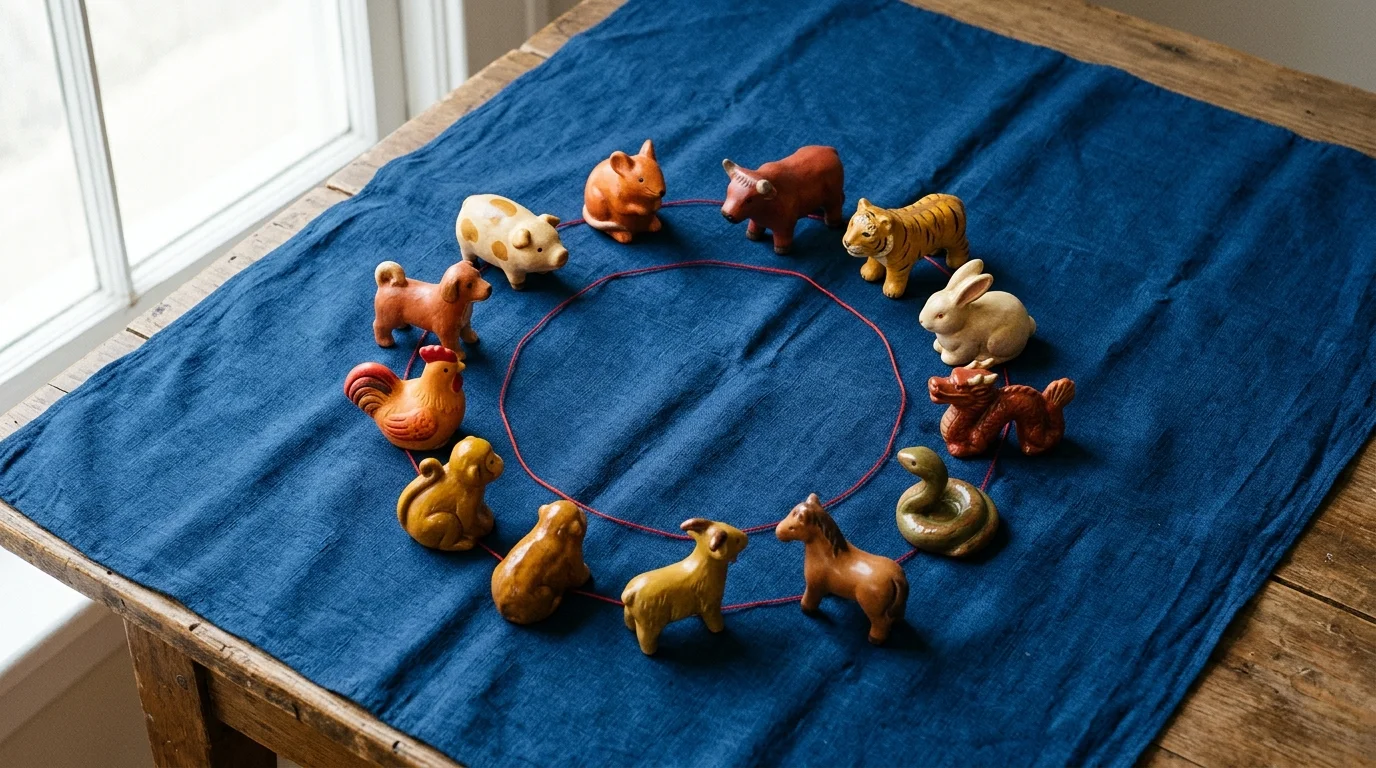
The twelve Chinese New Year animals (Rat, Ox, Tiger, Rabbit, Dragon, Snake, Horse, Goat, Monkey, Rooster, Dog, Pig) run in one fixed order, and the order is not really about the animals: each name is a label for one of the twelve earthly branches, a piece of the calendar that came first. 2027 is the year of the Goat, starting on 6 February. The full name for that year is 丁未, the yin-fire goat, and the previous one was 1967.
Most explainers stop at a list of personality traits. This one covers what the animals actually are (a calendar device, not a horoscope), how to calculate any year’s animal in two lines of arithmetic, why people born in January or early February so often get their sign wrong, what the excavated evidence says about where the animals came from, and the traditional trait and compatibility claims as well, since they are what people search for; they are simply labelled as beliefs and attributed, rather than written as facts. For the festival calendar around the animals, see our guide to Chinese festivals; for the exact 2027 date and its mechanics, see when Chinese New Year falls in 2027.
The twelve Chinese New Year animals, in order
The animals are not an independent list. Each one is bolted to one of the twelve earthly branches, and the branches come first, which is why the order never varies and why it is the same in every country that uses the system.
| # | Branch | Animal | Double-hour | Yin/Yang | Phase |
|---|---|---|---|---|---|
| 1 | 子 zǐ | Rat 鼠 | 23:00 to 01:00 | Yang | Water |
| 2 | 丑 chǒu | Ox 牛 | 01:00 to 03:00 | Yin | Earth |
| 3 | 寅 yín | Tiger 虎 | 03:00 to 05:00 | Yang | Wood |
| 4 | 卯 mǎo | Rabbit 兔 | 05:00 to 07:00 | Yin | Wood |
| 5 | 辰 chén | Dragon 龙 | 07:00 to 09:00 | Yang | Earth |
| 6 | 巳 sì | Snake 蛇 | 09:00 to 11:00 | Yin | Fire |
| 7 | 午 wǔ | Horse 马 | 11:00 to 13:00 | Yang | Fire |
| 8 | 未 wèi | Goat 羊 | 13:00 to 15:00 | Yin | Earth |
| 9 | 申 shēn | Monkey 猴 | 15:00 to 17:00 | Yang | Metal |
| 10 | 酉 yǒu | Rooster 鸡 | 17:00 to 19:00 | Yin | Metal |
| 11 | 戌 xū | Dog 狗 | 19:00 to 21:00 | Yang | Earth |
| 12 | 亥 hài | Pig 猪 | 21:00 to 23:00 | Yin | Water |
Two structural features fall straight out of that table. Yin and yang alternate without exception, because the branches are simply an odd/even sequence. And the animal is never chosen for its own properties: the Rat holds the first slot because 子 is the hour when the old day ends and the new one begins, not because anyone likes rats. The phases also repeat in pairs (two Wood branches, two Fire, two Earth in the middle, two Metal, two Water), which is what makes the branch element different from the element assigned to a whole year.
Why there are sixty combinations, not twelve
A year is written with a stem and a branch. There are ten heavenly stems and twelve branches, and because both advance by one each year, the pair only repeats after sixty years, the least common multiple of 10 and 12. That sixty-year round is the 花甲, and it is why each animal appears with each of the five phases exactly twice per cycle, once in its yang stem and once in its yin stem.
The arithmetic is two lines. Take 1984, a year everyone agrees was a Wood Rat, and use it as the zero point:
- stem index = (year − 1984) mod 10, read from 甲 乙 丙 丁 戊 己 庚 辛 壬 癸
- branch index = (year − 1984) mod 12, read from 子 Rat through 亥 Pig in the table above
For 2027: 2027 − 1984 = 43; 43 mod 10 = 3 gives 丁, yin fire; 43 mod 12 = 7 gives 未, the goat. Hence 丁未, yin-fire Goat. For 2028 the same two remainders give 4 → 戊 and 8 → 申, an earth Monkey year. That is the point of doing the arithmetic rather than reading a table: any label anyone prints can be checked in about ten seconds, and the check does not depend on trusting the publisher.
It is worth knowing because published zodiac year-tables do contain errors, including official ones. The China Cultural Portal’s long-running zodiac page, the same page that supplies the trait list below, lists 2036 as a Rabbit year in the Rabbit row while listing it correctly as a Dragon year in the Dragon row, puts 2020 in the Pig row although 2020 was a Rat year, and gives 2015 in the Snake row where the arithmetic requires 2025. Three slips in one twelve-row column, on a state-run English-language site. Two subtractions would have caught all three.
| Year | Ganzhi | Common name |
|---|---|---|
| 2024 | 甲辰 | Wood Dragon |
| 2025 | 乙巳 | Wood Snake |
| 2026 | 丙午 | Fire Horse |
| 2027 | 丁未 | Fire Goat (yin) |
| 2028 | 戊申 | Earth Monkey |
| 2029 | 己酉 | Earth Rooster |
| 2030 | 庚戌 | Metal Dog |
| 2031 | 辛亥 | Metal Pig |
| 2032 | 壬子 | Water Rat |
What animal am I? The trap in January and February
The zodiac year changes at Chinese New Year, not on 1 January. Anyone born between 1 January and the festival date belongs to the previous animal, which is why two people born three weeks apart in the same Gregorian year can have different signs, and why a birth chart drawn up from a passport date alone is often simply wrong.
There is a second boundary that confuses matters further. Professional practitioners of bāzì, four-pillar astrology, do not switch the year at the festival at all; they switch it at 立春, the Start of Spring, which falls on 3, 4 or 5 February and most often on the 4th. For most years this is invisible, because the festival arrives after Start of Spring. It matters in the years when it does not.
2028 is the clean example. Chinese New Year falls on 26 January, and Start of Spring on 4 February. A baby born on 1 February 2028 is a Monkey by the festival calendar and still a Goat by the four-pillar system for another three days. Both answers are correct in their own frame; the disagreement is not a mistake but the residue of two different ways of cutting the year, one following the Moon, one following the Sun.
What each animal is said to mean
Here you have to be clear about what kind of content this is. Nothing links a birth year to a personality; the twelve trait clusters are a horoscope convention, and the China Cultural Portal introduces its own list the same way, “a Chinese horoscope may predict that a person born in the Year of the Horse is cheerful, popular and quick to compliment others”. The table below reproduces that published convention, with the years computed rather than copied. Read it as a set of folk attributions that a great many people take seriously, not as findings.
| Animal | Last / next year | Traditionally said to be | Said to suit / clash with |
|---|---|---|---|
| Rat 鼠 | 2020 / 2032 | charming, ambitious, honest, generous, thrifty, quick-tempered, overly critical | Dragon, Monkey / Horse |
| Ox 牛 | 2021 / 2033 | reliable, dependable, upright, unyielding, easy-going, inspiring | Snake, Rooster / Goat |
| Tiger 虎 | 2022 / 2034 | courageous, sensitive, aggressive, emotional, charming | Horse, Dog / Monkey |
| Rabbit 兔 | 2023 / 2035 | affectionate, talented, good-tempered, conscientious, cautious, clear-sighted | Goat, Pig / Rooster |
| Dragon 龙 | 2024 / 2036 | energetic, intelligent, determined, flamboyant, bossy, lucky, a leader | Snake, Rooster / Goat |
| Snake 蛇 | 2025 / 2037 | intelligent, passionate, determined, romantic, careful, refined | Rooster, Ox / Pig |
| Horse 马 | 2026 / 2038 | hardworking, intelligent, talkative, popular, impatient | Tiger, Dog / Rat |
| Goat 羊 | 2027 / 2039 | creative, artistic, passionate, timid, fastidious, indecisive | Rabbit, Pig / Ox |
| Monkey 猴 | 2016 / 2028 | inventive, witty, versatile, popular, good-humoured | Dragon, Rat / Tiger |
| Rooster 鸡 | 2017 / 2029 | alert, talented, hardworking, shrewd, aggressive | Snake, Ox / Rabbit |
| Dog 狗 | 2018 / 2030 | honest, loyal, intelligent, generous, stubborn | Tiger, Horse / Dragon |
| Pig 猪 | 2019 / 2031 | sincere, reliable, tolerant, kind, shy, productive, short-tempered | Goat, Rabbit /, |
One thing in this area is not a belief and is worth knowing before you travel: the animal sign has a practical social function. Asking someone which animal year they were born in is a normal, polite way to place a person in a twelve-year cycle, and it is commonly used instead of asking their age directly. It is a question about the calendar, and it is safe to ask; treating the answer as a verdict on the person’s character is where the same convention stops being culture and starts being astrology.
Goat or sheep? The translation problem
The character for the eighth branch’s animal is 羊, and 羊 does not distinguish a goat from a sheep or a ram. Both “Year of the Goat” and “Year of the Sheep” are defensible translations of the same word, and there is no authoritative ruling that settles it, official Chinese-language usage and international coverage divide between them. Pick one and stay consistent; what matters is that 未羊 is the same branch whichever English animal you write beside it.
A subtler problem sits underneath the naming. The fire Goat label comes from the year’s stem: 丁 is yin fire. But Chinese metaphysics also assigns each of the thirty nayin pairs its own five-phase label, and in that system 丙午 and 丁未 share a single name, 天河水, the Water of the Heavenly River. So a fortune-teller calling 2027 a water year and a headline calling it a fire year are using two different layers of the same calendar, not contradicting each other. The popular element naming follows the stem; the classical nayin tables, whose systematic form is preserved in the sixth-century treatise 五行大义, follow the pair.
A Goat year is politically and demographically awkward
Folk belief holds that Goat-born people have harder lives. The phrase 属羊的人命苦, “a person born under the Goat has a bitter life”, circulates widely enough that, as the Peking University folklorist Chen Lianshan notes in his study of the zodiac’s origins, parents avoid planning a child for a Goat year and prefer a Dragon or a Pig year for the opposite reason. He records that as a fact about what parents do, not about what fate holds: there is no evidence that a birth year affects a life.
Nobody has established where the Goat taboo came from. Chen records the belief and does not explain it, and this article will not either: the reasons offered for it elsewhere are no better sourced than the belief itself. Naming that gap matters more than filling it, because most zodiac pages hand over a confident origin story as if it were settled.
What is documented is that the system travelled and the animals did not always travel with it intact. Vietnam reads 卯 as the Cat rather than the Rabbit and 丑 as the water buffalo rather than the ox. The usual explanations are phonetic, the Vietnamese word for cat resembles the branch name, and agricultural, since a water buffalo matters more to rice farmers than an ox does, but neither is established: as Reuters put it when Vietnam entered a Cat year in 2023, there is no official explanation for when or why the cat took the rabbit’s place. The Vietnamese lunar year carries its own moon legend regardless, told separately in the Moon Boy story.
Your own animal year: the benmingnian
Because the cycle is twelve years long, everyone meets their own animal again every twelve years, at 12, 24, 36, 48, 60, 72. That year is the 本命年, and in folk usage it is the risky one, not the celebratory one. The rhyme 太岁当头坐,无喜必有祸 (“with Tai Sui sitting overhead, absent joy there will be misfortune”) is the standard expression of the worry, and the year is nicknamed 槛儿年, a year like stepping over a threshold.
The countermeasure is red, and it is specific. Across northern Han communities, adults and children alike tie on a red belt in their 本命年 (the practice is called 扎红, “tying red”), and children additionally wear a red vest and red shorts. It starts on 大年三十, New Year’s Eve itself, with red underwear put on early, a red belt at the waist, and ornaments hung on red silk cord; the whole category of protective red items has its own name, 本命红. At the season’s markets the same idea is sold as 吉祥带 and 吉祥结, auspicious bands and knots in red and yellow silk, tied at the waist or the wrist. The sixtieth birthday counts twice over: it is the sixth 本命年 of a life, and it also closes one full cycle of the sixty 干支 pairs, the 花甲, which is why it is the big one.
Practically, 2027 is a benmingnian for anyone born in 1955, 1967, 1979, 1991, 2003 or 2015, who will turn 72, 60, 48, 36, 24 and 12. If you have Goat-born colleagues, this is the year in which the red-belt conversation happens.
Where the animals came from, the evidence keeps getting better
The standard story is the Great Race: the animals were summoned, the twelve that arrived first got the calendar, and the order is the order they crossed the river, with the Rat riding the Ox’s back and leaping off at the bank to take first place. Who hosts the gathering depends on who is telling it. Encyclopædia Britannica records the common telling as a race initiated by the Jade Emperor; the version published by the China Cultural Portal has Buddha convening the animals, the cat not pushed into the water but simply oversleeping because the Rat broke a promise to wake it, and its separate origin legend credits the Yellow Emperor with introducing the cycle in 2600 BC. A legend with no fixed host, no fixed river and no fixed date is not a distorted record of an event; it is a story told to make an ordering feel inevitable. It cannot be the origin, because it presupposes the sequence it claims to explain.
It is still worth reading as a folktale, and our guide to myths and legends covers how to tell which kind of story you are being handed.
The real history was reconstructed from excavated documents, and Chen Lianshan’s re-examination of the sources is the cleanest account available. It goes something like this. Shang-dynasty oracle bones already carry a complete sixty-sign cycle used to count days, but no animals attached to any of them. The pairing appears in Qin-dynasty manuscripts, and its earliest known purpose is not birth years at all. The 1975 Shuihudi bamboo texts include a chapter on thieves: for each of the twelve branches it lists the animal and then describes what a person who stole on that day’s branch looks like. Steal on a 子 day and the thief has a pointed mouth, a sparse beard, restless hands, dark skin, a mole on the face and a defect in the ear, with the loot hidden in manure and brushwood inside a wall, and names containing characters such as 鼠, 鼷, 孔, 午 or 郢.
That list is not yet our zodiac, in three separate ways. It reads the branch of the day, not of the year. Several of its animals are wrong, 午 is the deer, not the horse, and 未 is the horse; 辰 has no dragon at all; 戌 is “old sheep” and 酉 is rendered as “water,” probably pheasant. And the excavated lists disagree with each other: the Fangmatan slips from 1986 put the horse at 午 and the goat at 未 as we know them, but give 辰 as “insect” and duplicate the rooster, while the Suizhou Han slips from 1999 return to the deer at 午. Chen’s proposal is that these should be called 日肖, “day animals”, rather than生肖, and their disappearance from later literature is probably self-inflicted: a habitual thief who strikes on several different branch-days would be assigned mutually contradictory appearances.
The transmitted text usually credited with the earliest zodiac is Wang Chong’s 论衡 (Lunheng, first century CE), and it does list the twelve branch-animals exactly as we use them. But Wang Chong is not doing horoscopy. He is dismantling a bad argument of his time, that the five phases could be proved by watching which animals defeat which, tiger dominating ox and sheep because wood overcomes earth. His reply is a catalogue of counterexamples: if water overcomes fire, why doesn’t the rat chase the horse? If metal overcomes wood, why doesn’t the rooster peck the rabbit? The animals appear in his text as a shared vocabulary to be argued with, not as a system for reading a life.
So when does an animal actually attach to a person’s birth year? On the surviving evidence, Chen writes, the earliest use of the twelve animals to mark a birth year is in the Northern and Southern Dynasties, fifth to sixth century CE, later than the manuscripts, and later than Wang Chong. What formed the zodiac was not a discovery but a merger: the astronomical branch-animals of the scholars, combined with the numerologists’ conviction that a branch-animal determines what a person is like. By that point the pieces were in place; the 吴越春秋 already read 巳 as snake and 辰 as dragon for the orientation of a city gate, which is geography rather than astrology, and the later commentator quoting it shows how freely the same pairing moved between domains.
One old “proof” that does not work
Scholars used to open the story with a line from the Classic of Odes: 吉日庚午,既差我马, “on the lucky gēngwǔ day, I selected my horses.” Since 午 and 马 appear in adjacent clauses, it looked like a Han-dynasty record of the Horse branch. It isn’t. The two words do not form a compound and carry no correspondence: the line says the day was 庚午 and the poet chose horses. Chen Lianshan raises this precisely because it is still cited as the earliest evidence for the zodiac, and it is evidence for nothing, a useful reminder that a branch and an animal sharing a sentence is not yet a system.
Quick answers
What is the 2027 zodiac animal? The Goat (Sheep), 未, with the yin-fire stem 丁, 丁未, a fire-goat year.
When does the animal change? At Chinese New Year for everyday purposes; at Start of Spring, 3 to 5 February, in four-pillar astrology.
Is the order ever different? No. The twelve animals inherit their order from the twelve branches, which are fixed.
Why is there no cat? In China, never was. In Vietnam the Cat does hold the fourth place, displacing the Rabbit, and there is no settled explanation for when or why.
How many Goat years are there per century? About eight and a third, since the sixty-year cycle holds five of each animal and one hundred divided by sixty is not a whole number.
Can I work out my animal from my birth year alone? Almost. Take the year, subtract 1984, and read the remainder when divided by twelve against the table above. The only correction needed is the one at the top of the year: if you were born before Chinese New Year fell in that year, your animal is the one before.
Do the animals have real personality traits? No. The trait table on this page is a published horoscope convention, reproduced because readers look for it and attributed to its source so you can see exactly who is saying it. No evidence stands behind any of it.
Is the zodiac astrology? It is a calendar that acquired beliefs. Nothing about a birth year affects temperament, but the beliefs do change what people do: Chen records that parents avoid planning a child for a Goat year and prefer a Dragon or a Pig year.
Sources
陈连山 (Chen Lianshan), professor and head of the Folklore Literature seminar, Department of Chinese Language and Literature, Peking University: 《从”日肖”到”生肖”, 蛇年谈生肖起源史料的再审核》, published on the China Intangible Cultural Heritage digital museum, ihchina.cn, 14 April 2025. Source for the three defining elements of a zodiac, the Shuihudi / Fangmatan / Suizhou slip readings, the thief-divination context, the Wang Chong discussion, the Northern and Southern Dynasties first use for birth years, the 属羊 birth-avoidance belief and, relevant to this article, Chen’s own refusal to account for where that belief came from.
王充 《论衡》, 物势 and 言毒 chapters (Shanghai People’s Press edition, 1974), the twelve branch-animals and Wang Chong’s counterexamples against deriving the five phases from animal behaviour. Cited in the article above.
State Council of the People’s Republic of China, holiday notice for 2027 (gov.cn, 5 November 2026), Spring Festival 5 to 13 February 2027, establishing 6 February as the first day of the lunar year, at which the animal changes.
中国华文教育网, 《话说”本命年”》, 24 April 2009, the definition of 本命年 as the return of one’s branch year every twelve years, the Tai Sui rhyme, 槛儿年, 扎红 with the red belt, red vest and red shorts, the 大年三十 custom of red underwear and ornaments on red silk cord gathered under the name 本命红, the market sale of 吉祥带 and 吉祥结, and the 花甲 as simultaneously the sixth 本命年 and the close of one 干支 cycle.
GB/T 33661-2017, 农历的编算和颁行, registered with the State Administration for Market Regulation, with the Purple Mountain Observatory interpretation, the calendar rules that fix the new year and therefore the animal year.
Reuters, “Year of the Rabbit? Not so fast! Vietnam’s Lunar New Year celebrate the cat”, 20 January 2023, and VOA News on the same observance, the Cat for Rabbit and water buffalo for ox in the Vietnamese zodiac, and the absence of any official explanation for it.
China Cultural Portal (en.chinaculture.org), “The Wonders of the Zodiac”, 19 November 2003, the twelve branch-animals in order, the trait and compatibility convention reproduced in the table above and its framing as what a horoscope “may predict”, the Buddha version of the Great Race with the oversleeping cat, the Yellow Emperor origin legend dated to 2600 BC, and the social practice of asking an animal sign instead of an age. Three errors in its own year columns are identified in this article: 2036 listed under Rabbit as well as correctly under Dragon, 2020 listed under Pig, and 2015 listed under Snake where the cycle requires 2025.
Encyclopædia Britannica, “Chinese zodiac”, the common telling of the Great Race as a race initiated by the Jade Emperor, noted there as one of more than one version.
Sixty-cycle, stem-branch, hour and nayin tables computed directly from the (year − 1984) arithmetic; the 丙午丁未天河水 nayin pairing cross-checked against published 纳音 tables. 五行大义 (Xiao Ji, Sui dynasty) noted as the early systematic source for nayin.
