
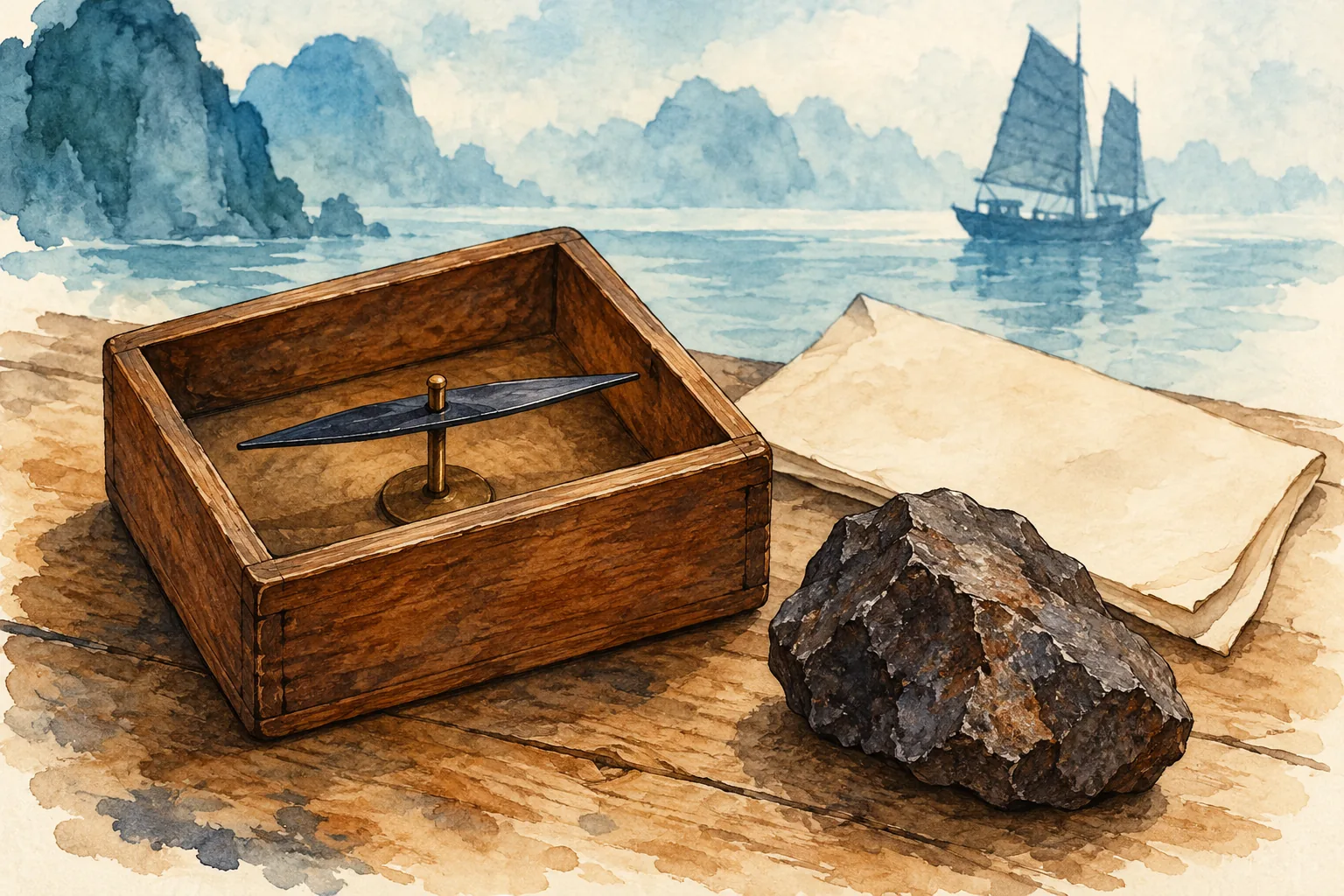
The magnetic compass developed through knowledge of magnetism and ways to use a magnetized object to find direction. Chinese sources are central to its early history, but a single inventor and one precise invention date are difficult to establish. Different claims may refer to observing magnetic properties, making a directional instrument or taking one aboard a ship.
What makes a compass work?
A magnetized needle that can turn freely tends to align with the local magnetic field. That makes it useful for direction finding. The needle needs a suitable support, such as a pivot or a floating arrangement. The instrument also needs protection from movement and interference if someone is to use it reliably.
The Mariners’ Museum’s lodestone record explains how natural magnetic stone was used to magnetize or remagnetize compass needles aboard ships. Its catalogued object dates to about 1600–1750. That object illustrates a later navigational practice; its date is not the date the compass was invented.
When did Chinese sailors use it?
A study in the Journal of Chinese History discusses a late-eleventh-century shipboard reference and later evidence for floating and dry compasses. It also points out how little direct research on some early instruments supports familiar sweeping accounts of their use.
The distinction between a written description and a surviving instrument matters. A text may establish that a method was known by a certain time without telling us exactly when it began. A later illustration or modern reconstruction can help explain a proposed design, but it should be labelled as such.
Why do accounts give different dates?
- They may date different stages: an observation of magnetism, a direction-finding device, a written account or maritime use.
- A text can describe an older practice without recording its beginning.
- A museum display may include a reconstruction beside original objects.
- The spread of an instrument between regions can be harder to document than its presence in a particular source.
How to read a museum label
Look for the object’s material, date and provenance. Then check whether the label calls it an original, a replica or a reconstruction. Ask what evidence supports its proposed function. An attractive demonstration should leave you able to distinguish what survives from what has been inferred.
The illustration accompanying this article is interpretive. It is not a photograph of a surviving early compass or an exact reconstruction of one.
Related history
Read about the Ming dynasty for a later historical setting, or explore how to distinguish traditional stories from historical evidence.
