
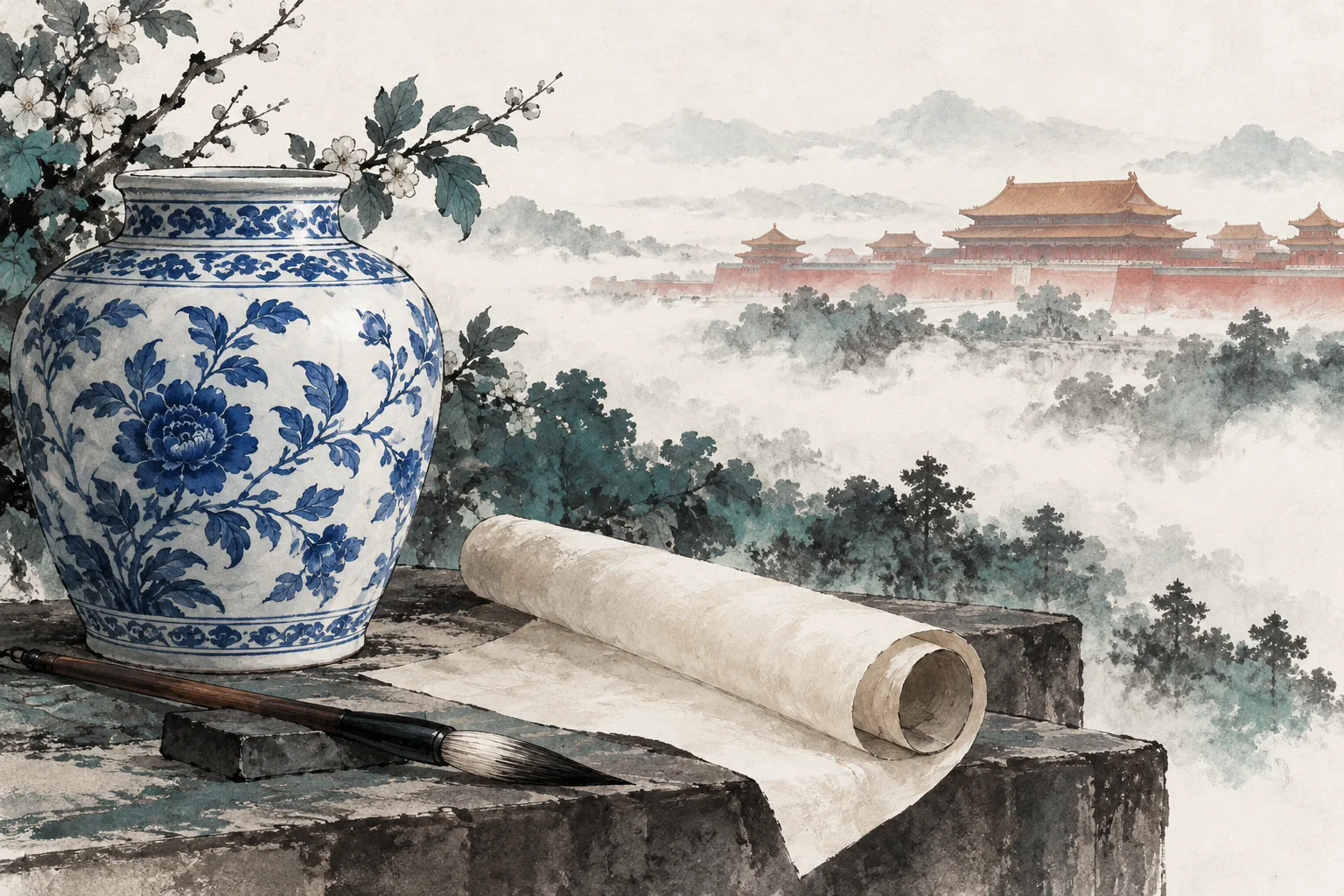
The Ming dynasty ruled China from 1368 to 1644. Founded by Zhu Yuanzhang, it is a useful starting point for understanding the Forbidden City, many surviving Great Wall fortifications and the porcelain seen in museum collections. Its history also includes government, trade and everyday life far beyond the imperial court.
When did the Ming dynasty begin?
The National Museum of China’s Ming and Qing overview dates the dynasty’s establishment at Nanjing to 1368. Zhu Yuanzhang became the Hongwu emperor. The court later moved its capital to Beijing under the Yongle emperor in 1421.
That move helps explain why both cities appear in accounts of Ming history. Nanjing belongs to the dynasty’s founding, while Beijing became the setting for the later imperial court.
What is the Ming dynasty known for?
The Smithsonian’s introduction to Ming China describes naval expeditions, maritime commerce and a growing market for art and luxury goods. Printed books and the novel also reached a wider audience. This was a period of cultural production and exchange, as well as imperial administration.
Porcelain offers a visible example. The Smithsonian explains how Jingdezhen became a major supplier to Chinese and overseas markets. Blue-and-white wares used cobalt decoration beneath the glaze, while other Ming ceramics used different colors and techniques. “Ming porcelain” names a broad period, not one identical type of blue vase.
Was the Great Wall built entirely during the Ming?
No. UNESCO’s Great Wall account describes fortifications with a history reaching back well before the Ming and continuing through it. The dynasty belongs to a long sequence of construction, repair and military use. It did not create the entire wall system from nothing.
When visiting a section, read its own history and conservation information. A general label such as “the Great Wall” cannot tell you the date of every tower, the condition of a route or whether a particular section is currently open.
What does the Forbidden City tell us about the period?
The Forbidden City in Beijing served both the Ming and the later Qing courts. UNESCO’s imperial palaces listing treats the complex as evidence of both dynasties. When a building, furnishing or object is discussed on site, check which period the interpretation refers to.
For a first visit, choose a few things to follow closely: the sequence of courtyards, the relationship between ceremonial and residential spaces, or the date of a particular collection display. This is more manageable than expecting to absorb several centuries of history in one walk.
How to look at Ming art in a museum
Ming art includes paintings as well as ceramics. Princeton University Art Museum’s Elegant Gathering in the Western Garden is a Ming-period painting of a gathering traditionally placed in the earlier Song dynasty. An artwork’s date and the date of the event it depicts can be different.
- Read the object’s date, maker attribution and material before drawing conclusions from the image.
- Notice whether the label says “Ming dynasty,” names an emperor’s reign, or identifies a later work in an earlier style.
- Treat a modern illustration as an aid to the article, not as evidence of an excavated object or a precise palace view.
- For ceramics, compare shape, glaze and decoration rather than looking only for a blue-and-white palette.
How did the Ming dynasty end?
The Smithsonian’s overview describes the late Ming as a period of border conflict, crop failures, financial pressures and problems at court. The dynasty ended in 1644, and Manchu rulers established Qing rule in China. This brief outline should not be taken to mean that political control changed everywhere at the same moment.
Related reading
Continue with the Qing, or Manchu, dynasty. For a different royal history in the region, our guide to the Nguyễn surname explains why a common family name should not be confused with membership of Vietnam’s imperial family.
