
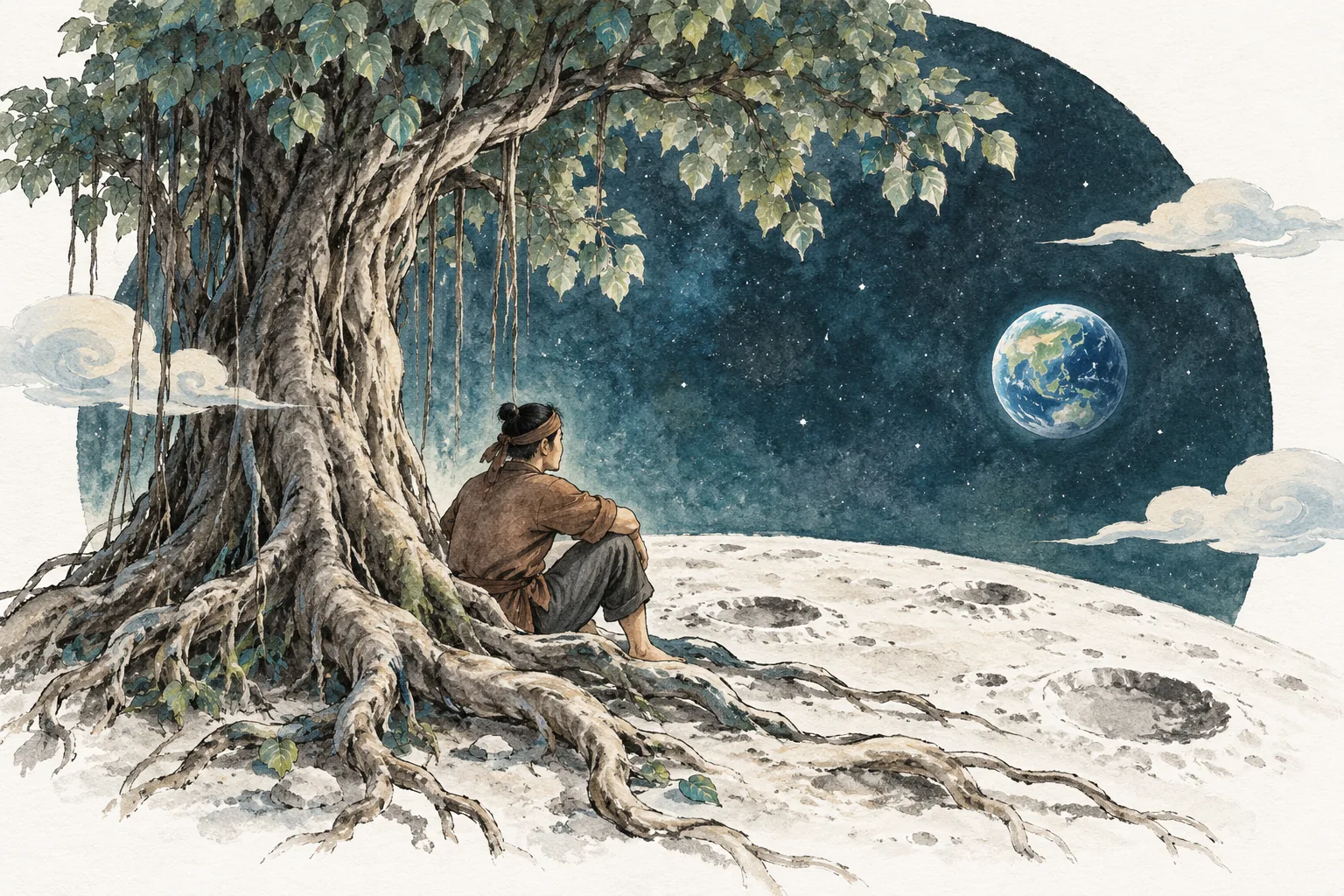
Cuội is the figure beneath a banyan tree on the moon in Vietnamese folklore. He is often called Chú Cuội and appears in stories and performances connected with Tết Trung Thu, Vietnam’s Mid-Autumn Festival. The old name “moon boy” is a loose English description; some tellings present him as a young man or woodcutter.
The story of Cuội and the banyan tree
In the version published by Vietnam Airlines’ Heritage magazine, Cuội discovers a tree whose leaves can restore life after watching a tigress use them on her cubs. He takes the tree home and uses its leaves to help others. The tree must be carefully protected, but a warning about its care is eventually broken.
As the tree begins to rise into the sky, Cuội tries to hold it down. He catches a root with his axe, but the tree carries him upward. It finally settles on the moon. The dark markings on the moon become, in the story, the outline of Cuội sitting beneath its branches.
This is a condensed account of a folktale, not a historical event. The tree’s powers belong to the story and should not be read as a claim about medicinal banyan leaves.
Why do different versions tell the story differently?
The details depend on the telling. The United Nations International School of Hanoi’s festival newsletter gives a version in which jealous villagers pour dirty water at the tree’s roots. Heritage magazine instead describes Cuội’s wife accidentally breaking the warning. Both bring Cuội and the banyan tree to the moon.
When comparing versions, keep track of who tells the story and where it was published. A school adaptation, a children’s picture book and a longer collection may make different choices about detail. It helps to say “in this version” when retelling the part that sends the tree skyward.
How does Cuội connect with Mid-Autumn Festival?
Hanoi’s Department of Culture and Sports describes Cuội as a familiar figure alongside Hằng Nga and the full moon during Mid-Autumn celebrations. Its account of Hanoi Chèo Theatre’s adaptation shows the story continuing through children’s theatre, songs and other forms of performance.
The UNIS Hanoi account connects children’s lanterns, drums and dancing with making the earth visible to Cuội. That gives the festival imagery a story to follow: someone far away is looking down, while children bring light and movement to the world below.
Is Cuội the same as Chang’e?
They are different figures. Cuội’s story centers on the banyan tree and his journey to the moon. The Hong Kong Tourism Board’s Mid-Autumn guide describes Chang’e through the Chinese legend of an elixir of immortality. Similar lunar settings do not make the characters interchangeable.
Reading the legend with children
- Introduce it as a Vietnamese folktale and explain which version you are using.
- Ask what changes when the tree leaves the earth and how Cuội might feel beneath it.
- Compare two endings or two explanations for the tree’s departure without insisting that one is the only traditional version.
- Keep the tale’s magical healing separate from real advice about plants or health.
Related reading
For another Vietnamese cultural topic, explore the Nguyễn surname and its history. Compare festival settings in our guide to Chinese festivals, which discusses Mid-Autumn separately from Lantern Festival.
