
The most-repeated sentence about the Saudi Arabia dress code is wrong in a way that is easy to demonstrate. It says women must wear a black abaya. The kingdom’s own tourist authority does not say that, and neither do the three government travel advisories that quote Saudi Arabia’s Public Decorum Charter. Nor does the penalty table attached to that charter — the document that actually puts a price on bad dress — use the word at all; across the pages we captured from the official Saudi tourist and eVisa domains, it appears zero times.
Two questions get tangled together in every guide to this subject, and they have different answers — although both run on the instinct behind our dining etiquette guide: in the Gulf you are being judged on whether you make the room comfortable, and an outfit is forgiven far more readily than a rudeness. One question is legal: what can you be fined for, by whom, and can you argue? That has a documentary answer, and the documents are quoted below with their wording intact. The other is social: what will get you looked at, or stopped at a door by a security guard who is not a policeman. That has none, and the honest response is regional.
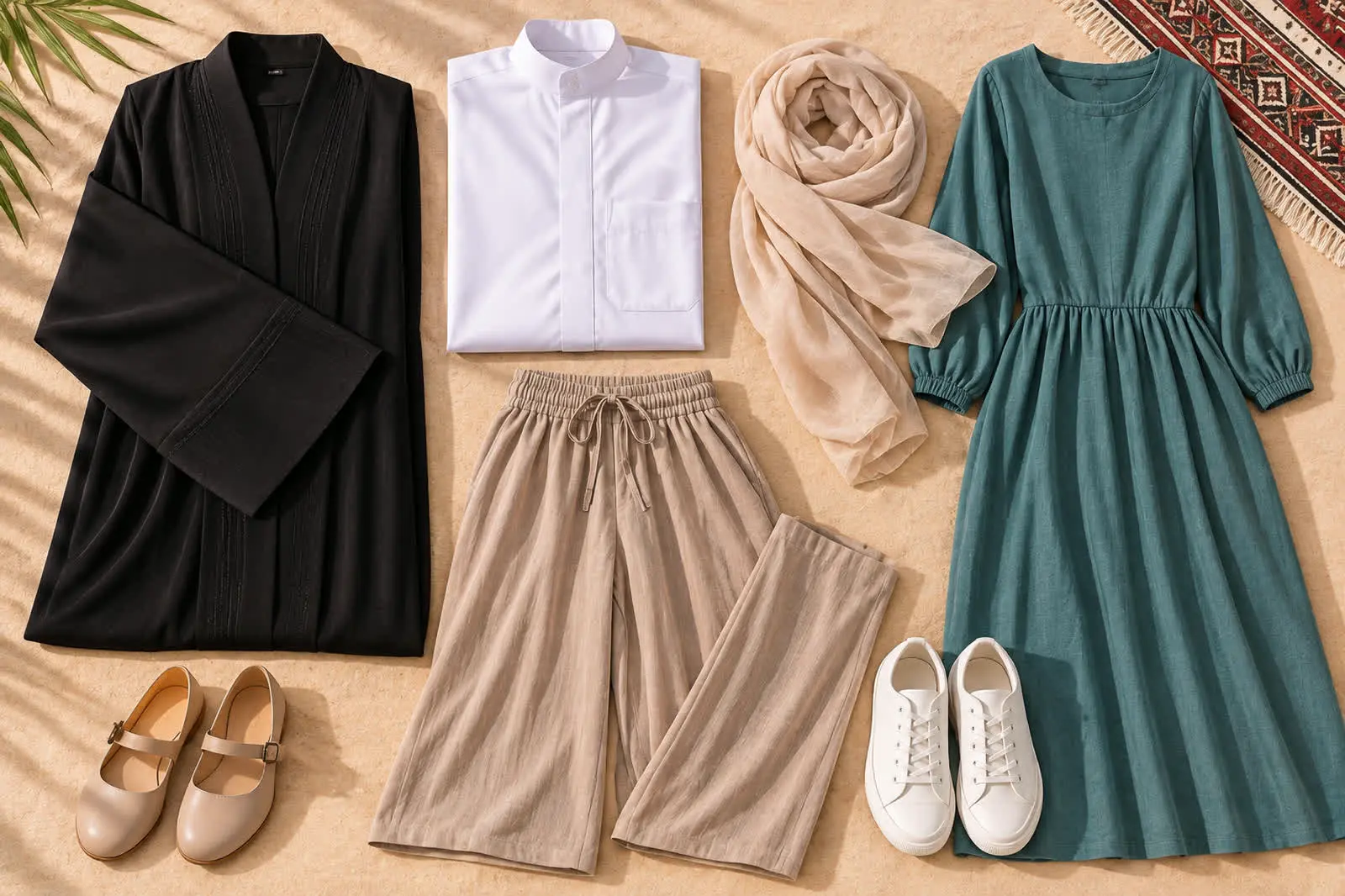
So here is the practical upshot, before the evidence. Buy the looser version of everything, cover to the elbow and below the knee, and put a large scarf at the bottom of the bag. That single choice satisfies every definition of modest that any government has published for this country, including the strictest. Everything past that line is argument about who gets to decide what modest means in a country whose own official pages give five different answers.
The short answer for women
No headscarf. No abaya, unless you want one. Loose clothing that covers the shoulders and the knees, and a scarf you can put on before a mosque. Below is each of those claims with the sentence it comes from, because the no-abaya point is the part travellers find hardest to believe, and it is worth reading the wording rather than trusting us.
- The abaya is not required of a visitor. The UK government’s travel advice for Saudi Arabia states it in one line: “Female travellers do not have to wear the traditional robe (‘abaya’) or cover their hair.”
- Modest means loose, not covered head to foot. Visit Saudi, the state tourism board’s own site, is careful about this: “As a tourist, you are not expected to wear the same attire as locals, or to cover up to the same extent, but it’s highly recommended that you dress modestly.” Then the specification: “Specifically, loose-fitted clothing that covers the shoulders, cleavage and legs.”
- Your hair is your decision, except inside a mosque. On head coverings the tourist board quotes a Saudi student: “If you want to wear it, if you don’t want to wear it, both are acceptable,” and then a woman from Khobar: “We do prioritize modesty,” followed immediately by “But we’re very much open to however a foreigner may present themselves.”
- Carry something to cover with. Same page, same sentence: “Women traveling to Saudi should consider packing a scarf or a pashmina for this purpose.”
- The legal floor is lower than the social ceiling. The dress clause of the charter that your visa application points at reads, in full: “All visitors to public places shall dress modestly and must not dress in outfits with photos, figures, signs or phrases violating common decency.” No body part is named. Every measurement you will read online comes from a foreign government’s advisory page, not from the Saudi text.
The short answer for men
Men have a dress code too, and it is the one that generates more fines. Not for women — for men. The clause that catches the most people is the one about sleepwear, and the demographic most likely to be wearing it in a Saudi street in July is a man in gym shorts and a vest.
- Shorts are fine at or below the knee; above it is the problem. Visit Saudi puts it plainly: “Modesty is also encouraged for men. For example, men should avoid wearing shorts above the knees or pajamas in public places.”
- Sleepwear and underwear are a named offence. The penalty table lists row 9 in four words: “Wearing underwear and sleepwear.” The researchers at the Arab Gulf States Institute recorded which row actually earns money: “the most violations recorded since the law’s implementation have been against men for violating Article 9, which forbids wearing indoor sleepwear in public.”
- A thobe is the cheapest way to be unambiguously correct. You will not be laughed at for wearing one as a foreigner, and it beats the alternative of guessing. Wikipedia’s article on the garment, which matches the tourist board’s description, calls it plain: “It is a long-sleeved, ankle-length robe that has regional variations in name and style.” Visit Saudi goes further on status: “The Saudi thobe is among the country’s most recognizable garments for men.”
- Nothing with a slogan on it. Any slogan. The charter bans outfits carrying “photos, figures, signs or phrases violating common decency”, the penalty table prices two separate rows of it, and the UK advisory adds the one line that no other government publishes: “has symbols or slogans that could be viewed as political and lead to arrest.”
Do you have to wear an abaya?
No — and the sentence that settled it for the English-speaking internet came from the crown prince, in an American interview, in March 2018. Asked by Norah O’Donnell on 60 Minutes, Mohammed bin Salman said: “The laws are very clear and stipulated in the laws of Sharia: that women wear decent, respectful clothing, like men. This, however, does not particularly specify a black abaya or a black head cover. The decision is entirely left for women to decide what type of decent and respectful attire she chooses to wear.”
Six months later Saudi Arabia began issuing tourist visas for the first time — DW reported “The announcement comes a day after the ultraconservative Islamic country launched a visa system that allows citizens from 49 countries to apply for travel visas to the kingdom.” — and the dress rules for visitors were written down for an audience that had never been addressed before. The German wire report summarised the Interior Ministry’s position exactly as every Western advisory still repeats it: “Female tourists are expected to cover their shoulders and knees. However, they will not be required to cover their hair or wear abayas, the long, black robes that Saudi women are required to wear.”
The American embassy in Riyadh has been quoted more often than anyone else on this, because the sentence is careful in a way a travel blog’s is not. The State Department’s 2019 human rights report, published in 2020, records: “In September the chairman of the Saudi Commission for Tourism and National Heritage, Ahmed al-Khateeb, stated abayas would not be mandatory for foreign tourists but modest dress covering shoulders and knees was mandatory.”
Now read the sentence two lines above that one in the same report, because it is the reason the folklore survives: “Cultural norms selectively enforced by state institutions require women to wear an abaya (a loose-fitting, full-length cloak) in public.” The distinction the drafters were making is between a written obligation and an enforced one. It is also the distinction that matters most to you, and it does not fall out the way the marketing suggests.
That June, the same report continues, “In June a Saudi woman was barred by male security guards from entering an upscale shopping mall in Riyadh because she was not wearing an abaya.” She was not a tourist. “In a video posted to social media, the woman said the guards told her she was not dressed modestly.” The Arab Gulf States Institute’s audit is the most useful thing written about how this feels at a door, because the woman argued from the documents and lost anyway. The law carries a clothing guide for visitors — “For foreign visitors, the law does provide a guide for appropriate clothing.” — and when she produced it, “She showed the guide to the security personnel but was nevertheless refused entry.” A Saudi lawyer, the same article reports, “A Saudi lawyer pointed this out as a flaw in the system violating the country’s Basic Law.”
Which is the honest answer to the question in this heading. As a visitor, you have a written right to be dressed differently from a Saudi citizen, and that right lives in an advisory leaflet rather than a statute. The people who check coats at a mall door are usually not lawyers and often not policemen. The abaya is not the law; the abaya is one plausible reading of a word — modest — that the Saudi state has never defined to a number, and a visitor’s risk is not prosecution but inconvenience at a threshold.
What the law actually says: the Public Decorum Charter
Almost nothing written about Saudi dress quotes this document, and it is the one text on the subject that a visitor is pointed to before the visa is issued. It sits on the official Saudi eVisa domain under the heading Public Decorum Charter, with a section headed “Laws and etiquette” whose first line is: “All visitors of public place shall respect common values, customs and traditions of Saudi Arabia.” The dress section, in full: “All visitors to public places shall dress modestly and must not dress in outfits with photos, figures, signs or phrases violating common decency.”
That is the entire dress rule. Two clauses, no measurements, no garments named, nothing about hair. It is worth knowing, because almost every claim on this page can now be sorted into one of two piles: things the charter says, and things someone else inferred from the word modestly.
And it is not decorative. The enforcement paragraph attached to the charter reads: “Without prejudice to any greater legal penalty, any person who breaches any of the provisions of this Charter shall be liable to a fine not exceeding (Five) thousand SR., according to the Penalty Matrix stated in Article Nine of this Charter.” Then: “In the event of repeated violation within a (year) of the first, the fine shall be doubled.” Then the sentence that tells you the document has a real procedure behind it, typo and all — the page prints “pervious”, not “previous”: “Any violator issued with a fine based on pervious paragraph of this Article, may appeal before relative administrative court.”
Two cautions about the page itself, both worth stating because we are about to rely on it. It carries no date, no article numbers in the body, and no version history; the heading labels and the paragraphs beneath them do not always match, so the paragraph printed under “Alcohol and substances” is the one about fines. We have therefore quoted complete sentences rather than numbered articles, and where the article numbering matters we have taken it from the penalty table instead.
The penalty table, and what dress actually costs
The charter links to a downloadable sheet titled VIOLATIONS TO PUBLIC DECENCY AND PENALTIES: nineteen rows, each with a first-time fine, a repeated fine and, sometimes, a remark. It is the closest thing to a dress code with a number on it that Saudi Arabia publishes, and only four of the nineteen rows are about clothing. We have kept the columns below exactly as the sheet lays them out; the riyal figures are not converted, because the exchange rate moves and the sheet does not.
| Row | The violation | First time (SR) | Repeated (SR) |
|---|---|---|---|
| 8 | “Wearing improper clothing in public places.” Then, as its own sentence: “Dress code for visitors of the Kingdom of Saudi Arabia shall be in accordance with the standards set for such purpose.” | 100 | 200 |
| 9 | “Wearing underwear and sleepwear.” | 100 | 200 |
| 10 | Clothing bearing profane language, or obscene images or symbols. | 100 | 200 |
| 11 | Clothing bearing language, images or symbols that encourage discrimination or racism, or promote porn or drug use. | 500 | 1,000 |
| 1 | Indecent behaviour that includes an act of a sexual nature, and the remark column prices it per person. | 3,000 | 6,000 |
Row 8 is the one that governs a visitor’s outfit, and it is about ninety riyals — roughly twenty-five dollars — at the time of writing. DW’s contemporaneous coverage of the same table gives the full span: “Fines can range between 50 and 6,000 riyals”. The cheapest row in the sheet is not a clothing row at all; the fifty-riyal minimum belongs to jumping a queue. The arithmetic is worth checking once, because the two documents look contradictory until you notice that the charter caps a first fine at five thousand and the table’s six thousand is a doubled three thousand.
The second sentence of row 8 is the important one and the least quoted. The sheet does not say what improper clothing is. It says the dress code for visitors “shall be in accordance with the standards set for such purpose”, which is a pointer to a document we have not been able to find — see the list at the bottom of this page. It is a deliberate piece of drafting: it keeps the standard flexible, and it is also the reason no article, including this one, can give you a defensible measurement.
Who writes the ticket, and what you can do about it
This is the part of the 2019 reform that most coverage missed, and the sheet says it in the plainest possible words, under General Provisions: “Persons authorized for the identification and recording of violations and imposition of fines as provided for in these Regulations are policemen.” Not the religious police. DW reported the same thing at the time: “The job of monitoring for violations and imposing fines will fall to the Saudi police force and not the country’s religious anti-vice squads, who have grown less powerful in recent years.”
Three more lines from the same block of General Provisions are worth more to a visitor than any styling tip. First, the principle of legality: “Penalties shall not be imposed on any behavior not provided for in the violations table.” Second, the thing that makes a group night out expensive: “In case of multiple violators in a single violation, the prescribed fine shall be imposed on each violator.” Third, the appeal: a person issued with a penalty “may file a grievance before the Public Decency Circuit at the Specialized Administrative Court (Board of Grievances).”
There is also a body that is not allowed to stop you, and travellers routinely confuse it with the police. The Arab Gulf States Institute describes it: “The Public Decency Association, which was launched in 2015 to provide guidance on decency and public taste but is not authorized to enforce the law, encourages different facilities and public spaces to specify what they consider an appropriate dress code.” That last clause is the whole story of Saudi dress in one sentence. The state sets a fine and leaves the standard to whoever owns the door.
Five official definitions of modest, side by side
We collected every sentence we could find, from five authorities, that tries to say what covering is expected. They do not agree, and the disagreement is the most useful thing on this page — because the overlap between them is the outfit you should actually pack.
| Who | What they say, verbatim | Shoulders | Elbows | Knees | Hair |
|---|---|---|---|---|---|
| Saudi Public Decorum Charter (the binding text) | “All visitors to public places shall dress modestly” | not stated | not stated | not stated | not stated |
| Visit Saudi (Saudi state tourism) | “loose-fitted clothing that covers the shoulders, cleavage and legs” | yes | not stated | legs, unspecified | mosques only |
| UK Foreign, Commonwealth & Development Office | “Men and women must wear loose-fitting clothing that covers the elbow and below the knees.” | yes | yes | below the knee | explicitly not required |
| Government of Canada | “Shoulders and knees should be covered.” Adding: “Women who don’t adhere to local dress standards may attract unwanted attention.” | yes | not stated | yes | “Women are generally expected to cover their arms and legs” |
| US State Department, quoting the Saudi tourism chairman (2019) | “modest dress covering shoulders and knees was mandatory” | yes | not stated | yes | not required of tourists |
Four of the five say shoulders. Only the British say elbows, and only the British say below the knees rather than to them. Nobody contradicts anybody on the hair. So: cover to the elbow, cover to below the knee, and you have satisfied the strictest published formulation on the list and the loosest at the same time, which is the only genuinely risk-free answer anyone can give you without a lawyer on retainer.
One caution about the table above. Only row 1 is Saudi law. The other four are foreign governments advising their own nationals, written by people who are not on the ground and who are, in the British case, describing a rule as an obligation (“must”) that the Saudi text does not state in those terms. They are the best evidence available of what a Saudi official is likely to consider modest. They are not statutes.
Can you wear shorts?
Yes, if they reach the knee, and this is one of the very few points where every source lines up. The Saudi tourist board’s line is about men and is quoted above: “men should avoid wearing shorts above the knees or pajamas in public places.” The British advisory folds both sexes into one sentence: “Men and women must wear loose-fitting clothing that covers the elbow and below the knees.” Canada asks for knees.
What is not in any of those sentences is a permission, and the asymmetry is worth noticing: the word shorts appears exactly once across every page we captured from the official Saudi tourist and eVisa domains, and it appears in a sentence telling you what to avoid. There is no Saudi document in the set that says a visitor may wear shorts. The practical reading is that below-knee tailored shorts are treated as acceptable in most of the country by most of the people you will meet, and are the item most likely to get you stopped at a conservative door.
Avoid three specific things. Anything tighter than the knee, since “is tight-fitting” heads the UK list of what to avoid. Anything that could read as sleepwear, which is row 9 and, per the AGSI figures, the most-fined garment in the kingdom. And anything that reads as sportswear worn as daywear — gym shorts and a vest is the outfit the sleepwear row was written for.
What to wear, setting by setting
The single best predictor of how strictly the rules get applied is not the city and not the season. It is the room.
Malls and high streets
The strictest public space in the country, and not because the law says so. “Visitors to shopping malls and parks are often subject to closer scrutiny, while those frequenting concerts and other tourist attractions are more often exempt from it.” That is the AGSI one-year audit, and the sentence explains a pattern travellers report constantly and cannot account for: the same outfit that is invisible at a concert is a conversation at a mall door. Malls are where the “determined by place” language of Article 8 does its work — the row is quoted in the AGSI article as covering “inappropriate clothing in public spaces is a violation determined by place”, “without providing specific guidance”. Carry the scarf through a mall even if you have no mosque to visit; the family section is where you will want it.
Restaurants and cafés
Dress to the same standard as a mall and expect the seating to be the bigger surprise. “Some restaurants have sections for men only and one for families where females can be served, including when unaccompanied,” as Canada puts it. In Ramadan the standard tightens rather than the seating: the UK advisory tells travellers to “follow local dress codes” during the fasting month and warns that “clothing that does not meet local dress codes may cause more offence at this time”.
Mosques and religious sites
Here the rules do become specific, and this is the one setting where a woman’s hair is a requirement rather than an option. The tourist board’s sentence covers all of it: “When visiting religious sites such as mosques, all visitors must remove their shoes and wear long pants/skirts; women must cover their hair.” Note “all visitors” — the shoe rule is not sexed, and neither is the long-trousers one. Sandals that slip off are not a style choice, they are logistics. Canada adds the general principle that explains why religious sites get their own paragraph: “You should dress conservatively, behave discreetly, and respect religious and social traditions to avoid offending local sensitivities, especially in the holy cities of Mecca and Medina and in mosques.”
Mecca and Medina
The first question in both cities is whether you are allowed in, and the answer is not about clothing. “The government prohibits non-Muslims from entering central Mecca and the Prophet’s Mosque in Medina,” the US State Department’s International Religious Freedom report for 2023 states without qualification. For Muslims travelling for Hajj or Umrah, the requirement is ihram, and ihram is a ritual state with its own garment rules rather than a stricter version of daywear — see the vocabulary section below.
Beaches, resorts and the desert
This is where our sourcing runs out, and we would rather say so than invent a rule. No page in the captured official set states a swimwear rule, for any body, anywhere. The nearest thing to evidence cuts the other way from what travellers expect: on Sindalah, the island off the NEOM project that began taking cruise guests in 2020, the concern was cameras rather than costumes. “When reaching Sindalah Island, guests’ phones are placed in special cases so that they cannot take photos.” The AGSI author’s reading of that measure is a reading, not a rule, and she labels it as one: “Since the island is a beach destination, banning photos seems to be a way to avoid debate on social media regarding potential violations of the decency law.”
What follows is our inference from the private-compound logic, not a citation: on a women-only beach or inside a gated resort compound you are in a private space, and the charter’s language is about public places. Take the conservative option until you can see the room, and cover up for the walk from the taxi.
A Saudi wedding
Assume you are going to a hall, not a garden. For men the safe formal answer is a thobe, clean and pressed, or a dark suit; a bisht over the thobe is what a Saudi man wears when the occasion is serious, and it is the one upgrade a guest is never criticised for. “The bisht is usually worn over the thawb for special occasions, including weddings, religious prayers, and national events.” For women: floor length, sleeves to the wrist, and nothing that reads as everyday. Weddings are commonly sex-separated, and the women’s hall is where local dress is most varied and most ornate, so a modest evening gown rather than a cocktail dress. Our guide to Indian culture has the parallel story for the other great wedding culture in the region’s expatriate community, and the same rule travels: dress up, cover more, outshine nobody.
What people are actually wearing: the vocabulary
You will be asked in a shop what you want, and the words matter more than the measurements. These are the garments the sources above actually name, with the Arabic as the reference works print it.
| Word | Arabic | What it is |
|---|---|---|
| thobe / thawb | ثَوْب | The men’s robe. Wikipedia records that the word itself is Standard Arabic for a garment; our source calls it “a long-sleeved, ankle-length robe”, and says “thawbs are the main formal attire for men in Saudi Arabia”. |
| bisht | بِشْت | The cloak worn over the thobe at weddings, prayers and national days. Now “mainly worn during special occasions and ceremonial events, rather than everyday life”. |
| ghutrah | غُتْرَة | The headscarf, “fashioned from a square scarf, and is usually made of cotton”. Also keffiyeh and, in the red-and-white checkered form, shemagh (شُمَاغ). “The keffiyeh is commonly found in arid regions, as it protects from sunburn, dust, and sand.” |
| agal | — | The cord that holds the scarf down: “A head cord, agal, is often used by Arabs to keep the keffiyeh in place.” |
| abaya | عباية | The woman’s over-garment. “Traditional abayas are usually black and may either be a large square of fabric draped from the shoulders or head or a long kaftan.” Note the next row before treating black as the rule. |
| khimar | خِمَار | Wiktionary, which lists the English word as borrowed from this Arabic, defines it as “A long veil worn by Muslim women as part of hijab”. The head covering, not the robe. |
| jilbab | جِلْبَاب | Wiktionary again: “A long, loose-fitting coat or similar garment worn by some Muslim women to fulfil hijab”. A coat, not a cloak you buy in a mall as an abaya. |
| niqab | — | The face veil, which the abaya “can be worn with”. You will not be asked to wear one, anywhere, as a visitor. |
| ihram | إِحْرَام | Pilgrimage dress, not daywear. For men: “Men’s garments often consist of two white unhemmed sheets (usually towelling material) and are universal in appearance.” The two pieces have their own names — the ridāʾ (رِدَاء) draped over the torso and the izār (إِزَار) secured at the waist. |
Two things fall out of that table. The first is that the abaya’s reputation as a uniform outruns the garment: the English Wikipedia article notes that “Commonly, the abaya is worn on special occasions, such as mosque visits, Islamic holiday celebrations for Eid al-Fitr and Eid al-Adha, and also during the Islamic holy month of Ramadan.” Whatever is true of the street, the encyclopaedia is describing an occasion garment. The second is that Visit Saudi’s own cultural page concedes the diversity that the word abaya flattens: “The Saudi thobe is among the country’s most recognizable garments for men, while traditional women’s attire varies from region to region, with distinctive designs, colors, and embroidery that celebrate local heritage.” Asked directly what makes traditional clothing unique, the same page answers with regional difference rather than a national dress.
Why nobody can define modest for you
Every other travel destination’s dress code is a venue policy. This one is a legal system, and the system is the reason the word stays open. State Department reporting puts it in one sentence: “According to the 1992 Basic Law of Governance, the country’s official religion is Islam, and the constitution is the Quran and Sunna”, and “The legal system is based largely on sharia as interpreted by the Hanbali school of Sunni Islamic jurisprudence.” A dress rule written inside that system is not going to be a measurement, because the underlying source is not a building code. When the crown prince said in 2018 that Sharia requires “decent, respectful clothing, like men”, he was describing the actual form the rule takes.
The procedural documents show the same thing from the other direction. Saudi Arabia’s Law of Criminal Procedure, in the government’s own English translation, lists the officials entitled to conduct a preliminary investigation, and item 6 of that list reads: “heads of centers of the General Presidency for the Promotion of Virtue and Prevention of Vice, with respect to matters falling within their jurisdictions”. So the religious committee is not absent from the statute book; its centre heads are still named in it. What changed is the gap between the named office and the officer on the street.
That committee — the CPVPV, and colloquially the mutawa, from the Arabic هيئة الأمر بالمعروف والنهي عن المنكر — is the thing most travel writing about Saudi dress is really describing when it describes the old regime. Wikipedia’s account of the change: “the body gained extensive powers in the 1980s and continued to function as a semi-independent civilian law enforcement agency for almost 35 years until 2016, when societal reforms driven by then-deputy crown prince Mohammed bin Salman led to limiting some of its authority through a royal decree by King Salman bin Abdulaziz.” It remains “a government religious authority in Saudi Arabia that is charged with implementing the Islamic doctrine of hisbah in the country”, which is why it still turns up in the law.
What changed, and what did not
| When | What happened | Where we read it |
|---|---|---|
| 1940 / 1980s | The religious committee is established, then gains extensive powers. | Wikipedia, sourced; State Department 2019 |
| 2016 | A royal decree limits its authority, “including the rights of pursuing, questioning, detaining, and interrogating suspects”. | Wikipedia |
| March 2018 | The crown prince tells 60 Minutes that neither a black abaya nor a head cover is specified. | CBS |
| September 2019 | Tourist visas open to 49 countries; the Interior Ministry publishes 19 decency offences with fines from 50 to 6,000 riyals, enforced by police. | DW; AGSI |
| 2019 | The tourism chairman tells the US delegation that abayas are not mandatory for foreign tourists but shoulders-and-knees is. | State Department |
| 2020 | Year-one audit: sleepwear produces the most recorded violations, malls are stricter than concerts, and a Saudi woman is refused a mall entrance while holding the visitors’ guide. | AGSI; State Department |
| 2023 | The committee’s field officers “did not patrol in public during the year but frequented mosques and other religious sites, where they were required to wear identification badges”. | State Department IRF |
What did not change is the vagueness, and it is documented rather than assumed. The AGSI audit of Article 8 — the clothing article — is a single damning clause: the article covers “inappropriate clothing in public spaces is a violation determined by place”, “without providing specific guidance”. A rule that is defined by the place and specifies nothing about the place is a delegation, and it has been delegated to mall security, to hotel lobbies and to whoever is standing at the door of a wedding hall.
One line of reporting is worth keeping in view when anyone tells you the religious police are gone. The State Department’s 2019 report on the committee’s street presence: “although in practice CPVPV authorities were greatly curtailed compared with past years”. Greatly, not entirely. And four years later the same department’s religious freedom report describes an agency that is still “charged with monitoring social behavior and reporting violations of moral standards to law enforcement authorities”, still overseen by the interior ministry, still told by law to “uphold its duties with kindness and gentleness as decreed by the examples of the Prophet Muhammad.” A rule that has to be decreed to be gentle is a rule with a history.
The packing list
This section is ours rather than sourced, and it is built by taking the strictest published line in the table above and dressing to it. Everything here is the version of a normal holiday wardrobe that costs you nothing to comply with.
- For women: three long-sleeved tops that are not fitted at the wrist. Elbow-length is the British minimum; sleeve-length is the version that never needs explaining.
- Two bottoms below the knee. Wide trousers and a maxi skirt. A midi that reaches mid-calf satisfies four of the five definitions and not the fifth.
- One large scarf, dayweight. It is a head covering at a mosque, a shoulder cover at a mall entrance, and a shade on the drive to Al Ula. The tourist board tells you to bring it, and it is the single item that converts a wrong outfit into a right one in about four seconds.
- Slip-on shoes, both sexes. Every mosque and many homes are a take-off, and you will be the one holding trainers.
- For men: two thobes before you buy anything else. They are cheap, they are cooler than trousers in July, and they end the argument. If you would rather not, take trousers and short-sleeved shirts and leave the t-shirt and shorts combination at the hotel.
- Nothing with a slogan, a face or a logo the size of a plate. The charter bans outfits with “photos, figures, signs or phrases violating common decency”, two rows of the table price it, and the British advisory is the only one that says the political version of it can end in arrest.
- No sleepwear outside your room, and no gym kit as daywear. Row 9, and the row the AGSI researchers say generates the most fines in the country.
- One genuinely formal outfit each. Not for you — for the invitation you may receive once you are there.
Frequently asked questions
Do I have to cover my hair in Saudi Arabia?
No, unless you are entering a mosque. The UK government’s advice is explicit: “Female travellers do not have to wear the traditional robe (‘abaya’) or cover their hair.” Canada’s is the same in different words, and the Saudi tourist board frames head covering as a personal choice. Inside a mosque it is a requirement, stated without qualification: “women must cover their hair”.
Can I wear jeans or leggings?
Jeans, yes. Leggings, not on their own — and the objection is fit rather than coverage. Canada asks visitors to avoid “tight-fitting clothing or items with language or images that may be considered culturally offensive”; the UK list of what to avoid opens with “is tight-fitting”; Saudi Arabia’s own tourist page leads with “loose-fitted”. Loose trousers over leggings is the version that keeps everyone’s attention where it should be.
Is Jeddah really more relaxed than Riyadh?
Everyone who has been to both says so, and not one official source in our set says it, so we are not going to either. What the sources will support is the general shape of the claim: “Different regions in the kingdom are on different social trajectories”, as the AGSI article puts it while describing the same ministry penalising one café and not another. Treat any city-by-city strictness table you read online as a traveller’s impression wearing a citation.
What actually happens if I get it wrong?
At worst, and only on paper, a hundred-riyal ticket for row 8, doubled if you do it again inside a year, appealable to the Public Decency Circuit at the Board of Grievances. More often: a look, and Canada says the quiet part — “Women who don’t adhere to local dress standards may attract unwanted attention.” Most often of all: a guard at one door asking you to wrap the scarf, and no consequence once you do. The charter’s own summary of what is expected of a guest is not about clothing at all: “All visitors of public place shall respect common values, customs and traditions of Saudi Arabia.”
Do I have to dress differently during Ramadan?
The rules do not change; the tolerance does. The UK advisory tells visitors to “follow local dress codes” during Ramadan and adds the reason: “clothing that does not meet local dress codes may cause more offence at this time”. It also warns that hotels and restaurants serving food in fasting hours may screen you off from Saudi guests. Eat the same modest food you would eat at any other time of year, and expect a curtain.
Is the dress code different for men?
It is shorter, and the fines are more likely. Men are told to keep shorts to the knee and sleepwear indoors, and — the part nobody mentions — the row that produces the most recorded violations in the country is the sleepwear row, and it is mostly men who pay it. A thobe covers every requirement at once, which is why it is what the men around you are wearing.
Can I visit a mosque as a non-Muslim?
Our sources answer only the negative half of this question, and they answer it specifically: non-Muslims are barred from central Mecca and from the Prophet’s Mosque in Medina. Nothing in the documents we captured grants or refuses entry to any other mosque, so check the site you actually want to see — some Saudi mosques admit non-Muslim visitors at set times, and we have not found the official page that says which.
What should I wear if I am transgender?
This is included because it is in the advice, not because it is an edge case. The UK government’s Saudi Arabia page says flatly: “Transgender people could also face difficulties with dress codes and access to medical care.” Canada’s page lists cross-dressing among the charges 2SLGBTQI+ people could face. Read both before you decide what to pack, and read our piece on dining etiquette for the general problem of being visibly different in a room that has a script.
Sources and method
This article was written from documents rather than from other travel articles, which copy each other and, on this subject, copy a rule that no Saudi document states. Every quotation is reproduced from a file we captured and read, and before publishing we check mechanically that each quoted run appears contiguously in the file it is credited to — including every Arabic word in the vocabulary table, which is matched against the reference work that prints it. Retrieved 19–20 November 2026.
Saudi official. The Public Decorum Charter and its penalty sheet, both from the official Saudi eVisa and Visit Saudi domains; the eVisa page publishes the charter text and links a PDF, VIOLATIONS TO PUBLIC DECENCY AND PENALTIES, which we downloaded (940,689 bytes) and converted twice, once in default reading order for the sentences quoted and once in table mode for the fine columns, because the two layouts disagree about which row a number belongs to. Visit Saudi’s women-traveller tips and its culture page.
Government advisories. UK Foreign, Commonwealth & Development Office, Saudi Arabia travel advice, Dress code section. Government of Canada, Saudi Arabia travel advisory, Dress and behaviour section, which is also the source that names the charter a Ministry of Tourism document. US State Department, 2019 Country Reports on Human Rights Practices and the 2023 International Religious Freedom Report.
Law. The Law of Criminal Procedure and its Implementing Regulations, from the Ministry of Justice’s English translation series.
Reporting and reference. CBS 60 Minutes, March 2018, on the crown prince’s interview. Deutsche Welle, 29 September 2019, on the decency regulations. Eman Alhussein in the Arab Gulf States Institute in Washington, 30 September 2020, the year-one audit of the same law. Wikipedia’s articles on the thawb, the bisht, the keffiyeh, the abaya, ihram and the Committee for the Promotion of Virtue and the Prevention of Vice, used only for garment vocabulary and for the 2016 decree; Wiktionary’s English entries for khimar and jilbab, used for the definitions and for the Arabic source-words printed with them.
What we could not source
The gaps below are the honest state of the record as of 20 November 2026. Where a gap has a working answer elsewhere, we say what we recommend and mark it as our inference rather than somebody’s rule.
- The “standards set for such purpose”. Row 8 of the penalty table defers the entire definition of improper clothing to a document we cannot find. It is the most important missing page in this subject, and no search we ran produced it.
- The charter’s date and status. The eVisa page publishes no date, no issuing decree and no article numbering that matches its own headings. Canada calls it a Ministry of Tourism document; we have not found the decree that puts it into force.
- Any swimwear rule, anywhere. Not one official source in the captured set addresses swimwear. We say so in the beaches section instead of inventing a number.
- Any workplace dress code. Nothing in the set states one. The labour amendments the AGSI article quotes are about gender discrimination in hiring, not about clothing, and the ministry penalty it records against a café was for employing a Saudi woman as a waitress, not for her outfit.
- Any figure for dress fines actually imposed. The AGSI article reports which rows generate the most violations; no source in the set publishes a count, a total or a breakdown by nationality.
- Whether a tourist has ever been fined under row 8. We found no reported case. The Riyadh mall episode in both the State Department and AGSI accounts involves private security refusing entry, which is not a penalty and not the police.
- A city-by-city or region-by-region guide. Every source that mentions regional difference does so in general terms. “Different regions in the kingdom are on different social trajectories” is the closest anything gets, and it is not a packing list for Jeddah.
- Whether the abaya is still required of Saudi women. The most recent sentence we found is the State Department’s 2019 formula about cultural norms “selectively enforced by state institutions”. The department’s 2024 country report contains no sentence with the word abaya in it, which is a fact about that report’s drafting and not proof of a change on the ground.
- A rule for the ihram beyond the two named mosques. We can source the prohibition on non-Muslims entering central Mecca and the Prophet’s Mosque, and we can source what a male pilgrim wears. We cannot source a list of which other mosques are open to a visitor, or in what clothes.
- Any measurement that appears in a Saudi document. Elbows, knees and ankles come from foreign advisories. The Saudi state’s own binding sentence on dress contains no body part whatsoever, and that silence is the finding of this article rather than a failure of it.
