
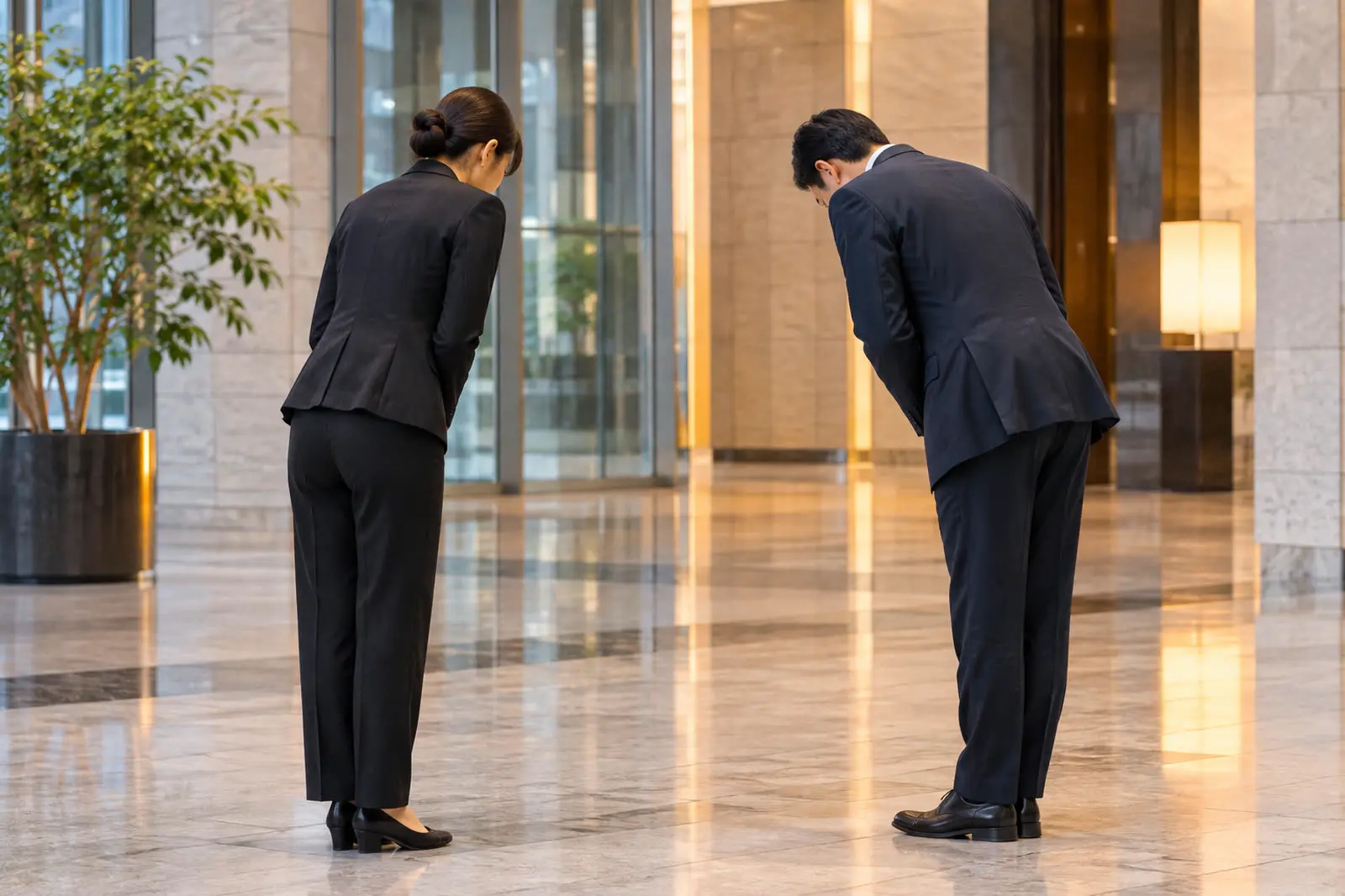
Every guide to Japanese bowing opens with three numbers, and the guides cannot agree on them. The set you will meet most often is 15 degrees, 30 degrees and 45 degrees. Japan’s national non-profit publisher of culture articles, supervising its own bowing page with the head instructor of the school that everyone treats as the authority on the subject, prints 15, 45 and a bow near a right angle instead. One of those is wrong, and the honest answer is that neither of them is a rule. Japanese bowing — ojigi — has one named rule with real currency, and it is not about the angle at all.
So this is the article that pairs with our guide to Japanese greetings, and it answers two questions that keep getting fused into one. The first is mechanical: how to bend, how far, how long, what the hands do. The second is social: who initiates, who is deeper, what a bow means when it is not a hello. The mechanical question has a weaker documentary basis than any travel page will admit. The social one has genuine answers, and they are more useful than the angles.
What follows was built by reading Japanese documents rather than other English articles, and every Japanese sentence in quotation marks is reproduced from a file we captured and can point at. Where we could not find something, there is a section near the end that says so.
The short answer
If you are a visitor and you want the whole thing in one paragraph: bow from the waist, not the neck; let your hands slide down your thighs; keep your eyes on the floor through the bow and look the person up again as you rise; say the words before you bend, not during it; hold the bottom of the bow for about one breath; and when someone bows at you, bow back at roughly the same depth and slightly after them. Do that and nobody in Japan will think you are rude, whatever the number was.
The names, with the depth that the modern teaching gives each and the thing it is actually for:
| Name | Written | Depth as taught | Use |
|---|---|---|---|
| eshaku | 会釈 | about 15° | The passing nod. Colleagues, a corridor, a shop assistant, an acknowledgement that needs no stop. |
| keirei | 敬礼 | about 30° | The default. Clients, entering and leaving a meeting, thanking a colleague senior to you. |
| saikeirei | 最敬礼 | about 45°, deeper in some sources | Very important counterparties, a serious request, a serious apology, weddings and funerals. |
| dogeza | 土下座 | forehead toward the ground | Not a greeting. Extreme apology or an extreme plea, and almost never something a visitor will do or see. |
Those depth figures are the ones the teaching materials give. The next section shows how much weight they carry, because the answer changes what you should do with them.
Why the numbers are softer than they look
Start with the dictionaries, because that is where a rule ought to live if it were one. We pulled six Japanese-English entries for the bow vocabulary and every headword in them, and not one prints an angle in any unit. 会釈 is “slight bow (as a greeting or sign of gratitude); nod; salutation”. 敬礼 is “salute; bow”. 最敬礼 is “a respectful bow”. 立礼 is “bowing while standing; standing bow”, 座礼 “bowing while sitting”, 黙礼 “silent bow”. Wiktionary’s own cross-reference list works the same way — eshaku “a slight bow”, saikeirei “a respectful bow, a low bow”, kōtō “a deep bow, a kowtow, a bow where one touches one’s head to the floor or ground”. The distinctions are lexical, not geometric. We also ran a literal search for the degree sign across all twenty-two dictionary captures we made, and it returned nothing at all.
Where the 15-30-45 set does appear
It appears in teaching material, and it appears consistently. A business-manner guide published by Yamagata University, a national university, states the three-type system outright and gives the reason for the basic depth: “基本のお辞儀は「敬礼」の30度になります。相手の膝あたりを⾒るイメージの角度になります。” That second sentence is the part the English pages drop — 30 degrees is defined by where your eyes land, on the other person’s knees. The angle is a description of a sightline, not a measurement.
Shibaura Institute of Technology’s careers guide teaches the same three tiers with the same figures — it has you enter an interview room at 30°, leave at 30°, and closes the panel with “45度くらいの最敬”礼 and open with “15度ぐらいの会釈”. The University of Security and Safety’s job-hunting guide carries the set too, and beside it the instruction “③先に言葉(先言後礼、語先後礼)” — word first, in both of the term’s spellings, in a handout for students who have never heard of either.
So the numbers are not an internet rumour. They are what Japanese universities teach students before job interviews. That is a real fact and it is the strongest thing that can be said for them. What cannot be said is that they are old, or that anyone measures them.
The school that is treated as the authority rejects the metric
Ogasawara-ryū is the lineage that every English account names when it wants to sound grounded, because it is the school that systematised samurai etiquette and is still the best known. Its position on degrees is not “we use different ones”. The SAMURAI’ve page reports it directly: “よくお辞儀は角度で種類分けされていますが、小笠原流では体型や腕の長さによって個人差があるため、角度では考えないそうです。” Bowing is often sorted by angle, but in Ogasawara-ryū they do not think in angles, because body shape and arm length differ from person to person. (Our translation throughout.)
That is not a style preference. It says the metric is the wrong metric: a tall person with long arms and a short person with a round middle cannot hit the same number while doing the same bow, so the tradition fixes the landmarks instead. The same page lists the standing bows by where the fingertips arrive — deepest is “立礼の中で一番丁寧な礼。指先が膝頭につくまで体を曲げる礼です” — and the principles are all postural, not angular: “襟が空かないように、顎が浮かないように、耳は肩にたれるように” — no gap at the collar, no floating chin, ears dropping toward the shoulders.
Read the page again two sections earlier, though, and it says something the summary above quietly omits. Describing the bowing of today, the same document prints the numbers: “立礼は大きく分けて3種類になります。角度が15度、30度、45度の3種類です” — the standing bows divide into three, at 15, 30 and 45 degrees. One page, both positions, no sign of the collision. That is the actual state of the metric in Japan: a teaching aid that schools hand out for interviews and that the tradition’s own lineages decline to measure, printed in the same brochure. The site even supplies the reason the modern set cannot be the historical one: an observer from the Edo period, it says, would find even the deepest bow of today insulting — “45度の最敬礼でも大変無礼なものだ!と感じるようです” — because a bow that passed for respect then folded the body all the way down toward the floor.
And there is a harder version of the rejection. The Japanese Wikipedia article on お辞儀, in the section that documents exactly the modern business system described above, closes with: “小笠原礼法を伝統的な礼法として支持する立場からは、これらを誤った礼法とする意見もある。” The footnote on that sentence is to a book by Ogasawara Kiyotada, the head of the line. Translated plainly: the school whose name the Western guides borrow says the guides’ own system is wrong etiquette.
Where the angles actually come from
If the numbers are not in the dictionaries and are disowned by the classical school, they are not old. They are in fact datable, and the date is not a comfortable one.
Japanese Wikipedia’s article on bowing carries a section headed 昭和の国民礼法 — Shōwa-era national etiquette — which opens: “1941年(昭和16年)、戦時下において国民が認識すべき礼法として文部省制定の「礼法要項」が発表された。” And then the sentence everyone has been repeating ever since: “立礼では上体を30度程度傾ける。最敬礼では45度。手は膝頭のあたりに自然にのばす。” Standing bow thirty degrees, deepest bow forty-five, hands extended naturally to the kneecaps. Same document, same two numbers, same hand instruction as the Yamagata handout, eighty-five years later.
The document is real, and a peer-reviewed history paper lets us pin it better than Wikipedia does. Nakajima Tetsuya of Ibaraki University, in 体育学研究 volume 66 (2021), works from the original: the 礼法要項 was issued by the Ministry of Education on 1 April 1941 as a special issue of the ministry’s own bulletin, 『文部時報』720号, its origin being the 作法教授要項調査委員会 the ministry set up in February 1938 to decide what etiquette schools should teach. Nakajima quotes chapter four, which is titled 敬礼・挨拶, and quotes its caveat: “教練・武道・競技に於てはその定むる礼法に従ふ” — for drill, martial arts and competition, follow whatever etiquette each of those lays down for itself. The ministry was standardising school bowing while expressly disclaiming authority over the dojos.
We should be exact about what that does and does not prove. Nakajima’s paper is about judo, and it does print degrees — just not for the ministry’s booklet. The angle in it belongs to the Kodokan’s own 修行者礼法 of 1940, where the ceremonial bow before the shrine is “拝礼は不動の姿勢から上体を45度傾け,それに伴い両手は膝蓋骨の前にくる「最敬礼」” — tilt the upper body forty-five degrees out of the fixed posture and bring both hands to the kneecaps. The stance it is performed from is “両足踵を合して爪先を約60度に開く” — heels brought together, toes opened to about sixty degrees — and the paper sets that beside the 歩兵操典, the infantry drill manual revised in February 1940, finding the two agree on the feet even where they differ on the back. So a 45-degree 最敬礼 genuinely is codified, in 1940, inside a martial body the ministry had expressly excluded from its rules. What the same paper will not find is a graded set: of the Kodokan’s etiquette as it stood in 1911 it writes “起居進退,お辞儀の角度など具体的な所作まで定めた規定は見当たらない” — no regulation going down to deportment, or to the angle of the bow, has turned up.
One angle, for one ceremony, in front of a shrine, is a documented fact. Three angles in graded succession, for shop floors and meeting rooms, is not, and we could not reach the 1941 text itself to test it: the National Diet Library record exists but its catalogue API refused us, and the digitised booklet is a scan whose text layer is empty. So the 30/45 attribution rests on Japanese Wikipedia’s citation of a 1941 compilation, not on our own reading of the primary. What we have confirmed independently is that the document, its date, its vehicle, its chapter titles and its carve-out are all real — which is enough to say the following with confidence: the two numbers at the heart of the modern system were published by a wartime ministry for the purpose of getting schoolchildren to bow alike, and have never been maintained by anyone since.
“Anyone since” is not rhetorical. Nakajima’s paper prints the state of things as described by the official who wrote the 1967 judo match rules, quoting him saying that after the war the wartime etiquette had been partly altered and that “現在,まとまった明文がない状況であった” — as of 1967 there was no consolidated written text. Japan lost its codified national bowing rules in 1945 and never replaced them. That is why the numbers drift, why two respectable sources disagree about whether 敬礼 is 30 or 45, and why nobody can settle an argument about it.
What does a 90-degree bow mean?
This is one of the phrases people actually search for, and it needs separating out, because “90-degree bow” means three different things depending on who is writing.
As a business tier, it does not exist. Ninety is not the deepest entry in the taught set; 45 is. If you read a hierarchy that runs 15, 30, 45, 90, someone extended a table by inventing a row.
At a shrine, roughly. The one place 90° genuinely circulates in English is Wikipedia’s shrine paragraph, which tells worshippers to “perform two deep bows of up to 90° to pay tribute to the Shinto kami”. We checked the authority that paragraph is friendly to, the Tokyo Shrines Office page on 参拝の作法, and it says only: “深いお辞儀(礼)を二回繰り返します。” Two deep bows. No degrees, anywhere on the page. The same office opens its guidance by refusing the premise of the question — “私たちが神社にお参りする際の作法には厳格なきまりはありません” — there is no strict rule for how we worship at shrines, and practice varies by shrine and by place.
As an image, yes. The 90° fold is what a bowed body looks like from the side when someone is really sorry, and the supervising expert on the nippon.com page does describe the deepest tier that way — just for gods and Buddhas: “神仏を拝む時の「最敬礼」は直角近くまで体を折りたたむ。” Near a right angle, at a shrine or temple. That is the honest content of the idea, and it is one notch short of dogeza, where the forehead goes toward the floor.
Why Japanese people bow at all
The standard story is that lowering the head offers the other person your weak point. The nippon.com article states it flatly: “元々は上位の相手に対して、最大の急所である頭を差し出すことで、敵意がないことを示した。” Originally, toward a superior, you showed you meant no harm by offering the most vulnerable spot you had. It then dates the practice: “奈良時代以前に中国から伝わったといい、中世に武家礼法として形式化し、相手に敬意を伝える所作となった。” Imported from China before the Nara period, formalised as samurai etiquette in the mediaeval era — note the hedge on the first half (伝わったといい, “it is said to have come”), which is a mark of someone who knows the earlier claim is not documented.
A former cabin-attendant trainer who is now a visiting professor at the University of Tsukuba and Kanda University of International Studies puts the same origin to work: “そもそも日本のお辞儀は、武士が主君の前で土下座をするように、急所である頭頂部を見せることで、相手に対する服従や敵意がないことを示すものです。” Note what she does with it — she reaches for dogeza and the samurai-before-his-lord image to explain why the crown of the head is the point, and then draws the practical rule straight out of it: since the gesture means I am showing you my soft place, you lower the head and drop the eyes.
Be clear about the status of this. It is an origin account, offered by manners teachers and repeated by encyclopaedias, not a documented history; no text says “we invented this because necks are vulnerable”. But it is the theory Japanese sources themselves use to derive the rules, and once you have it, the rules stop being arbitrary — which is the practical reason to carry it.
The bow you have already done a thousand times
Most visitors meet the most systematised bowing in Japan without thinking of it as etiquette at all. The nippon.com page describes it: “日本の学校には、授業の始まりと終わりに「お辞儀」をする慣習がある。座席から立ち上がり、先生に向かって「礼!」の号令とともに、頭を下げるのだ。” Every Japanese classroom opens and closes with someone calling rei! and thirty bodies folding on the count. The photo caption above it is the more useful sentence: “授業時の「礼」は近代教育から継承されているが、実施しない学校もみられる” — the classroom bow is inherited from modern schooling, and some schools no longer hold it.
That is the actual transmission channel. Not dojos, not shrines, not the classical schools — a command barked at eleven-year-olds since the Meiji state put etiquette in the curriculum, reinforced by the 1941 ministry booklet and then handed to university career offices and to the sports teams that bow to their home ground. The reason Japanese bowing looks uniform to a visitor is that it was uniformised by schooling, and the reason it has no official is that the official end of it was revoked in 1945.
The one rule with a name: say it, then bow
Angles have no name in Japanese. Timing does. The rule that Japanese manners education actually transmits with a term of art is that the greeting word comes first and the bow comes after, and the term is 語先後礼.
Here it is in the Yamagata University text, which is as good a statement as any: “挨拶は、⾔葉が先、お辞儀が後という先⾔後礼(せんげんこれい)(「語先後礼」といういい⽅もします)が基本になります。” The basic rule is sen-gen-go-rei, word-first-bow-after; the same thing is also called go-sen-go-rei. And the reason given is not reverence but optics — “⾔葉と同時に挨拶するとメリハリがない” — saying the word and the bow together has no edge to it, so you speak, you get their attention, and then you bend so that the bow itself is what lands in their eye.
The terminology is genuinely unstable, which is its own evidence about how it travels. A trade-magazine column by the trainer mentioned above lays out the synonym set in one sentence: “「分離礼」は別の言葉で、先に言ってから後から礼をするという意味の「先言後礼」、または言葉を先に言ってから後から礼をするという意味で「語先後礼」とも言われます。” Three names for one rule — bunri-rei, sen-gen-go-rei, go-sen-go-rei.
Unstable down to the reading. A Yahoo! Answers questioner reports taking manners training at two different places and being told two different pronunciations of the same four characters, and asks which is right: “二つの場所でマナー研修を受け講師の方の読み方が違っていたので どちらが正しいのか教えて下さい。”
The opposite practice, which is also standard
The word-first rule has a named rival: 同時礼, saying it while going down. One company’s training blog tells the story of adopting the rule and then finding what it collides with — its own author writes that they learned the basic bow of greeting “「語先後礼」として語り継がれているものがあることを知りました”, in the passive voice, “as something handed down”, and then: “一般には、正式なお辞儀が「語先後礼」で、日常の挨拶は「同時礼」と定義しているところが多いようです。” The mainstream split is formality: separate them in a formal bow, fuse them in an everyday one.
That is a usable rule of thumb, and it is worth more than any angle. In passing — a corridor, a till, an otsukare-sama to a colleague — say and bend together. In a bow that is doing work — greeting a client, thanking someone senior, apologising — say it to their face, then go down.
And the rule has an objection on record that nobody in the training industry has answered. The same Yahoo! thread that asks about the pronunciation is, in fact, a complaint: “この方法は、どこを調べても正しいと書いてあるのですが、相手が頭を下げているときに頭を下げないのは、大変無礼に感じます”. Everywhere I look says this is correct, but not bowing while the other person is bowing feels extremely rude. In the follow-up the questioner names the case where the rule really does break: “相手の礼に対して礼を返す時に言葉を言ってからお辞儀をしていたのでは間に合わないと思うのですが” — when you are answering a bow, speaking first means you are late, and arriving late to a bow-back is its own discourtesy.
Both sides of that are right, and the resolution is simple once you see it: 語先後礼 is a rule for initiating. It assumes you are the one opening the exchange and that the other person is standing upright watching you. When they have already gone down, the bow-back is not a speech act, it is a response — go with them.
Timing: how long to hold a bow
The advice almost everyone has heard is to count. The authority supervising the best-documented modern account of Japanese bowing is not a fan: “現代では「頭を下げたら心の中で3つ数える」などと、形だけの「お作法」が一人歩きしているように感じる”. Nowadays people say “once you have lowered your head, count three in your mind”, and it gives the impression that a hollow “etiquette” like that is running around on its own. He is describing the count as something that escaped its context, not as a rule to teach.
What he offers instead is measured in breath. The sequence is in-breath down, hold and exhale at the bottom, inhale as you come up, and the name for the pattern is 礼三息, “three breaths of the bow”: “個人差の少ない呼吸の長さを基準にすることで、お互いのお辞儀のタイミングが合いやすくなる。” The reason given is not spirituality but synchronisation — breath length varies between people far less than counting speed does, so measuring a bow in breaths is what lets two people rise together. A number you invented keeps you down after the other person has come up; a breath does not.
The same passage supplies the part that visitors miss entirely, and it is not the descent but the recovery: “元の姿勢に戻った後も、相手を見つめながら息を吐いて敬意を込めよう。これを「残心」といい、「心・技・体」の調和を重視する武道の心得に通じる”. After you are upright again, keep looking at the person as you breathe out. That is zanshin, the budō word for not withdrawing attention before the exchange is over. It is also the single cheapest upgrade available to a foreigner in Japan, because the mistake everyone makes is popping up and immediately turning away.
One more timing rule, from the Yamagata handout, and it is about repetition: “首だけを何度も上下に振るお辞儀は誠意が感じられない。” Bobbing the neck over and over reads as insincere. “一度だけ丁寧に⾏うのが基本” — once, done properly, is the basic form. If you bow three times you have not said it three times more strongly; you have looked flustered.
Who bows first, and who bows deeper
Depth is the visible expression of rank, and the sources are blunt about it. The SAMURAI’ve page: “礼をする相手の位の高さによって角度が深くなっていく” — the higher the other person’s standing, the deeper the angle goes. On who initiates, the same page describes the pre-modern rule as the reverse of what visitors expect: “補足を加えると身分の低いものから挨拶をするのが基本でした” — the lower-ranking person greeted first. Waiting for your superior to bow to you is not deference, it is a challenge.
How long is covered above — one breath, and hold your position for the other person’s sake rather than for the count. There is, however, no source of any kind that tells a visitor how deep to go relative to a specific counterpart, and the practical answer is the one everybody uses once you strip the numbers away: match, and a shade over. Bow at what you judge to be the other person’s depth and hold it a fraction longer. In a room where you have no idea who outranks whom, that is safe in both directions, and it is what the matching behaviour in dojos and schools actually amounts to.
How to bow: the standing form, step by step
The four steps below are the Yamagata University sequence, which is the plainest version of the taught form we found, with the details filled in from the other sources quoted above.
- Stop and square up. “①相手の正⾯に⽴つ。もし歩いていれ ば一度⽴ち⽌まる”. Face the person, and if you are walking, actually stop first. Bowing to someone’s back while you keep moving is the classic visitor error, and the classical teaching forbids it too — a deep bow is done with empty hands, so “荷物はかたわらに置くかそばの人に預けて両手を空にして行うことが重要である”: set the bag down or hand it to someone, do not bow around it.
- Say it to their eyes. “②相手の目を⾒て 挨拶の⾔葉を⾔う”. Eye contact happens before the bend, which is the opposite of the Western intuition that you look at someone while you are greeting them. This is the step that makes 語先後礼 a physical instruction rather than a sequencing trick.
- Bend from the waist, hands on the thighs. Inhale down, chin stays down, collar does not gape, and the hands travel with the body rather than flapping forward. Where they end up depends on whose teaching you follow and how deep you are going; where the eyes go is agreed — down, toward the floor in front of you, at roughly knee distance for the default bow.
- Rise and look back up. “④お辞儀を戻し 相手の目を⾒る”. Coming up and re-establishing the face. Exhale into it — that is the zanshin beat — and do not turn away until the exchange is genuinely over.
Two more things the handouts agree on and the English pages skip. Do not bow while doing something else: bowing with your hands still working tells the person their greeting ranks below whatever you were holding, so stop, turn, then bow. And do not bob — one bow, done properly.
Hands: the men-and-women rule, and where it came from
The instruction every visitor gets is that men leave the hands at the sides and women cross them in front. The Japanese Wikipedia article states the convention and then, unusually, explains its real genealogy:
The instruction every visitor gets is that men leave the hands at the sides and women cross them in front. The Japanese Wikipedia article states the convention and then, unusually, explains its real genealogy: “しばしば、男女のお辞儀の仕方に差異が見られ、男性は腰を曲げたときに手は体の横にそのまま添わせるように、女性は臍の下あたりで両手の指先を重ねるようにと教えている。男性のお辞儀は、旧日本軍の軍隊式礼を、女性のお辞儀は、昭和時代のデパート・ガールや客室乗務員が行っていたスタイルをベースにしている。” There is often a difference taught between men’s and women’s bows: men leave the hands resting at the sides of the body, women overlap the fingertips below the navel — and men’s bowing is based on the former Japanese army’s military salute, women’s on the style used by Shōwa-era department-store girls and cabin attendants. (Our translation.)
Read that again, because it is one of the more quietly funny facts available about Japanese etiquette. The split that millions of visitors are told is an ancient refinement of gendered manners is a 1940s army drill posture on one side and a retail-uniform convention on the other. Neither half predates the twentieth century.
The classical school declines the whole distinction. Wikipedia’s own section describing what Ogasawara-ryū teaches today closes: “かつてはともかくとして、現在教授している所作に男女の差はない”. Whatever used to be the case, the movements taught now make no difference between men and women. Which is consistent with the deeper logic of the tradition: hands exist to keep the collar shut and the body in one piece, not to signal sex.
What you should do with all of this depends on who you are. If you are a man in Japan, hands at the sides is universally safe. If you are a woman, crossing at the front is what Japanese women are taught and will never be read as odd; leaving the hands at the sides is the older form and also correct. If your job involves being photographed at a counter, do what the counter does. And if anyone tells you the folded-hands version is the highest form of respect available, they have the story backwards — see the next section.
The folded-hands bow is not a higher grade
Hotel staff and high-end restaurants in Japan receive you with hands placed one over the other at the front of the waist, and almost every visitor concludes this is deference turned up to its maximum. The nippon.com article, again under the supervision of the Ogasawara-ryū instructor, says the inference is a mistake, and gives a provenance: “これが最上級の礼だと思ってしまうが、一説には現在の三越の前身にあたる百貨店が近代に始めたという、比較的新しい商人文化の作法である”. You would take this to be the top-grade bow, but on one account it was started in the modern period by the department store that became Mitsukoshi — a comparatively new merchant custom. Then the verdict, in the caption: “手を前で組むお辞儀は客商売の慣習。日常のあいさつではまねしない方がいい”. It is a customer-trade habit. Better not to copy it in ordinary greetings.
Two honest caveats. The origin is given as 一説には — “on one account”, a hedge we are not able to retire, and we could not find the claim anywhere else; it does not appear in the etymology dictionary we used, and the Japanese Wikipedia article on お辞儀 does not carry it. And the “do not imitate it” line is the article’s own advice, not a rule. What the sourcing does support is the narrower and still useful point: hands-in-front is a service-industry convention, not the summit of the ladder, so a visitor should read it as staff doing their job rather than as a target to emulate.
Seated bows, and why the left knee goes down first
The floor bow is zarei, done from seiza, and it has a much older taxonomy than the standing three. The classical seated system is 九品礼, the nine grades: “九品礼と言って、目礼、首礼、指建礼、爪甲礼、折手礼、拓手礼、双手礼、合手礼、合掌礼の九種類があり” — and the ranking inside it is explicit, because two of the nine were reserved: “高い身分の者だけが許される目礼と首礼、および礼拝にしか用いない合掌礼を除き”, the eye-bow and the neck-bow being permitted only to people of high standing, and the palms-together bow reserved for worship. Nine graded positions of the hands and torso, versus three taught to job-seekers. And the nine did not die out naturally: “明治以降、日常生活では次第に簡素化され、やがて廃れていった”. After Meiji they were progressively simplified and eventually dropped from daily life.
The taxonomy that survived is tea’s, and it is not angular either — it borrows calligraphy’s three registers. “真行草 はお辞儀の長さや角度で三種類に分けられる。真のお辞儀が最も丁寧なお辞儀で、草のお辞儀が会釈に相当する”. Shin, gyō, sō, divided by the length and the angle of the bow, with sō the equivalent of the passing eshaku. Tea bows are seated, and the article notes that most Japanese people now meet 座礼 through tea clubs and school clubs rather than through samurai etiquette, which is the more rounded of the two traditions.
Now the left knee. In kendo you kneel and rise 左座右起 — left knee down first, right foot up first — and the standard explanation, which Wikipedia gives, is the sword: the katana is worn on the left, so keeping the left knee mobile means you can always draw. The same logic gives you 左進右退 in the seated bows and the right hand lagging behind the left on the way to the floor.
The sword explanation is the one practitioners repeat, and Nakajima’s paper is worth reading precisely because it does not accept it as the end of the story. His finding is that the seating posture in judo etiquette was changed — from right-knee-first to left-knee-first, the exact reverse — in 1943, and that the trigger was not the Education Ministry’s booklet at all but 内務省告示第六百八号, a Home Ministry notification amending the shrine ceremony code. The dojos moved to match State Shinto practice. An argument about which knee is historically correct has no answer, because the current answer was chosen by an administrator in 1943 to harmonise judo with shrines. If you are kneeling in Japan, go left knee down, right foot up, and stop worrying.
Seiza itself is worth one note, since you may be asked to sit in it. The knee-fold posture everyone pictures as timelessly Japanese is named by a word that does not appear in documents before Meiji: “実はこの「正座」歴史がとても浅く、この言葉が文書にて残っている一番古いものが明治時代のものでした。” And the reason is a levelling one — “明治維新以降、四民平等によって礼法を統一する過程でかしこまった座り方を「正座」としたようです”. Once the four classes were formally equal, the new government needed one “proper” way to sit for etiquette instruction, and the name was coined for it. Before that, people sat cross-legged, with one knee up, or in the splayed 割座, and portraits of samurai in seiza are mostly later convention.
At a shrine: two bows, two claps, one bow
Shrine worship is the one setting where a visitor is likely to be doing bowing in front of other Japanese people who will notice, and the form is short. The Tokyo Shrines Office gives it as five steps ending in “二拝二拍手一拝の作法で拝礼し、会釈をしてから退きます” — the two-bows-two-claps-one-bow form, then an eshaku as you withdraw.
- 一礼 at the torii. The gateway “には、一般社会と神域を区切る結界のような意味があるともいわれています”, and the polite way through is to bow once first, “目上の方のお宅を訪問するような気持ちで” — as though you were calling on someone senior at their house. On the way out, face the hall again and bow once more. Note the hedge on the meaning and the absence of any on the action: the shrine authorities are confident about the bow and careful about the doctrine.
- Water at the temizuya. The hand-washing sequence begins and ends with a shallow bow: “あらかじめハンカチを用意しておき、浅く一礼をして手水を始めます”, then, after drying mouth and hands, “最後に浅く一礼して手水を終えます”. Bring a handkerchief; the absence of one is the thing that actually stops people. The office gives a separate, shorter version for the flowing-tapwater basins.
- Step off the middle of the path. The centre is reserved; the office records several ways of handling it, including simply “軽く頭を下げながら通ったり” nodding as you cross, or stopping mid-path to face the hall and bow once before crossing.
- Bow twice, clap twice, pray, bow once. “深いお辞儀(礼)を二回繰り返します” — two deep bows. Then “両手を胸の高さで合わせ、右手を少し手前に引き、肩幅程度に両手を開いて拍手を二回打ちます” — hands together at chest height, right hand drawn back slightly, arms opened to about shoulder width, two claps. Then “そのあとに両手をきちんと合わせながら心を込めて祈ります”, hands squared and the wish. Then “両手をおろし、最後にもう一度深いお辞儀(礼)をします”, hands down and one last deep bow.
That shoulder-width gap is the whole trick and the thing almost every foreigner gets wrong: at a shrine the hands are not pressed palm to palm, they are cupped apart so the clap is hollow. The clap is for the deity’s attention, not for you.
Two useful truths from the same page. The first is that the formula is a convention, not a binding rule — the office says so before giving it, and adds that reverence is expressed differently by different people and that shrine etiquette has its own character by shrine and by region. If a local shrine does something else, that is not an error to correct. The second is dress, which surprises people: inside the hall, “男性はスーツにネクタイ着用、女性も同等の服装を必要とされることもあります” — a suit and tie for men, equivalent for women. A shrine ceremony is formal wear territory, and a T-shirt is not humility.
Temple or shrine? One difference that matters
The clapping is the visible one. In Buddhist temples the hands stay together, palms pressed, and there is no clap and no two-two-one. The shrine office’s own wording hints at why the two systems feel different to Japanese people without ever spelling it out: 合掌礼, the palms-together bow, is one of the nine classical grades and is described as the one used only for worship of a Buddha or kami. If you are uncertain which kind of building you are standing in front of, the giveaway is usually the gate and the absence of a purifying-water basin; if you are still uncertain, put your palms together, do not clap, and no one is offended. Bowing with clasped hands in a shrine is a small slip. Clapping in a temple is the loud one.
Japanese bowing in business
The business bow is where the 15/30/45 system lives, and its practical content is not the numbers but the selection. Working through the sources above, the actual business rules are these.
You bow more than feels natural, and you bow at nothing. The Yamagata guide lists, as ordinary conduct, things a visitor would not classify as greetings at all: entering and leaving a room where colleagues are, ending a phone call with someone senior, thanking a colleague for a small favour. The Shibaura careers guide puts 会釈 at the level of “移動中にすれ違った社員にも会釈をする” — nodding at staff you pass in a corridor. A day in a Japanese office involves a rolling low-intensity bow that never resolves into a single event, and visitors find the volume startling rather than the depth.
Bow at the door, not on the threshold. Both university guides put an eshaku on entry and another on exit, and the Shibaura text is precise about the closing beat — turn back to face the interviewer, then the 15° bow, rather than bowing while already rotated toward the door.
Introductions come with a bow each way, and the deeper one is the junior’s. This is the greeting-hierarchy question in its everyday form, and the pre-modern rule quoted above still governs it: the lower-ranking party speaks and bends first. As a visitor you are neither senior nor junior to anyone, which is a genuine advantage — you get to default to keirei and be thought careful.
Do not bow and keep working. The Yamagata list of what not to do leads with exactly this, and it is the most common thing visitors catch themselves doing on a video call.
One honest gap: we found no source of any tier that tells you what to do when the other person goes for a handshake and you go for a bow. What people actually do — oscillating, then shaking hands while bent at 30° — is covered next.
Bowing and shaking hands
The premise is worth correcting before the technique. Handshaking is not a Japanese greeting that has been blended with bowing; it is a foreign import that has never fully landed, and Japanese sources are candid about that: “国際儀礼のあいさつである「握手」は、日本人には根付いていない。握り合った手を振るという基本的な作法すら、あまり知られていないのだ”. The handshake has not taken root among Japanese people; even the basic mechanics of pumping a clasped hand are not well known.
Japan’s own wartime curriculum framework treats the difference as a skill to be acquired rather than a rule to be memorised — the Agency for Cultural Affairs’ list of competencies for foreign residents includes a heading for coping with diverse greetings, “多様なあいさつ(おじぎ,握手,ハグ,キス等)に対応する”, and under it items for understanding that greetings differ, recognising the other party’s form, and then “場面や相手等による適不適,要不要をわきまえて,実践したり控えたりする”: judging appropriateness and necessity by situation and counterpart, and either doing it or holding back. The state’s position on bow-versus-handshake is that it is contextual judgement, not an ordering rule. Which is why no authority can tell you which comes first — there is no such rule to find.
What an authority does say is unexpectedly specific. On the bow during a handshake: “握手と同時にお辞儀をする人もいるが、アイコンタクトを避けて潔白表明から逃げているように思われるので要注意”. Some people bow while shaking hands, but it reads as avoiding eye contact — as fleeing the declaration of innocence that the handshake is for — and that is a mistake to watch out for. The reasoning is symmetrical with the bow’s own origin account: a handshake historically demonstrates that neither hand holds a weapon, a bow demonstrates that the head is unprotected, and doing both at once means you get neither signal across. Two hands and averted eyes is the worst available outcome.
For the ordering question, the closest thing to a Japanese rule we found is a hundred and thirty years older than the travel advice that repeats it — a Meiji government etiquette manual, quoted on the SAMURAI’ve page: “握手の礼は、尊長、主人、婦人等より、先ずその手を出すを待ちて、之を行うものとす。” Wait for the superior, the host, or the lady to put out their hand first. And the technique: “握手礼を行う場合には、右手を出し、先方の眼に注目し、おもむろに先方の右手を執り、約一呼吸の間握るべし”. Offer the right hand, look the other person in the eye, take their right hand in due course, and hold for about one breath.
Two things to notice. “約一呼吸” is the same unit as 礼三息 — the manual measures a handshake in breath, exactly the way the bow is measured, which is what a country does when it is writing instructions for people who think in bows. And “先方の眼に注目し” is the eye-contact instruction that the modern critique above is appealing to: a Japanese government textbook told people to look at each other during a handshake more than a century before anyone complained about foreigners bowing through theirs. The caveat is the provenance: the page quotes it as from a Meiji-era etiquette textbook and gives no title, and an exact-phrase search finds it on that one page and nowhere else, so treat it as a second-hand quotation rather than a verified primary.
Practically: let the other person choose the medium, and commit to whichever it turns out to be. If a hand comes out, take it, stand up straight, look at the face, one breath, done. If a bow comes, bow. The genuinely rude move — and this is what the source above is on about — is the hybrid that puts your head down while your eyes stay up, because it produces a greeting in which neither culture’s signal is legible.
Bows that are not greetings
The reason bowing confuses visitors is that one gesture covers hello, thank you, sorry, excuse me and goodbye, and Japanese sources say so plainly: “日本における挨拶は「お辞儀」で始まり「お辞儀」で終わります”, and “お辞儀は敬意を示すほか、謝罪や感謝を示す場面で使われるので、海外からは分かりづらい面がある”. Beyond greetings it carries apology and gratitude, which is why it reads as opaque from outside.
The apology bow. The press-conference bow is saikeirei, the same word as the business tier and the deepest one on offer; the Japanese description of 最敬礼’s uses runs “重要な依頼や謝罪をするとき、冠婚葬祭の場” — a serious request or apology, and weddings and funerals. The apology is the bow plus the words plus the hold, and the hold is what does the work.
The sports bow, which is usually not an apology. This one produces real international misreadings, and the nippon.com article is explicit about it: overseas media and social feeds will report that a losing Japanese team is apologising for defeat, when what is more often being expressed is “応援してくれてありがとう” — thanks for the support, and your voices carried us. It gives the counter-example that made the point globally: at the 2019 Rugby World Cup, foreign national squads began bowing to their own supporters after matches, win or lose, following the host nation’s custom. So if a team bows at the final whistle, the default reading is gratitude, and the apology reading is available but not assumed. This is also why the losing-side bow looks deeper.
Dogeza. Kneeling with the head to the floor, and the dictionaries keep it out of the greeting family entirely: 土下座 is “kneeling down on the ground; prostrate oneself”. In the origin account above it is what the samurai did before his lord, which is the point — it is the bow that has been taken all the way to self-abasement, and it belongs to scandals, desperate pleas and fiction. It is not on your itinerary.
The silent bow and the eye bow. Two more in the working vocabulary. 黙礼, mokurei, “silent bow”, is the one you use when words would be intrusive — passing a funeral party, an early-morning colleague, someone who is clearly not available. 目礼, mokurei in a different spelling, is the eye-bow, and in the nine-grade system it was restricted to high rank; today it is a head-and-eyes acknowledgement of a person you cannot stop for.
Other bows you will be told about
A few terms circulate in the more enthusiastic guides and deserve a straight answer rather than a table row.
揖 (yuu). A hands-clasped salute, and it is real but not living: Jisho’s entry for 揖譲 is “bowing respectfully with one’s hands clasped in front of one’s chest”, flagged as a rare term, with a second archaic sense, an emperor’s abdication in China. Wiktionary stops short of the word: its Chinese section glosses the character as salute and bow, while its Japanese section carries no English definition at all and says so on the page. It is the ancestor of the Japanese fan-holding and incense-holding positions, not a bow you will be asked for. Guides go on to say that it survives in Shintō worship, as the bow that closes a shrine visit where clapping is not used. We could not source that, and we print the limit instead of the story: what a shrine authority does say is that worship etiquette has no strict rule and that its details differ by shrine and region — “参拝の作法も神社や地域によって特色があります”, in the Tokyo Shrines Office’s own words — which is the honest explanation for why a guide somewhere describes somewhere else’s practice.
The bow in a doorway. Kendo practitioners bow entering and leaving the dojo because the space counts as sacred; the same habit produces the low bow through the small entrance of a tea room. Neither is a rule for anyone else, and neither generalises to restaurants.
Mistakes that mark a visitor
In rough order of how visible they are.
- Neck-bending instead of waist-bending. Every source in this article, from a wartime ministry to a university handout, puts the fold at the waist — the hands travel down the thighs because the torso moved. A nod from a distance is a nod; it is not a small bow, and it reads as clipped.
- Bobbing. Multiple bows where one belongs. Once, done properly.
- Coming up before the other person does. If you are shallower or faster, you end your bow while theirs is still going, and that is the actual hierarchy gaffe. Being a shade slower than the other person is the safest thing you can do with your time in the whole exchange.
- Bowing while carrying on with your hands. Bags, phones, paperwork, food. Stop, then bow, or bow with empty hands.
- Bowing into a handshake. Discussed above: one medium, eye contact, about a breath.
- Saying the words during the descent. Not a catastrophe, and normal in casual settings — but in a bow that means something, speak first, then bend.
- Clapping at a temple, or clasping the hands at a shrine. The two mistakes people make once they have learned one of the two forms and generalised.
- Treating the counter’s folded-hands bow as a goal. It is service attire for the hands, not a rank you are being graded on.
- Not bowing back at all. The one that is genuinely hard to recover. A visitor who nods through a bow is not being insubordinate; they are being read as unwilling to meet the gesture halfway, which in a country whose whole origin story for bowing is meeting it halfway costs more than depth ever did.
If you remember one thing
Forget the angles. Here is the version that survives every source we read, including the ones that contradict each other: stop, face the person, say the words to their eyes, fold from the waist with your hands sliding down your thighs, hold it one breath, come up, and look at them again. Do that at about the depth they used, or a little deeper, and you have done Japanese bowing correctly in any setting from a convenience store to a funeral.
The reason that is the right takeaway is documented rather than sentimental. Japan has no codified national rule for bowing and has had none since 1945; the numbers in circulation are a wartime school standard that the classical school declines to use; the one rule that is transmitted with a name is about the order of the word and the body, and the one unit of measurement the tradition trusts is a breath. A visitor cannot be checked against a number that nobody agrees on. A visitor can be seen stopping, facing, speaking and holding — and that is what every source in this article says the bow is for.
Frequently asked questions
Is a 90-degree bow ever correct in Japan?
Not as a named business tier, and the “90-degree bow” phrase does not correspond to any category in Japanese. At a shrine the deepest bow is described as deep rather than as a number, though one modern account has 最敬礼 folding to near a right angle before gods and Buddhas, and a full prostration exists — dogeza — but it is not a greeting. If someone at an apology conference is down at ninety, that is saikeirei performed with commitment, not a fourth tier.
How deep should a foreigner bow?
Shallower than a Japanese person of the same rank would, and deeper than a nod. Fifteen to thirty degrees is what a visitor will be forgiven for at almost any moment, and the depth people remember is not the number but the fact that you stopped walking.
How long should you hold a bow?
One breath down, one breath at the bottom, one breath up — that is 礼三息, and it is the unit the tradition itself uses. Counting to three is common advice and is described by the scholar supervising the best modern Japanese account of bowing as a hollow formality that is going around on its own.
Should I bow to a waiter, a taxi driver or a shop assistant?
A passing eshaku at the end of a transaction is a small, entirely positive thing that costs nothing. It is not required, and staff will not expect it from a visitor. But the corridor nod is exactly what Japanese office etiquette instructs between colleagues, so nothing about it is presumptuous.
Do Japanese people bow when they say hello on the phone?
Yes, constantly, and without thinking. Nobody sources this as a rule and everybody does it, which makes it a good illustration of the gap between etiquette as documented and etiquette as practised.
Is bowing replacing kneeling?
Seated bowing has been in retreat for a century — the nine classical seated grades were simplified and then dropped from daily life after Meiji, and the surviving seats belong to tea, dojos and funerals. The standing bow’s own history is short: the heeled-together standing salute that judo, schools and sports now use was fixed in the early 1940s and re-adopted in 1967 because it matched what schools were already doing.
Sources and method
This article was written from Japanese-language documents and from institutional teaching material, not from the English bowing pages it will compete with, which are copies of one another and disagree with themselves. Each quoted run below was checked mechanically against the file we captured from it, so that nothing appears in quotation marks that is not contiguous in the source. Retrieved 20 November 2026.
Published, named authorities. Nippon.com, 由来からひもとく礼儀作法 series, 22 October 2023, supervised by Shibazaki Naoto, associate professor at the Graduate School of Gifu University and a chief instructor of Ogasawara-ryū reihō, with text credited to the nippon.com editorial team — this is our single highest-tier source and it is the one that gives the contradicting angle set. The Tokyo Shrines Office (東京都神社庁), 参拝の作法. The Agency for Cultural Affairs’ reference material for Japanese-language curricula, which is where the diverse-greetings competency heading appears.
Academic. Nakajima Tetsuya (Ibaraki University), 柔道の礼法における戦中・戦後史, 体育学研究 66: 573–590, 2021 — a peer-reviewed paper, and the reason we can date the standing bow rather than guess at it. It cites the 1941 primary as 文部省, 文部時報 720号, and we have taken the document’s date, vehicle, chapter titles and carve-out clause from it. The 1940 Kodokan angles come from its reading of 南郷次郎(1940)柔道修業者礼法, 柔道 11(9): 17–19 — Nangō Jirō was the Kodokan’s second president and the man who drove the 1940 codification, and the paper quotes his text page by page. Secondary works inside it that we relied on in attribution only: 赤江達也 (2013), 〈不謹慎〉の政治学, 年報社会学論集 26; 小笠原清忠, 小笠原流礼法入門.
Institutional teaching material. Yamagata University’s ビジネスマナーの基本 guide, whose bow slides are credited to Ito Hiroshi, Takahashi Osamu and Matsuzaka Nobuhiro (2019), 大学生のための実践的キャリア&就活講座, Chuo-Keizai Sha. Shibaura Institute of Technology’s Careers Support Guide 2024. The University of Security and Safety’s 就職応援 guide.
Reference. Jisho (JMdict) entries for 会釈, 敬礼, 最敬礼, 立礼, 座礼, 黙礼, 土下座 and 揖譲; Wiktionary entries for all of those except 座礼 and 揖譲, which English Wiktionary has no page for, plus 礼, 辞儀, 叩頭, 目礼 and お辞儀; the 語源由来辞典 entry for お辞儀; the English and Japanese Wikipedia articles on bowing and お辞儀 — used for the taxonomy of the modern business system, the hand-by-sex genealogy and the 1941 citation, and treated as leads we then checked, not as evidence. Denkosha’s training blog and a Call Center Japan column by Egami Izumi, visiting professor at the University of Tsukuba and Kanda University of International Studies, both for the vocabulary and the rival practices; a 2017 Yahoo! Answers thread for the objection to the word-first rule and for the two-pronunciation report.
What we deliberately did not use. japan.travel and its English mirror, which returned nothing usable for bowing; japan-guide.com, unreachable from here; the US Embassy in Japan’s public pages, which refused the request; a Ministry of Culture PDF that turned out to be a scan with no text layer; the Japan National Tourism Organization and the Ministry of Foreign Affairs’ public site, which returns 403 to a normal client. And no Ubersuggest report was spent on this article — its volume and difficulty figures come from the measurement made on 14 November 2026.
What we could not source
The gaps below are the state of the record as of 20 November 2026. Where a gap has a workable answer elsewhere, we say what we recommend and mark it as our inference rather than somebody’s rule.
- The 1941 primary, first-hand. We confirmed through a peer-reviewed paper that 礼法要項 was issued by the Ministry of Education on 1 April 1941 in 文部時報 720号, and we have its chapter titles quoted from that paper. We did not read the booklet, and so cannot confirm that it prints 30° and 45°. The attribution of the two numbers to it comes from Japanese Wikipedia citing a 1941 compilation we also could not reach — one of three similarly titled 1940s publications, with a companion title that dates from 1936. The figures are old and official-looking; the chain from them to this page has one link we could not verify.
- Who measures, and against what. The figures name the upper body and a number of degrees and stop there. No source we found states who measures the angle, against what reference line, or how the number is meant to be checked on a bending person, and the Ogasawara position is that the metric is meaningless across different bodies. We are reporting taught numbers, not measured ones.
- Where the eye goes, agreed. Wikipedia gives three metres in front of your feet for eshaku and one metre for keirei; the Yamagata handout says the 30° bow is the one where you look at the other person’s knees; commercial Japanese guides give about half a metre. Those are three different distances that cannot all describe the same geometry, and they look like three different guesses.
- Who bows first in a modern Japanese meeting. The pre-modern rule — the lower-ranking person greets first — is documented in the source quoted above, but we found no authority of any tier stating it as current practice, and the Yamagata material on introductions is procedural rather than rank-aware. Our recommendation to initiate with a bow when you are unsure is an inference from the general disposition not to make an older person greet you first, not a quotation.
- Regional variation in how much people bow. Everyone has heard that some regions bow deeper or less; we could find nothing citable for it at all. What exists is stronger and vaguer in a useful way: the Tokyo Shrines Office says shrine practice differs by shrine and by region. Nobody has published a depth-by-prefecture table, and any article that shows you one is inventing it.
- The Mitsukoshi origin of the folded-hands bow. Stated once, hedged with 一説には, by a source we otherwise rate highly, and absent from the etymology dictionary, from both Wikipedias and from every manners page we captured. The characterisation of hands-in-front as a merchant-service convention is corroborated; the specific department-store origin is not.
- The Meiji handshake manual’s title. Two sentences of classical official Japanese, quoted on one page, attributed to a Meiji-government etiquette textbook that is never named, with the finder’s own hedge (〜と記載されていたそうです, “it is said to have been written”). An exact-phrase search of the open web returns that page and nothing else. We print it because the content is unusually specific and because it independently matches modern guidance about eye contact, and we flag it as second-hand.
- 揖 as a living shrine form, and the counts of three and nine. Guides say the clasped-hands salute 揖 closes a visit at shrines that do not clap, and that ritual bowing runs in sets up to three bows and nine kowtows. Both may well be true of particular sects. We reached no source that states either — the shrine authority we used says only that etiquette varies by shrine and region — so neither appears above as anything but guide lore.
- The origin story itself. The claim that you show the crown of your head because it is your vulnerable place, and so that you come peacefully, is asserted with confidence by manners teachers and by an academic-adjacent publisher, and is marked as reportage rather than history by the same nippon.com article that relies on it. We found no historical text establishing it, and the sentence that would settle it cannot be written from the material available. It is a functional explanation Japanese sources use to derive rules, and it is not evidence of origin.
- Whether the school 礼 is disappearing. The claim that some Japanese schools no longer open and close with a bow appears once, as a photograph caption, with no figure and no citation attached. It matters for this article’s thesis about where bowing is transmitted from, so it is worth knowing it rests on a caption.
- A count of what Japanese people actually do. Everything above is prescription and history; none of it is survey. There is no measurement we could find of how many Japanese adults use keirei in a normal day, and the nearest thing to one is a 2017 book title whose English rendering reads “The Japanese etiquette that ninety percent of Japanese people don’t know”.
Read alongside our chopstick etiquette guide for the table version of the same problem, the pan-Asian dining rules article for who is being polite to whom, and saving face and what face means in Chinese culture for the idea of a gesture whose meaning lives in the fact that both parties agree to pretend it has one.
