
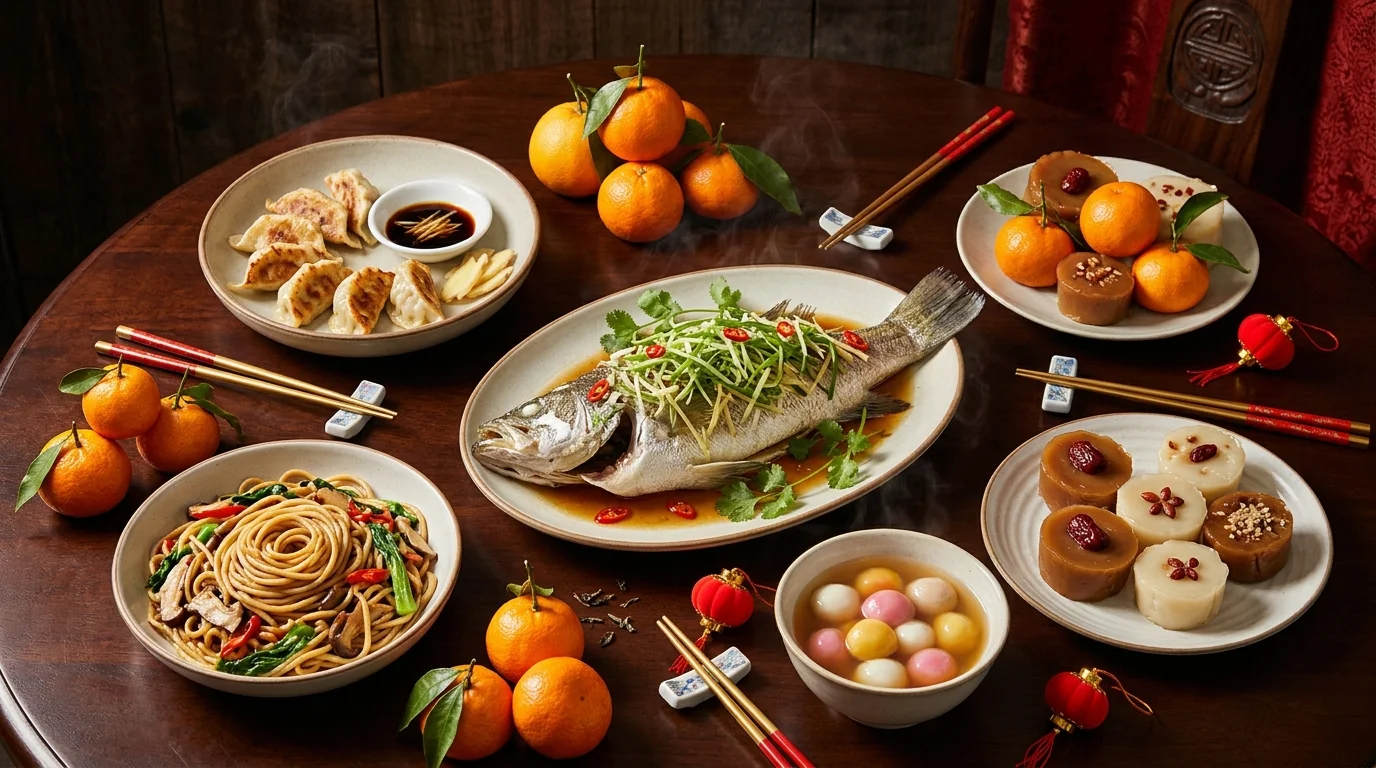
Nearly every dish on a Chinese New Year table is there for a reason that has nothing to do with flavour. Fish (鱼, yú) appears because the word sounds like 余, surplus. Sticky rice cake (年糕, niángāo) appears because gāo is the syllable used when an income or a position goes up. That is the mechanism, and it has a practical consequence for a guest: what matters at the table is usually what you say about the food rather than how much of it you eat. The festival itself (its dates, its other customs, its fifteen days) is covered in our guide to Chinese festivals; this page is only about the table.
Every claim below says where it came from: an inscription at UNESCO, a folklorist’s account of the New Year table, a 1,400-year-old diary of one region’s year, a 1900 account of Beijing households, and Singapore’s national heritage board. Two things that appear in nearly every English list are in none of those sources, and they are named at the end rather than quietly included. For the dates and the animal, see when Chinese New Year falls in 2027 and the twelve zodiac animals; for what not to do at the table, see Chinese New Year taboos.
The reunion dinner is the meal. The menu is secondary.
The strongest citation available for any Chinese New Year custom is not a tourism page. In December 2024 the UNESCO committee inscribed Spring festival, social practices of the Chinese people in celebration of traditional new year on its Representative List of the Intangible Cultural Heritage of Humanity (element 02126, decision 19.COM 7.b.29), and the text it inscribed is unusually specific about food: “In the days preceding the festival, people clean their homes, stock provisions and prepare food. On New Year’s Eve, families dine together and stay up late to welcome the new year.” The record names the whole run-up as one practice called 过年 (guonian, “crossing the year”).
The folklorist Wan Jianzhong puts the same weight on the same evening in plainer Chinese: the New Year’s Eve banquet 除夕宴 is the most abundant meal of the year, and its everyday name is 年夜饭, literally “year-evening rice”. Note what that term is built on. It is not a recipe; it is a dinner defined by who is at it.
The nearest thing the tradition has to an on-the-record account of that evening is 富察敦崇’s 《燕京岁时记》 (Records of the Seasons in the Capital, 1900), a book whose author insists at the end that everything in it was written from what he saw. His New Year’s Eve is all household and no menu: noble families sacrifice at the ancestral hall and hang the portraits, and after dark 合家团坐以度岁, the whole family sits in a circle to cross the year, with wine and dishes laid out, lamps bright, the women and children playing dice and card games until the hinge between the pig and rat hours, when incense goes out to welcome the gods down and people sleep in their clothes.
That book also carries the one dish that proves the point. Its entry headed 年饭, the same three characters now used for the reunion dinner, does not describe a dinner at all: “年饭用金银米为之,上插松柏枝,缀以金钱、枣、栗、龙眼、香枝,破五之后方始去之.” A bowl of gold-and-silver rice with sprigs of pine and cypress stuck into it, dressed with coins, dates, chestnuts and longan, and not removed until after the fifth day. It is food as a fixture, set out to be looked at and left there for most of the first week. In Beijing in 1900 the New Year’s rice was the dish you did not eat.
What you are allowed to call the food
The most useful thing in any of these sources for a guest is a rule about vocabulary. Wan records 讨口彩, literally “begging for a good line”, as table practice during the New Year’s Eve meal: certain items are not called by their ordinary names, because the ordinary name is a missed opportunity.
| On the plate | What it is called at the table | The wish in it |
|---|---|---|
| Dates (枣) | “春来早”, spring arrives early | An early start, not a fruit |
| Dried persimmon (柿饼) | “事事顺”, everything goes smoothly | The word for persimmon does double duty as “thing” |
| Apricot kernels (杏仁) | “幸福来”, happiness arrives | 杏 picked up as the near-sound of 幸 |
| Tofu (豆腐) | “全家福”, the whole family’s fortune | A dish renamed as a blessing on the household |
| Three-fresh vegetables (三鲜菜) | “三阳开泰”, three yang open the way | A New Year phrase borrowed from the Book of Changes |
| Peanuts (花生) | “长生果”, long-life nut | The older, auspicious name rather than the botanical one |
| Sticky rice cake (年糕) | “年年高”, higher every year | Sound, not ingredient |
| Sugarcane (甘蔗) | “节节高”, higher at every joint | The plant’s own segments as the image of a rising year |
Read the tofu row against the usual English list. China’s state-run cultural portal tells its readers that people eat vegetables and tofu “which will bring harmony and prosperity”, with no reason attached. Our reading is that the English sentence is a flattened copy of the Chinese rule: tofu does not symbolise family fortune in any botanical or culinary sense, it is called “the whole family’s fortune” out loud, at that meal, and the English writer recorded the attribute instead of the act. The difference matters practically. You are not avoiding tofu; you are not naming it plainly in front of a host who has planned the words.
The dishes and what they are supposed to bring
Fish
The portal’s version: fish plays a large role because 鱼 sounds like the words for wealth, abundance and happiness, so a fish is served at the end of the New Year’s Eve dinner, whole, with head and tail attached, for a good beginning and ending. Two institutional sources add a handling rule that contradicts the “eat it all” instinct. The Confucius Institute for Scotland says do not eat the head or the tail, because leaving some fish over from Eve into the next day means you will always have enough; Macau News Agency gives the same prohibition and quotes 年年有餘 as the saying behind it. Wan’s account is the other way round again (people eat a piece of the head or the tail, for 头尾都有余, surplus at both ends) while agreeing with everyone that the head and tail must not be skipped. The one handling rule all three support is Wan’s: in most regions you do not turn the fish over, because 翻 (flip) forecasts 翻车, overturning a cart or a boat. The contradiction over whether the head and tail are eaten or kept is genuine and is left standing here, not tidied away.
Dumplings
Food pages lead with three claims about jiaozi (饺子): that the word means the meeting of the old and new year, that the crescent shape recalls a gold or silver ingot, and that a coin is hidden inside one for luck. The portal states all three and dates the food at some 1,600 years, which nothing else in our source set corroborates, so the date is dropped. The practice is documented far better than the blogs suggest, because 《燕京岁时记》 records it on the first morning: 无论贫富贵贱,皆以白面作角而食之,谓之煮饽饽,举国皆然,无不同也, rich and poor alike eat a white-flour parcel called 煮饽饽, “the whole country does it, there is no difference”. Note that the Beijing book does not use the word 饺子 at all. And the hidden prize is real but was not a coin: wealthy households put small ingots of gold and silver, and gems, inside the dumplings to test the year’s fortune, and whoever bit one 则终岁大吉, had great luck for the rest of it.
Sticky cake and glutinous balls
年糕 is the southern festival food in the portal’s telling, sweet, sticky, made of rice flour and brown sugar, its name meaning “higher each year”, its roundness standing for family reunion. Beijing in 1900 used it as furnishing rather than dessert: the 天地桌, the long table set in the courtyard on New Year’s Eve for the gods, carried layers of honey offerings, apples, dried fruit, steamed buns, vegetables and 年糕, and the whole arrangement stayed up until the Lantern Festival. The round glutinous balls belong to the fifteenth day: the portal calls them yuan xiao or tang yuan and reads their shape as family unity and completeness, and 燕京岁时记, describing the capital’s lantern days, says of the market stalls that 市卖食物,干鲜俱备,而以元宵为大宗, dried and fresh goods alike, but the glutinous ball was the bulk of it.
Spring pancakes, radish and the five pungents
English lists put a fried spring roll on the New Year table because its shape resembles a gold bar. That single sentence is the whole of the evidence we can find for it; the portal says it, and no other source in this set repeats it. Meanwhile the actual documented festival wheat-and-radish custom belongs to a different day. Spring Day (立春) opens the solar year, and 《燕京岁时记》 has it: 是日富家多食春饼,妇女等多买罗卜而食之,曰咬春,谓可以却春困也, well-off families eat spring pancakes, and people buy radish to “bite the spring”, said to fend off spring grogginess. The older layer is a plate of five pungent things: the sixth-century 《荆楚岁时记》 records 下五辛盘 on the first morning, and its commentator explains why (五辛所以发五藏之气, the five pungents stir the five organs’ qi), then lists them (garlic, small garlic, chives, and two herbs) and quotes 《庄子》 on drinking wine and eating scallions in the first month to open the viscera. A spring roll is a shape; a five-pungent plate is a prescription.
Noodles
The portal is the source for the standard line that noodles stand for a long, happy life and that an old superstition forbids cutting them: the same reasoning as the fish rule, since you do not want the year’s length shortened on your plate. Nobody in this source set gives a New Year noodle by name; the 长寿面 claims we found belong to birthdays and to the ninth month. What the fifth-century text does give, in the same first-day sentence, is 胶牙饧, a malt-sugar sweet explained on the spot as 取胶固之义, chosen because it sticks and holds firm, with the compiler adding that northerners still do it.
Chicken, citrus and forced flowers
Chicken should be served whole, for family togetherness, in the portal’s account; its further claim that 鸡 sounds like 吉, good fortune, is a near-homophone at best, and is reported here as the portal’s rather than as a fact. Oranges and tangerines are the lucky fruit because their names sound like luck and wealth, and pomelo because its name sounds like “to have”. Beijing’s version of the festive table was more engineered: the 1900 book has an entry on 唐花, flowers forced by heat in closed rooms so that peonies and kumquat are in bloom and exchanged between households during the New Year fortnight, its own description being 牡丹呈艳,金橘垂黄, the peony showing colour and the golden kumquat hanging.
The prosperity vegetable it is illegal to pick
发菜, sold in English as fat choy or “hair vegetable”, is the Cantonese New Year ingredient whose name opens the standard greeting 恭喜发财. Wikipedia states the pun and, usefully, its limits: it works in Cantonese, and the second syllable is a different tone. The legal position is not on the blogs. In June 2000 the State Council raised 发菜 from a grade-two to a grade-one protected wild species and banned its gathering, purchase, processing, sale and export outright, authorising checkpoints on the roads into the grassland, because raking it was destroying the grassland and desertifying it. The same notice instructs press units to “纠正对发菜消费的不科学认识”, correct the unscientific notions behind eating it. That is a rare official statement aimed squarely at a food symbol, and it is why the black strands on a modern reunion table are usually a seaweed substitute; the study that tested Hong Kong retail samples found real 发菜 dark green and the counterfeit black.
What is not eaten
Only one food carries an actual prohibition in these sources, and two independent institutional pages give it with the same reasoning. The Confucius Institute for Scotland: “No eating porridge. In old times, only poor families would eat porridge, so in order to gather wealth in the coming year, do not eat porridge.” Macau News Agency states the same rule for the first day with the same logic, hedged with “seen by some”. Do not read it as a rule against congee. The season opens with one: 腊八粥 on the eighth of the twelfth month, whose ingredients the 1900 Beijing book lists one by one, several millets with rice, water caltrop grain, chestnuts, red beans and peeled date paste boiled together, then decorated with dyed peach and almond kernels, melon seeds, peanuts, hazel and pine kernels, sugars and small raisins. It carries a prohibition of its own (切不可用莲子、扁豆、薏米、桂元, never lotus seed, hyacinth bean, job’s tears or longan, they spoil the taste) and a timing rule a guest can actually breach: besides the offerings to ancestors and Buddha, the bowls are shared out to relatives and friends, and 不得过午, not after midday. So porridge is compulsory a fortnight before the New Year and unwelcome on its first morning.
What we could not find is the wider colour taboo that English lists attach to food. The black-and-white prohibition in both institutional sources covers garments, not dishes; nothing here bans white food, and tofu’s problem at the table is its name, not its colour. If you read that a plain-white bowl is unlucky, that claim has no source in this set.
The first-day menu, 1,400 years ago
Everyone writing about symbolic dishes is describing a modern list, and it is worth seeing what the oldest detailed description of a Chinese New Year table actually contains. 《荆楚岁时记》, compiled in the sixth century by 宗懔 in the southern region around the middle Yangtze, sets out the first morning at a single breath: young and old dress correctly, congratulate each other in order of seniority, and then 进椒柏酒,饮桃汤,进屠苏酒,胶牙饧,下五辛盘,进敷于散,服却鬼丸,各进一鸡子, pepper-and-cypress wine, peach-bark water, the medicinal Tusu wine, the sticky malt sweet, the five-pungent plate, a powdered herbal powder, a pill against ghosts, and one raw or poached egg each. It adds the drinking order, which is the point at which a modern guest is most likely to be surprised: 凡饮酒次第从小起: the wine starts with the youngest. The book’s own note explains both halves of one of the most repeated festival anecdotes, the toast given to the young first because 小者得岁, they are gaining a year, while the old are losing one and drink last.
Read the list again. No fish. No dumpling. No rice cake. Nothing in the oldest surviving New Year menu is there for a homophone; the egg, the powder, the pill, the wine and the five pungents are there to keep illness and ghosts off the household in the year’s opening days, and the text quotes medical and quasi-medical authorities for each of them, 正月旦,吞鸡子、赤豆各七枚,辟瘟气 and 旦及七日,吞麻子、小豆各十七枚,消疾疫. It also records one change of fashion in the same region: after the Liang court took to Buddhist abstinence from 荤, the people of Chu stopped eating the New Year’s egg altogether, 梁有天下,不食荤,荆自此不复食鸡子. A festival food was switched off by a court’s diet, which is the clearest evidence in this article that these customs are history rather than nature. And the compiler twice writes 未知所出, I cannot find where this comes from, about customs he is describing. His candour is worth keeping in view when a modern page states a reason with more confidence than the record allows.
Lo hei: the newest tradition on the table, and it is Singaporean
If the New Year table you are invited to is in Singapore, Malaysia or a Gulf city fed by those communities, the first dish will not be fish but yusheng, and the event around it is lohei (捞起, “toss up”). Singapore’s National Heritage Board documents it in full, including its age. The raw-fish dish itself is old, NHB traces written references to eating raw fish to the Zhou period, notes that it was popular enough in the Han for the poet 曹植 to praise it, and records that by the late Qing it had nearly died out in China and survived only around Guangzhou and Chaozhou, where fishermen of Jiangmen and Shunde ate a humble raw carp salad on the seventh day, the human birthday. The version now on every table was made in 1964 by four chefs at the newly opened Lai Wah Restaurant (Loke Yuke Pui, Than Mui Kai Yu, Hooi Kok Wai and Sin Leung, remembered as the Four Heavenly Kings), who produced a seven-coloured yusheng with peanuts and flour crisps, put it into New Year set dinners, and named variants 好运鱼生, 发财鱼生 and 鸿运鱼生. Grass carp went out of it because of the parasite risk; wolf herring and now salmon went in.
NHB is also honest about how the ritual arrived, which is the most instructive sentence in any of our sources: the four chefs paired auspicious phrases with some of the original ingredients, and “the customers themselves spontaneously associated other ingredients with their own auspicious phrases and well wishes”. As for the tossing, the board records a plausible origin without pretending it is settled: the platter was so large and hard to mix that diners stood to help the waiter, and this “somehow evolved” into standing up together as a celebration of togetherness. The published sequence, with what is said at each step:
| Added | Said out loud |
|---|---|
| Diners gather round the plate | 恭喜发财 (congratulations and great wealth; 万事如意) may every wish be fulfilled |
| Raw fish | 年年有余, surplus every year (fish and surplus are homophones) |
| Pomelo or lime | 大吉大利, great luck and great profit |
| Spices | 招财进宝, may wealth and treasure come in |
| Oil and plum sauce | 一本万利 (one part capital, ten thousand parts profit; 财源广进) may the sources of wealth flow wide |
| Shredded carrot | 鸿运当头, great fortune at your door (the red of the carrot and “great” are homophones) |
| Shredded green radish | 青春永驻, may youth stay forever (green and youth share a syllable) |
| Shredded white radish | 风生水起 (may you rise with the wind and water; 步步高升) promotion at every step |
| Crushed peanuts | 金银满屋, may your house fill with gold and silver |
| Sesame seeds | 生意兴隆, may your business boom |
| Golden flour crisps | 满地黄金, may your floor be covered in gold |
| Everyone stands and tosses, as high as they can | 捞起, toss it up! The higher the toss, the better the year’s prospects |
NHB records that Singapore kitchens now make halal, vegetarian, vegan and takeaway versions, with the fish replaced by strips of vegetable gluten. For a Muslim reader in Riyadh or Dubai who is invited to a New Year dinner, that is the difference between watching a ritual and joining it.
North, south, and one day apart
The portal draws the standard line (northerners eat jiaozi, southerners 年糕), and the 1900 Beijing book supports it for the capital. It supports a different split better: when the Kitchen God is sent off. That book gives the capital’s date as the twenty-third of the twelfth month and cites the imperial compilation 《日下旧闻考》 confirming that sojourning households from the south use the twenty-fourth, “as 刘侗 noted”. It says what the offering consists of too: 南糖, 关东糖 and candy biscuits, with a bowl of water and a handful of grass and beans, sugar for the god, fodder for his horse. Two regions, one festival, a day apart, in writing for three hundred years: treat any national statement about New Year food as one city’s opinion.
Sitting down as a guest: what is actually documented
Nothing here is a rule you can be fined for, but these are the practices with a source rather than a blog behind them.
- Wait for the ancestors. Wan records that at the New Year’s Eve meal the offerings go to the ancestors before anyone eats, and that a visitor arriving mid-meal is unwelcome because it disturbs the household. This is the one seating-and-timing rule in the set with a named source.
- Do not flip the fish, and do not clear it. Turn a fish and you have, in the picture the custom draws, overturned your own cart; leave some of it on the platter overnight, head and tail included. Two institutional sources give the second half, disagreeing only about which parts you may eat, see the fish section above.
- Let the youngest drink first. The order is 1,400 years old and it is a sign of respect, not a mistake: the young are gaining a year. Our taboos article gives the reasoning and the source.
- Stand up for lo hei and toss high. Shout the phrase with the rest of the table. It is the loudest moment of a Singapore or Malaysian New Year and sitting it out is the visible choice.
- Mind the chopsticks, not the menu. Our chopstick etiquette guide covers the five countries’ forms and the shared-plate rules that differ between them; eating at other people’s tables covers the wider setting.
- Bring fruit, not a plant. Citrus is the correct gift on every source in this set; see red envelopes for what else belongs in your hand, and Chinese customs for the greeting that goes with it.
Quick answers
What do people eat at Chinese New Year? On New Year’s Eve, the most abundant meal of the year, called 年夜饭, with the family sitting down together, UNESCO’s inscription names that dinner as the festival’s core practice. The common symbolic dishes are a whole fish, dumplings in the north, sticky rice cake in the south, glutinous balls at the Lantern Festival, citrus, chicken served whole, and in Singapore and Malaysia a raw-fish salad tossed at the table.
Why is fish served whole, with the head and tail? For a good beginning and ending to the year, and because 鱼 sounds like surplus. The sources disagree about eating those ends: leave the fish partly uneaten, all of them say; never turn it over.
Why hide a coin in a dumpling? To read the year’s fortune off whoever bites it. The practice is documented in 1900 Beijing, where what went inside for well-off households was a small gold or silver ingot or a gem, not a coin; the coin version is what the modern English sources describe.
What should you not eat at Chinese New Year? Plain porridge on the first morning, in two independent institutional accounts, because it was the food of a household with nothing else. The first day is not the twelfth month: Laba congee a fortnight earlier is expected, and given away before midday.
Is lo hei Chinese? The dish is: raw fish salad, eaten around Guangzhou and Chaozhou, documented by Singapore’s National Heritage Board as nearly extinct in China by the late Qing. The version on the table and the shouting ritual are a 1964 Singapore restaurant invention that diners finished by writing their own phrases for the ingredients.
Sources
UNESCO, Intangible Cultural Heritage of Humanity Representative List, element 02126, “Spring festival, social practices of the Chinese people in celebration of traditional new year”, inscribed 2024 at the nineteenth session (decision 19.COM 7.b.29); the nominated text is China’s own description of the practice, credited to the Ministry of Culture and Tourism. Wan Jianzhong (万建中), “本土概念与方法:春节的禁忌与习俗”, 《群言》 2024 issue 1, published by the Research Center for Folklore Classics and Palaeography at Beijing Normal University, the source of the reunion-dinner naming, the fish handling rules and the whole 讨口彩 list.
《荆楚岁时记》 by 宗懔 (sixth century, Southern Liang), with the commentary attributed to 杜公瞻, read in full at zh.wikisource.org, which is also where the 五辛盘, 胶牙饧 and first-day egg passages and their quoted medical sources come from. 《燕京岁时记》 by 富察敦崇 (1900, Beijing), also at zh.wikisource.org, for 煮饽饽, 年饭, 破五, the Laba congee recipe, 元宵 as the lantern market’s bulk sale, 唐花, 咬春 and the twenty-third-versus-twenty-fourth Kitchen God note; it cites 《日下旧闻考》, 《帝京景物略》, 《燕都游览志》 and 《北京岁华记》 inside those entries. “Main dishes in the Spring Festival”, China Cultural Portal (en.chinaculture.org), 24 January 2005, for the north/south split and the homophone list. National Heritage Board Singapore, “Lohei, Our Way: Celebrating Togetherness, Tossing Up Abundance” (last updated 15 October 2020), for the dating, the four chefs, the phrase sequence and the halal and vegetarian versions. State Council of China, notice on banning the gathering and sale of 发菜 and curbing over-digging of licorice and ephedra, 14 June 2000, published by the Ministry of Ecology and Environment. Confucius Institute for Scotland, “Taboos During Chinese New Year”, compiled by Wang Qixia, and Macau News Agency, “10 things you shouldn’t do during Chinese New Year”, for the two food prohibitions. Wikipedia, “Fat choy”, used here only for the Cantonese pun and its tone, the luxury status and the counterfeiting study it cites (But et al., Journal of Applied Phycology 14:2, 2002), which is a weaker tier than the rest of this list and is flagged as such.
How we checked this
Four things changed between the draft and this version, all of them from reading the primary texts rather than the lists. The symbolic dishes turned out to involve a rule about naming: these sources do not say a dish carries a property, they say the table renames it, which is why the tofu row in that table replaced a sentence about tofu symbolising harmony. The dumpling’s hidden prize is not a coin in the 1900 record but a small ingot or a gem, and the book never uses the word 饺子. Biting spring, spring pancakes and raw radish, belongs to the solar Spring Day, not to New Year’s Day, and the sixth-century text has no spring roll at all. And the fifth-day limit that English taboo lists describe vaguely as “the taboos loosen” has a name and a rule in a dated source: 初五日谓之破五,破五之内不得以生米为炊,妇女不得出门, which is also why the 年饭 bowl sits untouched until then.
Five claims did not survive the source set and are not in this article. That dumplings are 1,600 years old appears only as an undated sentence in one English-language portal. That a fish head should be pointed at the guest of honour appears nowhere: the sources regulate turning the fish and eating the ends, not its orientation. That certain numbers of dishes are lucky, that white foods are inauspicious, and that the monster frightened off by light, noise and staying up is called 年 do not appear in any source here; the two institutional accounts that name a creature at all both call it 祟 (Sui), and the Macau piece gives its own legend for the practice rather than a Nian story. The “spring roll as a gold bar” line is kept, but attributed to a single 2005 page, because that is the whole of the evidence.
