
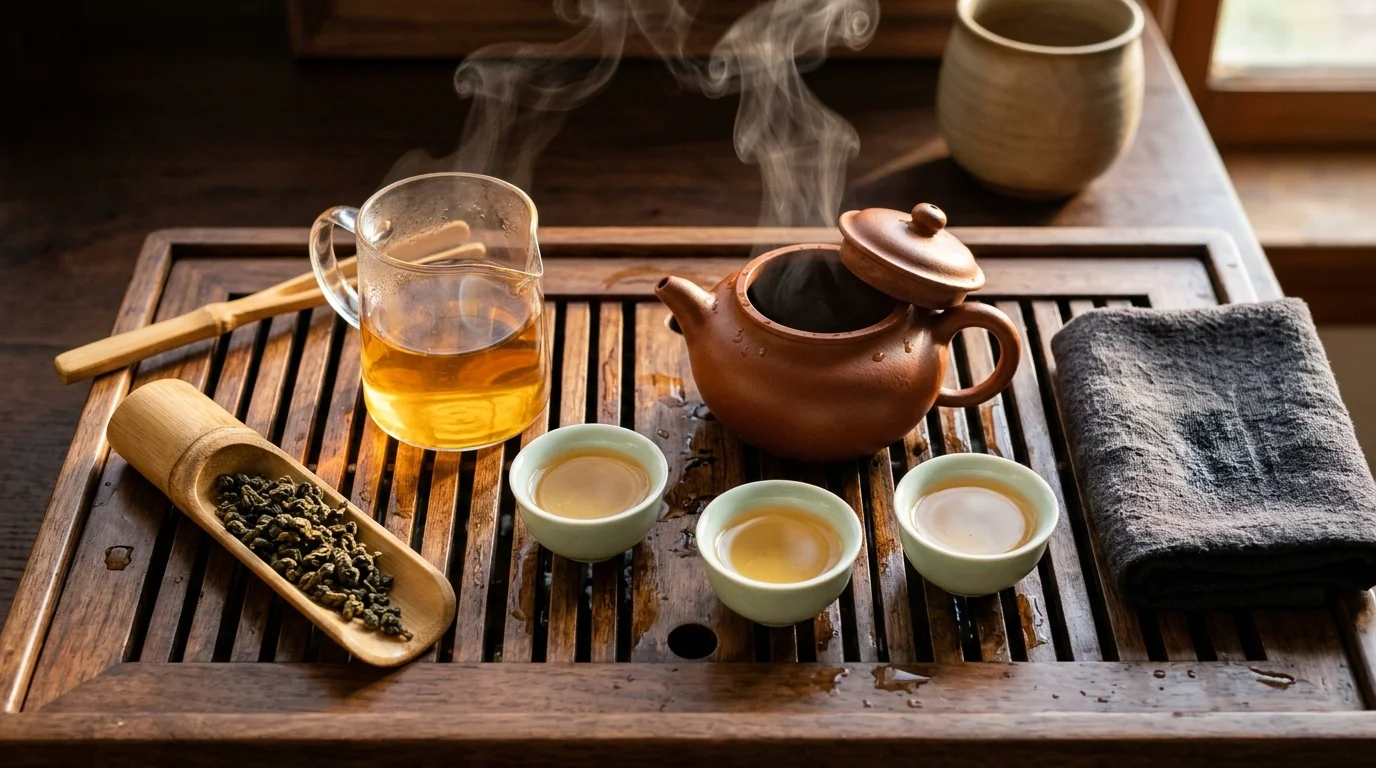
“Chinese tea ceremony” is not one thing. In most English usage it means 工夫茶 (gongfu cha): the way tea is made and served in Chaozhou, Shantou and the Fujian towns next door, a small clay pot, a handful of oolong leaf, very small cups, and a sequence of rinses, pours and sniffs that a household runs through several times a day rather than on ceremony. This guide is about that practice: the steps in order, the equipment, the finger-tap you owe the person who pours for you, and how much of it is genuinely old. For the wider culture it sits inside, start with our guide to Chinese culture.
One warning before anything else. Almost every English article on this subject recites a list of steps, and no two lists agree. That is not sloppiness. There are several real lists, published by different bodies for different purposes, and this article gives you four of them side by side, with the name of whoever publishes each. Numbers are meaningless without owners, so we will not say “the eight steps” without saying eight steps according to whom.
What the English phrase is translating
汉语 has two written forms of the same spoken word, gōngfu: 工夫茶 and 功夫茶. The 汉典 dictionary treats them as one word: its 工夫茶 entry closes 也称”功夫茶”, also called 功夫茶, and its 功夫茶 entry carries a 工夫茶 sense with quotations of its own. Its English gloss for 功夫茶 is, plainly, tea ceremony, which is where the English phrase in your search box comes from. That dictionary entry is worth pausing on, because it means the most common English name for this practice is a back-translation of a word that names an everyday habit.
The two characters also explain the collision with martial arts. 汉典’s first sense of 功夫 is 武术技能, glossed in its own English as the skill of Chinese boxing and swordplay, and its translation list carries kungfu; its second and third senses are the time and energy an activity costs, and attainment or cultivation, and for those it notes 也作”工夫”, also written 工夫. 工夫 itself is glossed as time, the human effort an activity consumes, and a competence learned by training. The tea word belongs to the second family, not the first. In the words of Lawrence Zhang, writing in Gastronomica in 2016, gongfucha “has no real English translation aside from the literal”, making tea with effort or skill.
Zhang adds a second thing worth holding on to: “to non-Chinese, this type of tea brewing is often simply introduced as the Chinese tea ceremony.” That is the whole problem in one line. The English phrase flattens a regional method into a national ritual, and then lends the practice a fixed, numbered form that the older Chinese texts never claim for it. Zhang’s own comparison is to Japan: a beginner’s manual for sencha, he notes, lays out a first tea ceremony in fifty-two steps.
Three ceremonies, one label
Gongfu cha, the household method. The national inventory of intangible cultural heritage describes 茶艺(潮州工夫茶艺) as a tea-brewing technique of the Chaoshan area of Guangdong (our translation, as with all Chinese rendered in this article unless a source’s own English is quoted), and names its other outstanding feature bluntly: besides the brewing itself, 以乌龙茶为主要茶品, oolong is its principal tea. This is the daily practice, and it is what this article covers.
茶艺 (chayi), the performed “art of tea”. A stage version, with a choreographed body, a designed table and an audience. It is younger than anyone admits. Zhang’s paper is specific about the word itself: 茶艺 “is a neologism without historical background”, and neither the 汉语大词典 of 1989, the Chinese equivalent of the Oxford English Dictionary, in his description, nor the Taiwanese 中文大词典, published in 1968, has an entry for it. A mass-market dictionary published later does.
Wedding tea. A different ceremony with a different grammar: the couple kneel and serve. The English-language culture portal en.chinaculture.org describes it in one sentence, “in a traditional Chinese marriage ceremony, both the bride and groom kneel in front of their parents and serve them tea. This is a way of expressing gratitude to their elders for raising them up”, and China National Tea Museum in Hangzhou keeps a page on it. We treat it separately below rather than folding it in.
The steps, in the order the official record gives them
The Chinese government’s own heritage site (中国非物质文化遗产网, run by the 中国非物质文化遗产保护中心 under the Ministry of Culture and Tourism) publishes a record for the Chaozhou item as Ⅹ-107, project number 1014, inscribed in the second national batch in 2008, applied for by Chaozhou city, with the 潮州市文化馆 (Chaozhou Cultural Centre) as its protecting unit and 叶汉钟 listed against it as its named inheritor. That record is the closest thing to a definitive sequence, and it names its stages in this order. Ours are the translations; the record supplies no glosses.
- 茶具讲示, show and name the ware.
- 茶师净手, the tea-maker washes their hands.
- 泥炉生火, light the clay stove.
- 砂铫掏水, draw water into the kettle; the record glosses 砂铫 itself as 煮水器具, the vessel that boils the water.
- 榄炭煮水, bring it to the boil over olive-pit charcoal.
- 开水热罐, scald the pot.
- 再温茶盅, then warm the cups.
- 茗倾素纸, tip the dry leaves onto plain paper.
- 壶纳乌龙, load the pot with oolong.
- 甘泉洗茶, rinse the leaves.
- 提铫高冲, lift the kettle and pour from high.
- 壶盖刮沫, scrape the foam off with the lid.
- 淋盖追热, pour over the closed lid to hold the heat in.
- 烫杯滚杯, scald the cups and roll them.
- 低洒茶汤, pour the liquor low.
- 关公巡城, Guan Gong patrols the city: the pot travels in a circle over the row of cups.
- 韩信点兵, Han Xin inspects the troops: the last of it is distributed drop by drop.
- 敬请品味, offer the cups.
- 先闻茶香, smell before you drink.
- 和气细啜, sip slowly.
- 三嗅杯底, three sniffs of the empty cup.
- 瑞气圆融, the close.
Two honesty notes about that list. It is introduced by 主要由 … 等多个环节组成, “made up of stages including“, so even the official record declines to call it complete. And the record puts no numbers on it; the ordering is the order of writing, which we have kept. Now the part nobody else does: those 22 stages are not the only published sequence.
| Sequence | Whose it is | What it actually contains |
|---|---|---|
| 22 named stages | The national intangible heritage record Ⅹ-107, on the Ministry of Culture and Tourism’s own heritage site | The list above, unnumbered, hedged with 等 (“and so on”) |
| 四段十六式, sixteen moves in four rounds | The tea programme at 广东省粤东技师学院, reported by 人民日报海外版 (People’s Daily Overseas Edition) on 8 May 2023 | 备茶 (prepare): 净手净心,活火活水,热罐热盅,纳茶鉴茶 · 洗茶 (rinse): 砂铫高注,甘泉洗涤,清风拂面,乌龙入海 · 冲茶 (brew): 高山流水,狮子戏球,关公巡城,韩信点兵 · 请茶 (serve): 尊礼敬茶,观色闻香,品茗啜味,嗅底审韵 |
| Eight heads | 潮州市侨联, the Chaozhou federation of returned overseas Chinese, on a gov.cn domain | 治器、纳茶、候汤、冲茶、刮沫、淋罐、烫杯、酾茶, with 治器 itself split into six actions: 生火、掏火、煽炉、洁器、候水、淋杯 |
| Six actions in three sentences | China National Tea Museum, Hangzhou (国家茶叶博物馆) | “The first step is to warm the pot and cups, and then fill the tea leaves with 70% of the pot. The water has to be poured at a high place, while tea soup is distributed at a low place. Foams are scraped, and lids are rinsed.” |
Read the columns against each other and they agree on the mechanics and disagree on the granularity: 22, sixteen, eight or six, depending on whether you are writing a heritage file, teaching a class, describing a household or talking to a foreign visitor. One caveat on the sixteen: the newspaper prints the rounds and their moves without a break between them, 纳茶鉴茶洗茶, so splitting the text into four named rounds of four moves each is our reading, forced on us by the phrase 四段十六式 itself. The four moves the sixteen-step programme keeps in its third round (high stream, the lion playing with a ball, Guan Gong, Han Xin) are the brewing itself, and that is the part worth memorising.
The equipment, piece by piece
The best single inventory we found is the one a native body publishes: the Chaozhou 侨联 page, which counts a set of ten-odd kinds. In its account the pot is called 冲罐 in the local dialect, or 苏罐 because it comes from 江苏 (Jiangsu), specifically Yixing purple clay, and the smallest size it makes; the criteria for a good pot are given as a four-character formula, 小、浅、齐、老, which the page does not gloss, and the test it does explain is 三山齐: laid upside-down on a table with the lid off, spout, rim and handle must sit level. The named makers collectors prize are 孟臣, 铁画杆, 秋圃, 萼圃, 小山 and 袁熙生.
The cups run on their own four characters, 小、浅、薄、白 (small, shallow, thin, white), with the reasoning supplied in the same breath: small so one sip empties it, shallow so no water stands at the bottom, white so the liquor shows, thin so the aroma lifts. Chaozhou drinkers prize the blue-on-white cup, flat-bottomed and wide-mouthed, marked 若深珍藏 on the base. Beyond pot and cups the set continues: a 茶洗 rinse-bowl as big as a bowl, of which a proper outfit has three, one to steep the cups in, one for the pot, one for the rinse-water and spent leaves; a 茶盘 tray, 宽、平、浅、白; a smaller 茶垫 mat under the pot, shallow in summer and deeper in winter so that the scalding water poured over the pot has somewhere to sit, lined with a 垫毡 cut from dried loofah rather than cloth, because cloth holds smells; a water bottle and a water basin; the 红泥小火炉, the long red-clay stove six or seven 寸 high with a narrow deep coal-pit and its own little door and lid; and the 砂铫, a sand-clay kettle called colloquially the 茶锅, of which the most esteemed come from 枫溪 in Chao’an, whose lid begins to rattle and sing as the water comes to the boil.
The Chaozhou page backs its own inventory by quoting the Qing account at length, including 先将泉水贮罐,用细炭煎至初沸,投闽茶于壶内冲之, store the spring water in the jar, bring fine charcoal to the first boil, put Fujian tea in the pot and pour onto it; then cover, pour over the whole lid, and only then 斟而细呷之, sip it out in small drafts. The full text survives separately, and it is worth comparing: in the Wikisource edition the same vessel is a 鐺 rather than a 罐, and the sentence that the modern page drops is the one about the cups, 杯小而盘如满月, the cups small, the tray round as a full moon. The page then notes, without embarrassment, that nowadays nobody is that fussy: “再不像过去一定要用优质木炭或者榄核炭和泥炉来烧水.”
Two familiar pieces are missing from that list, and that is a fact worth knowing rather than a gap in our source. The tall 闻香杯 (aroma cup) you will be shown in tea shops, and the 公道杯 (fairness cup) you will be shown decanting into, are not in the Chaozhou inventory and not in the Qing texts. Zhang’s paper calls them, precisely, “the most obvious Taiwanese modification” and “another innovation”, and dates their arrival in the standard kit: both “became part of the classic set of necessary teaware for serious practitioners in the 1980s”, and even now, he writes, the aroma cup is “somewhat less popular in the People’s Republic of China”. In Chaozhou itself, he notes, tea is poured directly into the drinking cup.
That leaves the object most English guides put at the centre of a Chinese tea ceremony, which is the gaiwan. It is real, it is old and it is not part of this set. 汉典 defines 盖碗 as 带有盖子而无把手的茶杯,通常配有杯托 (a lidded tea bowl with no handle, usually sitting on a saucer) glosses it in English as lidded tea bowl, and supports it with two quotations from 《红楼梦》, one of which has Daiyu carrying a 盖碗 of tea across to Grandmother Jia on a small tray. It is, in other words, a Qing-dynasty drinking vessel for a household like the one in the novel, and the saucer under it has its own name, 茶船, from a Qing miscellany of customs. None of the Chaozhou inventories above contains one, and neither does 俞蛟’s list of what is on the boat table. If a “Chinese tea ceremony” article shows you a handleless lidded bowl and no stove, it is describing a different tradition from the one this article is about.
What the older set was is documented twice over. A Qing Fujian miscellany, 施鸿保’s《闽杂记》, survives in the 汉典 dictionary’s quotation files with the line 漳泉各属,俗尚功夫茶。器具精巧,壶有小如胡桃者, through Zhangzhou and Quanzhou the custom favours 功夫茶, the ware finely made, with pots as small as a walnut. And in 1957 a Chaozhou native romanised by Zhang as Weng Huidong, who lived from 1885 to 1965, wrote what Zhang describes as the first treatise devoted to gongfucha at all; his utensil list (a small teapot, small cups, a dish, a kettle with its stove, a bowl for waste water, and a few small sundries) is, in Zhang’s words, “essentially the same” as a description written a century and a half earlier. The 1957 text was never formally published.
The finger tap: what to do when someone pours for you
This is the gesture visitors actually want to get right, and it has a written rule-book, though you should know who keeps it. The clearest version we found is on teaexpo.org.cn, the site of a Beijing tea trade exhibition whose organiser is a private exhibition company, 北京京港环球国际展览有限公司. It is a trade handbook, not a heritage document, and we are treating it as one. Its name for the gesture is 叩手礼 or 叩指礼, and the explanation it gives for the odd word is a pun: 以”手”代”首”,二者同音, the hand stands in for the head, because the two characters sound alike. The 汉典 dictionary confirms what the head would have been doing: 叩首 is 跪下磕头, kneeling to knock the forehead, its 国语辞典 sense 伏身跪拜,以头叩地, “prostrating so that the head touches the ground”, which it calls 古代的最敬礼, the supreme salute of antiquity, with 三跪九叩首, three kneelings and nine knockings, as its example.
The trade handbook then sets out three versions, and the version you use depends on who is pouring relative to you:
- Junior to senior, or subordinate to superior. The whole hand closed into a fist with the palm of the fist turned down, all five fingers striking the table at once. The handbook says this stands for 五体投地跪拜礼, the full prostration, and that three taps will do in ordinary use, three bows.
- Between equals. Index and middle fingers closed together and tapped on the table, which stands for the cupped-fist salute made with both hands. Again three taps, which the handbook explains as showing respect for the other person.
- Senior to junior. One finger, index or middle, taps once. This stands for a nod. The handbook allows three taps if the elder is particularly pleased with you.
So the two-finger tap that English guides describe as the Chinese gesture is the peer-to-peer one. Doing it to an elder, in the handbook’s own logic, is doing the salute a colleague owes you.
As for where it came from, the story you will be told involves the Qianlong emperor travelling incognito, and the honest answer is that it is a story. 南方+ ran a piece on 27 February 2019 headed 关于”叩指礼”的由来,你知道吗? the piece is carried under the name of a branded tea account, T三有机茶, and 南方+ appends its own disclaimer that such a post is published by the account and does not represent the platform. It labels each of its two versions as 传说, legend, before telling them. In the first, a tea-house owner pours in three unbroken nods to the cup, the emperor asks why, is told it is the trade’s own rule and is called 凤凰三点头, then seizes the kettle to try it himself into his eunuch’s cup; the eunuch cannot kneel and shout 万岁 in a room full of strangers without unmasking his master, so he taps the table with his fingers instead, the page’s words are 以”叩手”来代替”叩首”. In the second, the incognito emperor plays host and pours for a local prefect, who bends index, middle and ring fingers and knocks three times to stand for 三跪九叩. Note that the arithmetic does not match the handbook above, which gives three taps for the full nine and five fingers for the prostration; folklore is looser than the trade. The article ends by admitting that some of its text and pictures came off the internet. That is the actual state of the evidence: a real custom with a real pun, attached to two stories that every reteller marks as folklore.
Being the guest: the rules that are actually written down
Some of what a visitor is expected to do is recorded by the same bodies that record the steps, and a good deal of it is more interesting than the finger-tap.
Which cup you may take. Chaozhou’s 侨联 page is unusually explicit. Tea is poured out and the pourer does not drink first, 冲茶者自己不先喝, the cup goes to the guest or to someone else at the table. If three cups are on the tray, the order of taking them matters: you take the one nearest your reaching hand, and the middle cup belongs to the last person served. Help yourself to the middle cup before the outer two have gone, and the page says what it means, disrespect to the host, and disrespect to everyone else at the table. After your cup, you wait until everyone has had one before a second round is poured.
When the tea gets changed. Same source, same paragraph: if a guest of standing arrives while you are drinking, the leaves come out and the round starts again. If you are that guest, understand that you are interrupting a service, not joining one.
How much goes in the cup. 茶倒七分满, fill it seven parts in ten. The tea trade explains the spare three as room for feeling, and for taking advice; the practice has an obvious physical reason too, since the water is at a rolling boil and the cup, in a Qing description, is the size of a walnut. A cup arrives short by design, and brimming one is the error rather than the courtesy.
How the cup is offered. The trade handbook: two hands, the tray or cup-bearer brought up to chest height, offered from the guest’s right side with the right hand, with eye contact and 请用茶, “please have some tea”. Serve the highest-ranking guest or the eldest first. Hold a handled cup by the handle only and a handleless one low down; never touch where your guest’s mouth will go. Never lift a pot or cup by its rim with all five fingers. Lay a lid down with its rim facing up, never resting on its mouth. And hand the cup to someone on your left with your right hand, to someone on your right with your left, never with the back of your hand toward them, which the handbook reads as refusal.
Two things you must not do to the pot. Do not leave its spout pointing at a guest; the handbook says this means 请客人离开, you are asking them to leave. And if you are the one pouring in a circle, the direction is not free: turning counter-clockwise with the right hand (or clockwise with the left) reads as 来!来!来 (come and look, come and taste; the opposite direction reads as 去!去!去) go, go, go. The handbook’s own summary of this whole class of rule is worth quoting as the principle behind it: 沏茶时应处处从方便他人来考虑, when you make the tea, think of everyone else’s convenience at every step.
Salutes you may see instead. The same handbook lists a bow used to open and close a performance, in standing and kneeling forms and three depths, 真礼 between host and guest, 行礼 between guests, 草礼 around a remark; an open-palm gesture, 伸掌礼, four fingers together and hand slightly hollowed, extended beside the object being offered while the body inclines and the head nods, meaning both “please” and “thank you”; and 注目礼, a fixed forward gaze for solemn moments, stand straight, chest lifted, eyes front, hands at the sides, with no leaning, no slouching and nothing in the pockets. Two people facing each other may both extend the right hand, the handbook says, each showing respect to the other; so if a cup reaches you palm-up from someone who has just inclined their head, the courtesy is complete and the same gesture back is all it asks.
The wider manners of a Chinese table (seating, toasting, who pays, the shared dishes that tea is served around) are a separate matter, and we cover them in our guide to dining etiquette while travelling and, for the home-visit version, Chinese customs for visitors. One overlap is worth flagging here: 汉典’s 国语辞典 entry for 工夫茶 resolves, in its second sense, to a cross-reference, 一种发酵过的茶。参见「红茶」条, “a kind of oxidised tea; see the entry for 红茶”. In other words, a dictionary is warning that if you write gongfu tea, some of your readers will hear an entirely different kind of leaf.
Which tea, and why it is an oolong
The heritage record singles this out as the one feature of Chaozhou brewing apart from the procedure itself: 以乌龙茶为主要茶品. The Hangzhou museum, in its English page, is more specific about the cup: oolong “is also known as Kung Fu Tea in Fujian, Guangdong, and Taiwan”, the water should come from a spring or a well, and “the tea is preferably Tieguanyin, which is semi-fermented, baked, and shaped”. Chaozhou’s own answer is 凤凰单丛, the dancong oolongs of Phoenix Mountain, which rises on the borders of Raoping, Fengshun and Dapu and carries its best tea above a thousand metres, in cloud. The 侨联 page gives the local grading: within dancong the top quality is 乌岽, and the standard of the whole class is that its bushes are picked, first-processed and dried single-plant, one tree at a time, on dry cool spring afternoons between one and four, because picking in rain or morning fog loses the 香韵, the rhyme the tea is judged by.
Why an oolong and not a green tea? The Chaozhou answer is the climate. 潮汕工夫茶具有”杯小茶浓”的特点 (small cups, strong tea), and People’s Daily Overseas Edition attributes the shape of the habit to a hot, humid coast where a concentrated cup salivates and refreshes you while adding very little water. There is a historical reason layered underneath it, and it is visible in the oldest description: 俞蛟’s Qing account puts 闽茶, Fujian tea, into the pot, and remarks that the tea of Sichuan has not reached these waters for a long time, while what the boat households now prize is 武彜, Wuyi, the best of which costs two pieces of silver a 斤. The Chaozhou gazetteer quoted on the 侨联 page says the same thing from the other end: 粤素不产茶,所给皆闽产 (Guangdong has never grown tea worth supplying, and what was traded came from Fujian) with the local mountains only coming into production afterwards. If you want the economic version, the same paper cites the tea specialist 蔡泉宝 writing in 1996 that a Chaozhou household of three got through more than eight 斤 of tea a person a year, about a fifth more than a British drinker, which is why locals call the leaf 茶米, tea-rice.
How old is it, really?
You will find two answers in circulation: several thousand years, and a few hundred. The longer one has a source, and the source is a dictionary.
汉典 defines 工夫茶 as a custom of the Chaoshan region “即按陆羽《茶经》烹茶法所烹的茶”, tea made according to the brewing method of Lu Yu’s Classic of Tea. The dictionary is not inventing this; it is copying the eighteenth century. The line it cites under 功夫茶 comes from 俞蛟’s《潮嘉风月》, and the text itself opens: 工夫茶,烹治之法,本諸陸羽《茶經》,而器具更有精致, the method of preparing gongfu tea derives from Lu Yu’s Classic, only the implements are finer. Chaozhou’s own 侨联 page repeats the claim, and so does a thousand years of Chinese habit of writing tea books under Lu Yu’s shadow. The trouble is that the claim is checkable, because we still have the book.
Lu Yu wrote in the eighth century; the Wikisource text of the chapter on boiling is headed with a note dating the composition between 760 and 780. Its method is: roast the compressed tea, grind it to a powder whose best grade is “like fine rice”, heat water through three recognised boils, 其沸如魚目,微有聲,爲一沸;緣邊如湧泉連珠,爲二沸;騰波鼓浪,爲三沸, skim and salt the water at the first boil, then ladle out a dipper at the second, stir the centre with a bamboo implement and drop the measured powder into the swirl, arrest it with the reserved water to raise a foam, then divide it among the bowls: 凡煮水一升,酌分五盌, a 升 of water to five of them, with the note handed down with the text allowing as few as three. Salt goes in. The tea is powdered. It is boiled, not infused, and it is drunk from a bowl, not a three-centimetre cup. There is no pot, because there is no leaf. And the chapter immediately after this one, listing what passes for tea where he lives, has a name for our method: leaves pounded and kept in a jar, 以湯沃焉, drenched with hot water, which he calls 痷茶, while the scallion-and-ginger brews around him are 溝渠間棄水, the water they tip out in a ditch.
The middle ages close the gap no further. Cai Xiang’s 《茶录》, presented to the throne in the 皇祐 years of the 1050s, is a handbook of ground, sifted and whipped tea: 碾茶 to grind it, 羅茶 to sieve it, 熁盞 to heat the bowl, then 環回擊拂, pour in a ring and beat it in circles until 面色鮮白, a white face, stands at the wall, which the book says is the best you can get: 著盞無水痕為絕佳. The 《大观茶论》 attributed to the emperor Huizong describes the whisk itself, the 茶筅, and insists the bowl be dark blue-black so the froth shows. This is the tea of the Song, and it is the tea Japan inherited. If gongfu cha “started in the Song”, as the heritage record says it did, what started was something else.
The practice you would recognise is Ming. Xu Cishu’s 《茶疏》 (thirty-nine short sections, printed after his death from a manuscript a friend carried out to be read in the spring of 丁未, 1607, three years after he died) describes a small pot, whole leaves, and a timing method no one had used before: cover, count three breaths, decant all of it into a bowl, pour it back to rouse the fragrance, count three more breaths to settle it, then serve. Its rules are recognisably the ones still taught (rinse the leaves, never leave liquor standing in the pot, one cup per person rather than passing cups around), and its limits too: 一壺之茶,只堪再巡, one pot, and one more round on it, because 初巡鮮美,再則甘醇,三巡意欲盡矣, the first pour is fresh, the second mellow, and by the third the leaves have said what they had to say. Even the imperial librarians, who summarised the book into the Siku catalogue, felt obliged to record that its chapter on choosing water mistakes a well on Jinshan for the Zhongling spring, 考證殊為疏舛.
Then, and only then, the word. 工夫茶 as a name for this method surfaces in Qing writing: 俞蛟 in the Chao and Jia rivers, 施鸿保 on Zhangzhou and Quanzhou, and, most vividly, 袁枚, whose 《随园食单》 was published in 乾隆五十七年, 1792. Yuan had hated Wuyi tea, “嫌其濃苦如飲藥”, until a visit in the autumn of 丙午, 1786, when monks and priests at Manting Peak and Tianyou Temple pressed it on him: 杯小如胡桃,壺小如香櫞,每斟無一兩, cups no bigger than walnuts, a pot no bigger than a citron, and no more than a 两 in each pour. He sniffed first, then tasted, then conceded that even Longjing, however clear, was thin beside it, and found that the leaves stood three floodings with flavour left over: 且可以瀹至三次,而其味猶未盡. If you have ever been told that the Chinese method is the one where the same leaves go three times, that is a 1786 temple visit. (The book this comes from is 《随园食单》, written at a Nanjing garden that sits squarely in the Huaiyang food world our Huaiyang cuisine guide covers, and its tea chapter is a list of what the author found drinkable, not a ritual.)
Lawrence Zhang’s 2016 paper pulls the threads together and lands on a date far later than anyone wants. Gongfucha “necessarily uses leaves rather than powder” and “was first mentioned in text during the Qing dynasty”. The claim of a thousand-year Chaozhou continuity has, he writes, “historical inconveniences”, not least reconciling the small cup and small pot with the whisked powdered tea that was the dominant trend from the Tang to the Yuan, roughly the ninth to the fifteenth centuries, whole-leaf brewing, in his account, not becoming mainstream before the fifteenth. And the national version of the custom is younger still: “this custom was first taken up by Taiwanese pioneers, repackaged as an element of quintessential Chinese culture, and then exported back to mainland China since the 1980s”, carrying with it “foreign elements of the Japanese tea ceremony, especially influences from sencha”, a borrowing that travelled inside the package it was repackaged as. His test case is the 茶席, which Zhang renders as “tea setting”, the arranged table of ware a guest looks at, and he shows it arriving from Japan. The older gongfu texts “are focused on the technical aspects of tea brewing”, and “authors such as Weng”, meaning the unpublished 1957 record of the Chaozhou method, “never mentioned how items should be placed in relation to each other on the table”; a beginner’s sencha ceremony in one Japanese manual, by contrast, runs to fifty-two steps.
None of this makes the practice fake. It makes it a nineteenth-century household craft that was formalised in the twentieth, nationalised in the 1980s and inscribed in the 2000s, and it means the oldest thing about it is the pouring, not the ceremony.
What the heritage listings do and do not say
Two listings get conflated constantly, including in Chinese state media.
The national one. 茶艺(潮州工夫茶艺)was added to the state inventory of intangible cultural heritage in 2008, in the second batch, under category 民俗 (folk custom) with the number Ⅹ-107. Its protecting unit is a cultural centre, not a museum or a school. Its record is candid about its own future: as life speeds up, it says, 大多数年轻人对工夫茶已不甚了解, most young people no longer understand gongfu tea, the traditional technique is being replaced by abbreviated brewing, and the item shows 衰退的趋势, a trend of decline, and urgently needs protection.
The UNESCO one. Chaozhou gongfu tea art was not inscribed on its own. It travelled as one component of a much larger Chinese nomination. The Ministry of Culture and Tourism reported on 5 December 2022 that “traditional tea techniques of China and associated social practices” had passed examination and entered the Representative List of the Intangible Cultural Heritage of Humanity at the committee’s seventeenth session, held in Rabat, Morocco; the ministry gives the moment as 29 November, Beijing time. That single file, the ministry says, covers 44 national-level projects drawn from 15 provinces, autonomous regions and municipalities, spanning green, black, oolong, white, dark, yellow and reprocessed teas and tea customs such as the 径山茶宴 tea banquet, and the Guangdong entry inside it is Chaozhou gongfu tea art. We could not read UNESCO’s own record page from this network, it serves a JavaScript challenge to plain requests, so every detail above is from the ministry’s file rather than from the organisation that kept the vote.
One consequence of the “44 projects” structure is worth knowing if you are trying to cite the honour: any Chinese tea page can now truthfully say it is UNESCO-recognised, and none of them means the same thing by it. What is also worth saying is that heritage status has, in Chaozhou, been spent on standardisation rather than nostalgia, the ministry’s own report lists, among the standards Chaozhou has written, a 团体 and 地方 set titled 《潮州工夫茶艺技术规程》, 《潮州工夫茶器四宝》 and 《潮州工夫茶少儿茶艺》, which are, respectively, a technical procedure, a list of four treasures, and a curriculum for children. The state has also, in People’s Daily Overseas Edition, quoted the bid white paper as finding in Chaozhou gongfu tea a spiritual content of 和、敬、精、乐, harmony, respect, precision, joy. The poet 张华云, quoted at the head of the 侨联 page, gives five characters instead, 和、爱、精、洁、思, and no one has reconciled them for us.
Gongfu cha and the wedding tea ceremony are not the same event
The overlap is real, a Chinese wedding tea service uses a small pot and small cups and the same two-handed offering, but the grammar inverts. In the household ritual the host pours and the guest taps the table. In the wedding ritual the couple kneel and the elders receive, and the point of the ceremony is the direction of the gesture, not the brewing. The Hangzhou museum gives the traditional reason for using tea at all: “tea is a symbol of purity, dedication, fortune, and many offspring. The Chinese ancients believed that once the tea seeds landed, they could not be transplanted. Therefore, tea is a symbol of unswerving love for one’s spouse.” (That is folklore about a plant, not horticulture, but it is the argument the custom is built on, and a national museum printed it.) And serving tea upward through a family is not confined to weddings: the same state portal says a younger person shows respect and thanks to an older one by offering a cup, that this is common at birthdays and during Spring Festival, and that in modern China “even the simplest dwelling has a tea set and a water heater for making a hot cup of tea.”
Four questions people ask before they sit down
Do I have to buy a tea set to be a guest?
No. But understand what is being offered: the Chaozhou page you will be reading off says the host will not drink first, and that a round is not yours to hurry. The minimum competent guest is a person who accepts the cup with two hands or with the right hand supported at the elbow, waits for the table, and taps once with two fingers if the pourer is their peer. Anything more than that is a bonus.
Is refusing a cup rude?
The written material is about how to give, not how to decline, so anyone who tells you there is a prescribed refusal is inventing. What the sources do establish is that the offer is a claim on your attention, tea is 敬, respect, and the host has just spent a kettle’s worth of it on you. If you will not drink, say so before the round begins rather than at the cup.
What is the difference between 工夫茶 and 功夫茶?
Spelling, mostly. The dictionaries cross-reference each other and the Qing sources differ by province: the Fujian miscellany writes 功夫, the Chaozhou-Guangdong account writes 工夫. If you want to be pedantic, write 工夫茶 for the tea and leave 功夫 to the martial arts, but expect to be corrected by someone with a sign that uses the other one.
Is this the same as the Japanese tea ceremony?
No, and the nearest institutional statement of the difference is Chinese. The state culture portal’s own summary is that unlike the world-famous Japanese ceremony, “the Chinese one emphasizes the tea rather than the ceremony, like the taste of the tea and the difference between various cups.” The reverse of that claim is Zhang’s: that the modern Chinese stage version borrowed its discipline from Japan (from sencha, the steeped-leaf counter-tradition to 茶道), which is why a fifty-two-step beginner’s sequence, a styled table and a choreographed body arrived in Chinese tea rooms at all.
Sources
Chinese, read in full: the record for 茶艺(潮州工夫茶艺) at Ⅹ-107 on 中国非物质文化遗产网 (ihchina.cn), the Ministry of Culture and Tourism’s report of the Rabat inscription dated 5 December 2022; the Chaozhou 侨联 page 潮州饮食习俗之工夫茶 on a gov.cn domain; 人民日报海外版, 8 May 2023, on Chaoshan gongfu tea and Cantonese cuisine; China’s culture portal en.chinaculture.org, “Serving tea: A sign of respect”, 7 July 2014; the tea-etiquette page on teaexpo.org.cn, dated 19 August 2021, whose organiser is 北京京港环球国际展览有限公司; 南方+, 27 February 2019, on the 叩指礼 legends. Primary texts read in the Wikisource full text: 陆羽《茶经》 with its 四库全书 catalogue note; 蔡襄《茶录》; 《大观茶论》; 许次纾《茶疏》; 袁枚《随园食单》; 俞蛟《潮嘉风月》. Dictionary entries: 汉典 for 工夫茶, 功夫茶, 工夫, 功夫, 叩首, 盖碗 and 茶船, including its quotation files, which supply the 《闽杂记》 line and the two from 《红楼梦》. English, in full: Lawrence Zhang, “Rescuing Taste from the Nation: Oceans, Borders, and Culinary Flows”, Gastronomica 16:1 (spring 2016), pp. 53 to 62, University of Hong Kong. Museum text: the English tea-ceremony pages of 中国茶叶博物馆, the China National Tea Museum in Hangzhou.
What we could not source
We publish these gaps so you can see where the confident sentences in other articles stop having evidence under them.
| Claim | Status |
|---|---|
| That the “four treasures” of Chaozhou gongfu tea are a specific list of four pieces | The standard 《潮州工夫茶器四宝》 exists, the ministry names it, but no reachable document enumerates its four. What we can show you is 张华云’s poem, which pairs 泥炉 with 榄核 charcoal, a boiling 薄锅, a 孟臣 pot and 若深 cups, and the 侨联 inventory, which runs to “ten-odd kinds” instead of four. We have not asserted a canonical four. |
| That you should drink the cup in three sips | Not in any source we could read. The number three in the official list attaches to 三嗅杯底, three sniffs of the spent leaves in the empty cup, and to 凤凰三点头, the three-nod pour. The three-sip rule may well be real practice; we could not put a name to whoever wrote it down first. |
| That what 关公巡城 and 韩信点兵 physically mean is a metaphor of equal strength | Actually sourced, and we kept it, but note the tier. The explanation comes from the Chaozhou 侨联 page (酾茶 four characters: 低、快、匀、尽, and 匀 “is what is called Guan Gong patrols the city, Han Xin inspects the troops… so that the colour is even across the cups, showing equal respect to every guest seated”). The national heritage record names the two steps without glossing either, and no dictionary has entries for them. |
| That the finger-tap dates to the Qianlong emperor | Legend. The single best-sourced version, in 南方+, labels it 传说 twice and credits its material to the internet. There is no document we could read connecting the custom to any emperor. |
| That 酒满敬人,茶满欺人 (a full glass honours, a full cup cheats) is a traditional saying | Cut. 茶满欺人 has no headword in 汉典, it is not on the tea-etiquette page that the phrase is usually credited to, and the seven-tenths rule we do cite is given an entirely different reason there. |
| That Chinese tea drinking is four or five thousand years old, from Shennong | Cut as history. The 神农 claim is Lu Yu’s own line in 《六之饮》, 茶之爲飲,發乎神農氏, repeated by a 2014 state-portal article. It is a third-century-BC author naming a mythical emperor, not evidence. |
| Why oolong in particular suits a small clay pot | Cut. Every source asserts the pairing; not one explains it. The closest thing to a reason we found is the Chaozhou explanation for strength (humid heat) and Yuan Mei’s observation in 1786 that Wuyi leaves gave up three infusions. |
| That the gaiwan’s three parts stand for heaven, humanity and earth (三才) | Cut. It is on tea-shop pages in three languages and in no dictionary we can reach: 汉典 has 盖碗, with a definition that never mentions three, and returns nothing at all for 三才碗 or 盖碗茶. The symbolism may be taught somewhere; we did not find the teaching. |
| Whether “始自宋代”, begun in the Song, has a document behind it | We could not find one. The phrase appears in the national record without citation, and the surviving Song tea manuals describe whisked powder in a dark bowl. We have reported the claim and the objection instead of choosing. |
| That gongfu cha spread to Southeast Asia because of Chaozhou emigration | Not asserted. The record says the practice 甚至流传到东南亚各地 (spread, by the mid-Qing, to places across Southeast Asia), and stops there; the agent and the route are not named. |
