
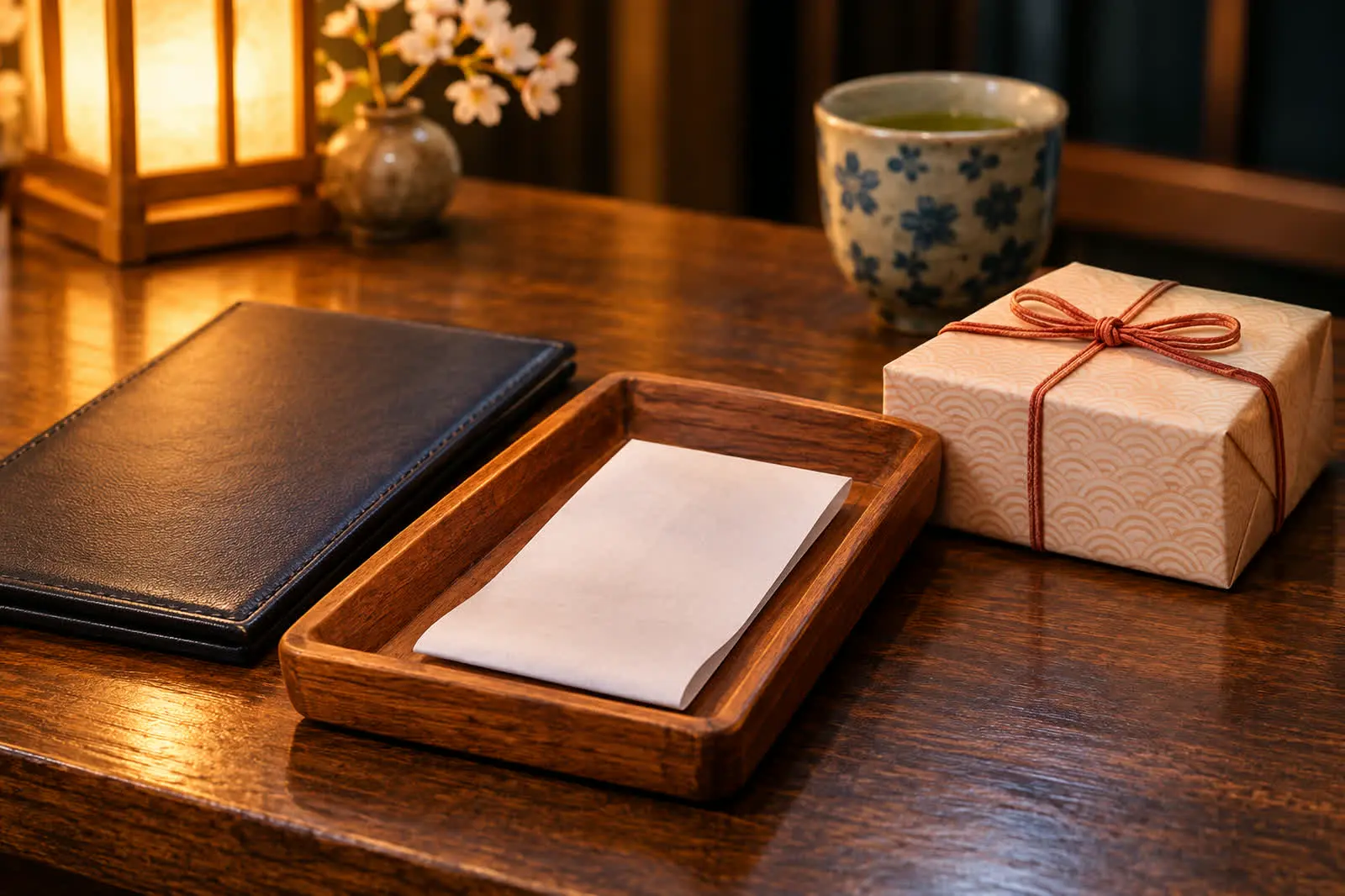
The Japanese ministry that handles tourism never told the world that tipping in Japan is rude. It told Japanese restaurants to state on their menus that the house runs a ノーチップ制 — a no-tip system — and supplied the English sentence for the point: “Tipping is not necessary.” That document is a government manual teaching food-service staff to look after foreign guests, and it is the closest thing to an answer the question has. In its pages, no tip is expected here, while American and Canadian diners leave fifteen to twenty per cent and German diners five to ten. Japan’s officials know precisely what a tip is. They ruled it out of the transaction.
The word you will be handed instead is “rude”, and this is the tipping companion to our guide to Japanese greetings. No official Japanese source we could find uses it. What exists is narrower and considerably more useful: a set of reasons why money handed over after a service cannot be processed — not by the person receiving it, not by the till behind them, not by the tax authority above both. It also separates the one question travellers ask — should you tip in Japan — into the four that are actually different: is it rude, will it be accepted, is it ever right, and what do I do with the gratitude instead.
Everything below was built from Japanese documents rather than from the English tipping pages it competes with. Every Japanese sentence in quotation marks is reproduced from a file we captured; every percentage is attributed to the institution that printed it. Where we could not find something, there is a section near the end that says so.
Should you tip in Japan?
No — and the short reason is not that it offends anybody, but that there is nowhere for it to land. In a restaurant, a taxi, a hotel or a shop, the price you paid is the whole of the transaction as far as the business is concerned, and staff are very often trained to refuse. Leave cash on a table and it will probably be chased after you. Press it on a driver and it is likely to come back as change you did not want to lose.
The exceptions are real, but they are narrow, they are not in restaurants, and in almost all of them the correct object is not a tip but a wrapped gift. And there is one situation in Japan where a gratuity carries a published legal rate, which has nothing to do with service: the money you owe a stranger who hands back something you lost. That rate gets a section below, because it is the single best clue to how Japanese institutions think about paying an individual for kindness.
| Where | The practice | What actually happens |
|---|---|---|
| Restaurants, cafes, bars | No. Never the default. | The bill already carries whatever it carries, and staff are trained to decline. Most attempts are turned down on the spot. |
| Taxis | No. Take your change. | Japan’s tax authority publishes a ruling on exactly this case, and it treats the money as consideration for nothing. |
| Hotels and ryokan | No, and the historical version was abolished. | What used to be paid separately to the room attendant is inside the room rate now, as a service charge. |
| Private guides and interpreters | The one case the national tourism body names. | Acceptable if they are used to overseas practice — discreetly, and in an envelope. |
| School trips, golf, movers, contractors | Yes, as a collected or wrapped 心付け. | Domestic practice with its own vocabulary, amounts and occasions. Not the traveller’s case. |
| Doctors, civil servants, police, examiners | Never. This one is criminal. | Money to a public official in connection with their duties is 贈賄 under the Criminal Code, and the giver is the one charged. |
What Japan’s official sources say, in their own words
Begin with the page a visitor is most likely to reach: the tipping article on Travel Japan, run by the Japan National Tourism Organization, the state tourism body. It is careful, and it is not the sermon the summary articles claim to be quoting. Its actual sentence is this: “it’s not common to tip for services such as those provided in bars, cafes, restaurants, taxis, and hotels.” Not common. Not rude, not forbidden, not an insult.
The same page then does what none of its competitors do — it concedes that a custom exists. “However, there is a custom in Japan of giving a gratuity, called” kokorozuke, it writes, romanising the word and glossing it as “coming from the heart”, “in some situations.” The situations it names are the ones a traveller can actually meet: “if you’ve engaged a private guide or interpreter accustomed to overseas practices, they may accept a tip as a gesture of gratitude.” And the instruction that follows is the operative one: “tipping is not expected and should be done discreetly, even in these cases. If you do decide to offer a gratuity, it is customary to put it in an envelope. You can purchase small cash envelopes at convenience stores, stationery stores, or 100 yen stores.”
One detail from our own testing belongs here. We requested that page’s Japanese and Arabic address paths directly, and both return the English article. The tourism body has written no tipping page for Japanese readers. There is nothing there for them to read.
The manual that tells restaurants to announce the absence
The deeper document is a manual issued in February 2008 by the tourism division of the Ministry of Land, Infrastructure, Transport and Tourism, titled 多様な食文化・食習慣を有する外国人客への対応マニュアル — a response manual for guests who arrive with different food cultures and eating habits. It runs to nearly two hundred pages, its purpose is to teach Japanese restaurant staff how to handle foreign diners, and it is where the phrase at the top of this article comes from. In the chapter on giving customers the right information before they order, it tells the establishment to consider a short note under the heading 日本の飲食施設のシステム, the Japanese food-service system, and lists what belongs in it: “税金の金額、ノーチップ制、お通しに別料金が発生すること” — the tax, the no-tip system, the cover dish that carries its own charge.
So the no-tip system is not folklore passed around by travel writers. It is one of four things a government ministry instructs restaurants to disclose to foreign customers, alongside tax and the price of the first dish.
Further along, near the back, the manual carries a foreign-language phrasebook with a block headed “税金、サービス料金、チップ” — tax, service charge, tipping — containing the sentences a restaurant should be able to say. Two of them are the ones that matter to you: “当店では、サービス料を必要としません”, with its printed English “No charge for service is made at this restaurant”, and then, as a numbered phrase of its own, “チップは不要です” — tipping is not necessary.
And the same document is the strongest available evidence against the comfortable claim that Japanese staff have never heard of tipping. It works through its guest nationalities one at a time and prints, as a bullet, whether the visitors come from a tipping country. The line チップの習慣はない — no tipping custom — appears for Korean, Taiwanese, Chinese, Thai, Singaporean and Malaysian guests, who are treated as sharing the Japanese position. The line for a tipping custom appears for Hong Kong and Italy, and for three countries it carries a figure: the United States at 全体の15~20%程度, Canada at the same, and Germany at 全体の5~10%程度. Across the eight Japanese public documents we assembled for this article, those three numbers and a service charge are the only percentages printed anywhere near a tip word. A ministry told the industry, in 2008, that American guests arrive expecting to leave a fifth of the bill — and the instruction for what to do about that was to state your own system clearly, not to accept.
What the tax authority says a tip is
The National Tax Agency publishes a standing collection of answered questions, and in its consumption-tax section there is one headed チップの支払. The question is whether tips given to drivers count as taxable purchases of services. The answer, dated on the page as current to 1 August 2025, is the most compact statement of the Japanese position we have found anywhere: “運転手等に対するチップは、運送等の役務の提供の対価の支払とは別に支出するものであり、提供を受ける役務との間に明白な対価関係は認められませんから、課税仕入れに該当しません” — a tip to a driver is spent separately from the payment for the transport service, and since no clear relationship of consideration can be found between it and the service received, it is not a taxable purchase.
Read that back as description rather than as tax law and it is exactly right about the experience. In Japan a tip is money that is not for anything. It buys no service, discharges no obligation and creates no claim. The revenue authority is not being pedantic; it is reporting the shape of the object. Which is also why a server cannot simply take it and put it in an apron: a payment that is for nothing has no line to go on.
Why it lands badly even when nobody is offended
The reason the gesture goes wrong is not sensitivity. It is that Japanese food service settled the problem of paying for kindness a long time ago, and the settlement was to put it on the bill.
The evidence for that mechanism is older and blunter than anyone expects. The slang dictionary that Weblio carries under the entry for 祝儀 — a compilation of Meiji-and-after thieves’ argot — defines the word as the fixed sum paid in Tokyo, over and above a geisha’s time charge and her box fee, and then adds the clause that explains the entire Japanese arrangement: “本来は客の「心づけ」の意味であつたが、今日では、勘定書に入れて公然と請求することになつて居る”. It originally meant the customer’s 心づけ; by the time that dictionary was written it was entered on the bill and openly invoiced. That is not a story about Japan being inhospitable. It is the story of a gratuity being absorbed into a price — which is precisely what the Japanese encyclopaedia article on the subject says happened: “日本では、このような慣習は廃れた、もしくはサービス料や商品代金として無意識のまま徴収されているため、一般にはあまり馴染みの無い習慣となっている”. The custom died out, or is collected without anyone noticing, as a service charge or a line in the price.
That explains the awkwardness you will actually meet. If your money is a thank-you for good service, the establishment has already billed something for that, so a second payment is not additive but contradictory: it implies the first one did not cover it, or that the person in front of you is being paid for something the price did not include. And in the many venues where the answer is that no such payment exists here, the staff have been trained accordingly — the encyclopaedia’s plain account of modern practice is that employees are instructed not to accept and that the overwhelming majority of attempts are refused.
There is a third friction, and the ministry manual documents it as a complaint. Its case file on service problems prints a real one: “お通しを提供する場合には、要求していない料理の金額が請求されたことに対して苦情を言うお客様がいる” — where a cover dish is served, some guests complain at being charged for a dish they never ordered. The manual’s remedy is disclosure: write the house system on the menu and explain it again before the meal. So the restaurant end of the counter is already anxious about unrequested charges appearing on a bill. A visitor adding an unrequested payment of their own invents the same problem from the other direction.
The words before the rule
The vocabulary is more informative than any etiquette column, because it records what Japanese has been trying to say about money and gratitude for centuries. Start with the word the tourism body romanises. 心付け carries two senses in Shogakukan’s デジタル大辞泉, and their order is the history of the idea. Sense one is not money at all: “気をつけること。注意。配慮。心添え” — paying attention, care, thoughtfulness, the attentiveness itself. Sense two is the cash: what you give a person who has looked after you, and the dictionary’s own synonyms for it are 祝儀 and チップ. The payment is named after the attention. JNTO’s “coming from the heart” is folk etymology, but it is pointing at the right thing.
チップ itself is a loanword and behaves like one. Its definition is unapologetically transactional: “サービスや芸などに対する慰労や感謝の気持ちとして与える少額の金”, a small sum given to acknowledge service or a performance, and its listed synonyms are 心付け and 祝儀 — the native words it has been absorbing. 謝礼 is the safe one, and it is broad enough to cover a word or an envelope: “感謝の気持ちを表すための言葉や金品”. 寸志 is the modest-giver’s word, a humbling term for your own gift and, in one dictionary’s gloss, the phrase written on the paper wrapper. 志納 is the concept visitors are usually groping for: paying what you feel, in a situation where neither the amount nor the payment itself is owed — a term the dictionary defines against temple offerings and admission fees, where the sum matches your 志. And 御礼, the ordinary word for thanks, has covered thank-you money as well as thank-you words for four hundred years.
Envelope, paper, and the bare-money rule
If there is one genuine etiquette rule surviving in this area, it is about the condition of the money rather than its existence. Cash that changes hands as a personal thank-you is wrapped. The encyclopaedia names this as the point of difference between Japanese practice and the Western tip: paper, or a 祝儀袋, or a ポチ袋. And the reason a loose banknote feels wrong is given as a rule of courtesy in its own words — handing over coins or notes directly is treated as “相手に対する非礼”, discourtesy to the other person. Watch what that does to the popular claim. What is rude is not the payment. It is the bare payment: money with nothing folded around it, in a culture that has a wrapper, a name to write on the wrapper, and a set phrase for the gesture.
The exception proves the shape of the rule. In a taxi, where there is no ceremony and no envelope, the same source notes that even when a passenger declines change and lets it stand as a tip, the money goes over bare, as it would in Europe. This is a sit-down rule, not a law of money.
What the ryokan was doing before it stopped
The reason every guidebook says something specific about ryokan is that something specific used to happen there, and the record is unusually good. Two payments ran side by side. “宿屋における茶代とは宿泊料とは別に帳場(宿主)へ客が与える金銭であり、心づけは部屋の女中や荷物係の下男などに与える金銭を指した” — the 茶代 went to the office, to the innkeeper, separately from the room charge; the 心づけ went to the woman who looked after your room and the boy who carried your bags. One tip, split between the house and the person.
How much? A manners book from 1940 set 茶代 at two to three 割 of the amount paid and the attendant’s 祝儀 at one to two — twenty to thirty per cent and ten to twenty, on top of the room rate. The same article records the former president of the Imperial Hotel, 犬丸徹三, describing the sum as freely given but in practice expected, sized by the rank of the inn, the dimensions and fittings of the room and the quality of the attendance — and that connoisseurs used to leave a 茶代 equal to the bill itself.
It was abolished by argument, not by law. The Meiji thinker 内村鑑三 treated 茶代 as a species of 賄賂 and preached its elimination. Novelists were complaining about the double standard before that: 村井弦斎 wrote in 1903 of diners who would fling fifty sen at a waitress in a Japanese restaurant and never give a Western one so much as a ten-sen coin. Inns began dropping the charge, or replacing it with a flat attendance fee scaled to the total, and the custom faded through the Showa period. There is even a structural explanation for how it started, attributed to the poet 萩原朔太郎: Edo-period travel regulations fixed inn charges and forbade overreaching, so inns took their margin from favoured guests under a name the rules did not touch — and, since the 茶代 was nominally the customer’s free choice, no regulation was broken. A gratuity as a price-control workaround. If that is where it came from, its disappearance once a price could simply state itself was never really in doubt.
Where you will be tempted anyway
Restaurants, izakaya and counters
Don’t. This is the one context where the tourism body and a government manual for the industry agree, and where every mechanism described above fires at once: a printed bill, a service charge that may already be sitting on it, staff trained to decline, and a tax treatment with no category for the money. Pay what the slip says, at the register rather than on the table. For the rest of the meal, which end of the chopsticks to eat from, how to take a shared dish, what to say when the food arrives, see our guides to chopstick etiquette and dining etiquette when travelling.
Taxis
The temptation is strongest here, because the fares are small, the door closes itself and somebody has clearly done you a kindness by driving at all. Take the change. The National Tax Agency’s chosen example of a non-tip is a tip to a driver, which tells you how ordinary the question is on their side of the counter, and the general account of the practice in the encyclopaedia is that passengers occasionally refuse change and that this counts as a tip in a broad sense — not that anyone is waiting for it. If a driver genuinely goes out of the way, say so, clearly, and let the meter be the meter.
Ryokan and hotels
This is where travel copy promises you a tradition, and where the history above should make you cautious. The 茶代 and the attendant’s 心づけ are documented, and so is their replacement: inns dropped them and took a stated attendance fee instead, which is what your room rate is now. The national tourism body lists hotels in the same sentence as restaurants and taxis when it says tipping is not common, and its advice for the exceptional case — an envelope — is exactly right for a ryokan, because the wrapping is the surviving half of the old custom. What is not right is the confidence with which visitors are told that the 仲居 is waiting for the money. She has been trained to hand it back.
Guides, drivers and interpreters
The one case JNTO names outright, and the one place where a tip will not cause a moment of confusion — provided the person is, in the agency’s phrase, “accustomed to overseas practices”. Notice how carefully that is written. The qualifying condition is not the length of the tour or the quality of the commentary; it is whether the guide works in a market where this kind of money exists. Discreetly, in an envelope, at the end, as thanks rather than as a settlement. For a Japanese-language guide working to Japanese rates, the reasoning that applies to a waitress applies to them.
Delivery apps, salons and everything else
Platform work is the one live edge, and the source that records the death of 茶代 is explicit that a courier’s kept change is a tip in the broad sense — which is why food-delivery apps built on overseas payment models show you a prompt that no Japanese shop ever will. Expect the interface, not the person, to be the thing deciding. As for hairdressing and beauty, we found nothing in the Japanese official material that addresses them at all; the tourism body’s list of places where you might feel the urge stops at bars, cafes, restaurants, taxis and hotels, and that is as far as anyone’s authority actually extends.
The exceptions that really are Japanese
Several customs of giving money to individuals did survive, and they are domestic, seasonal and named — which is why a visitor almost never runs into one. They are worth listing, because the articles claiming that tipping does exist in Japan are usually reaching for one of them without saying which.
- School trips. A 心付け for the coach driver and the bus guide is often collected in advance as part of the cost of the outing, rather than handed over on the day. This is the most common living use of the word, and it is a budgeted institutional payment, not a verdict on the driver’s performance.
- Golf. Caddies are sometimes given a 心付け individually, in an envelope, and the practice is associated with days when the players are mostly beginners or the round has to keep to a schedule — that is, when the caddie is doing more than the green fee covers.
- Movers and tradespeople. Households giving a removal crew a 御飯代 or a 御祝儀 — a meal’s worth, a small congratulatory sum — is recorded as a thing some customers do and not all, entirely at the customer’s discretion.
- Sumo teahouses and the rake market. At a stable restaurant the person who seats you is paid by how generously you give, and the record is blunt that better money buys better service and cheap money buys curt service. At the 酉の市 fair, the discount you haggled out of the seller is handed straight back to them as 祝儀, which the source calls the knowing way to buy.
- Mountain toilets. A number of public washrooms, typically at mountain tourist sites, run on an honesty fee and are known by a name that is not a euphemism: チップトイレ. The stated reason is the cost of waste handling and environmental protection, which makes it the one clean case in this entire subject — money handed over for a service with nobody there to receive it.
- Temples and shrines. Not a tip and not a gratuity, but the nearest thing a visitor will be offered: 志納, paying an amount matched to your own 志 where neither the sum nor the payment is owed; and 御礼, which the historical dictionary defines as the word for the money as well as the word for the thanks.
The one gratuity Japan puts a rate on
Japan has a statutory gratuity, with a published percentage band, an enforceable claim and a limitation period. It is called 報労金, a reward for the trouble someone has taken, and it is what you must pay a stranger who finds your property and gives it back. It is the best evidence we found of where this system actually puts its money, and it reframes the whole question.
Article 28 of the Lost Property Act sets the figure. A person whose property is returned must pay the finder a 報労金 of “百分の五以上百分の二十以下に相当する額” — between five and twenty per cent of the value of the item, or of the sale price if it was sold under the Act. Paragraph two handles the case that matters to a traveller, because in Japan you almost never hand a found object to its owner directly; you hand it to a station, a department store or a police box. Where a 施設占有者 — the operator of the premises — has taken delivery, the owner pays half the figure to the finder and half to the operator: “それぞれ同項に規定する額の二分の一の額の報労金を支払わなければならない”. The National Police Agency’s public flowchart for lost property does the same arithmetic in plain language: five to twenty per cent of the value, and at a station or a department store “お礼は施設と折半となるので、落とし物の価値の2.5%から10%となります” — the reward is shared with the facility, so the band halves.
The rest of the machinery repays reading, because it is a set of answers to the questions people ask about tips everywhere.
| Question | The Japanese answer, and where it comes from |
|---|---|
| How much? | Five to twenty per cent of the item’s value — a band, not a schedule. Article 28 and the police chart both say so, and the police chart adds that finder and owner settle the actual figure by discussion. |
| Is it optional? | No. The Act says the owner must pay. This is the only place in anything we captured where a gratuity is compulsory, and it is the one a stranger earned by not stealing your wallet. |
| Can it be declined? | Yes, and from both ends. A finder may declare in advance to the police station chief that they abandon every right in the object and are owed nothing for the bother. An owner may surrender their rights in the property and so escape both the costs and the reward. |
| Does it expire? | Yes. Article 29 kills the claim for costs and for 報労金 once a month has passed since the property went back. |
| Who may never take it? | The state. Article 28 paragraph three bars national and local government, incorporated administrative agencies, local independent agencies and other public corporations from claiming it at all. |
| And if nobody claims the thing? | The finder keeps it. Three months without an owner turning up and the property is theirs, subject to a two-month collection window at the police station and a long list of things — cards, identity documents, phones — they may never own. |
Hold on to that fifth row. When a Japanese public body is the one involved — a station operator, a national institution, a police box — the reward for the finder is switched off by statute. A system that fixes a rate for private kindness in one breath and forbids its own employees to collect it in the next has thought about precisely the thing the “just tip, it’s fine” columns tell you to wave away.
Where a thank-you becomes a crime
The strongest thing any of these sources says about giving money to someone who helped you is not about manners at all. The Japanese encyclopaedia article closes its section on Japan with the statement that a 心付け given to a 公務員 — a public official, a category its own text extends to national and public hospitals and universities — is a criminal act under the Criminal Code, and that the person handing it over is the one liable for 贈賄. That is consistent with the Code itself, which we read in the official consolidated text rather than in a summary of it.
Article 197 punishes a 公務員 who, in connection with their duties, receives, demands or promises 賄賂 with up to five years, and a heavier term where they were asked to do something; paragraph two catches someone who takes it before entering office. Article 197の2 covers directing the payment to a third party. Article 197の3 raises the penalty to a fixed term of not less than one year where the official acted improperly, or failed to act, because of it — and catches ex-officials for things done while they served. Article 197の4 is the brokerage offence, and 197の5 provides for confiscation. Then 第百九十八条 is the giver’s own crime: up to three years, or a fine of up to ¥2.5 million.
Definition is the interesting part, and it is missing. Article 7 of the Code exists to define terms, and what it defines is 公務員 and 公務所 — who counts as an official and what counts as an office. It does not define 賄賂. The word appears eight times in the bribery articles and nowhere in the definitions article, so what qualifies is left to the courts. That is why nobody, in any country, can hand you the figure at which a bottle of whisky becomes a felony.
Above the criminal law sits an administrative rule that reaches further, and it is the closest thing Japan publishes to a standard for what an official may accept as a gesture of thanks. Article 5 of the National Public Service Ethics Code forbids a staff member from receiving hospitality or property beyond what ordinary social convention would consider reasonable — “社会通念上相当と認められる程度を超えて供応接待又は財産上の利益の供与を受けてはならない” — and applies that even to businesses that have no dealings with them. Its second paragraph has no counterpart in any Western tipping guide: an official may not make a party who was not present at the transaction pay, as their burden, for goods, property or services the official received. And the Code’s own trigger is 社会通念上 — according to social convention. Which is an elegant way of saying that the test applied to the official is the same undefined thing the tourist has been trying to find out.
Service charge, cover charge, and the line you already paid
Most of the confusion in this subject is a billing question wearing an etiquette costume. Three different charges appear on Japanese restaurant bills, and only one of them is anything like a tip.
| On the bill | What it is | What to do about it |
|---|---|---|
| サービス料 | A service charge stated as a percentage of food and drink. The ministry’s model sentence is “当店では、総飲食額に10%のサービス料を申し受けておりますので、ご了承下さい。なおチップは不要です” — ten per cent is charged, please understand, and no tip is needed. | Nothing. It is the tip, invoiced. If a percentage is printed on the menu it is part of the price. |
| お通し, also written 付き出し | A small dish that arrives unasked and is charged for. The ministry’s own case file records complaints about exactly this, and the remedy it prescribes — put it on the menu and explain it beforehand. | Ask before ordering at a counter or a small izakaya you have not used before. It is a few hundred yen and it is not a tip. |
| 席料, printed as 御席料 in the phrasebook | A cover charge taken per head. The ministry hands venues the sentence for it — “当店では、御一人様につき1,000 円の御席料を申し受けておりますので、あらかじめご了承下さい” — a thousand yen a guest, please understand in advance — plus a version charging it only to customers using a 御座敷, the tatami room, and one applying it only after eight in the evening. | Treat it as the price of the room. It goes to the business, not to whoever seated you. |
The pattern across all three is that Japanese venues that want to pay for good service do it with a line the customer sees before ordering, and the ministry’s phrasebook hands the industry sentences to say in advance rather than after. The slang dictionary’s account of 祝儀 — once a customer’s private 心づけ, later openly billed — is the same process described eighty years earlier and in a different trade. When you tip on top of these you are not topping up an underpaid wage. You are paying twice for one thing, in a currency the till cannot record.
What to do with the gratitude instead
Every alternative below has a source somewhere on this page, and none of them is invented. They share one property: they are payments, or gestures, the recipient is allowed to keep.
- Say it in the language the word is built for. The first sense of 心付け in the standard dictionary is not money; it is attention, care, thoughtfulness. The thanks is the thing the envelope was named after, it costs nothing, and no compliance officer has ever objected to it.
- Buy more from the same person. A drink at the bar, one extra dish, the better bottle. Money that arrives as a larger order is revenue, and revenue is the one form of praise a business can accept without discussion. This is not a workaround for tipping; it is the substitution the service charge already made on your behalf.
- If you must give cash, give it wrapped. This is JNTO’s own instruction and it is the survivor of the paper-and-envelope rule above. Small envelopes are sold at convenience stores, stationery shops and the ¥100 shops. A folded note with nothing around it is the version that gets chased after you.
- To a doctor or an official: not in any form, and not on a modest scale. The record is that hospitals refuse the practice on professional-ethics grounds, that the relationship with the patient is the stated reason, and that the substitute recommended for someone who wants to convey thanks is a letter. A letter also happens to be the only gift an official’s employer cannot put a value on.
- Give to the institution, in its own currency. At a temple, 志納 exists for exactly this — money whose amount is yours to set, where neither the sum nor the payment is owed. The mountain washrooms run on a fee of the same shape. These are payments the recipient has an established way to take.
- Spend the tip at home. If the real impulse is to reward a person, the cheapest route is to work out what you would have left and put it somewhere with a bank account — or tip generously on the way back through a country where the wage genuinely depends on it.
Common questions about tipping in Japan
Is tipping rude in Japan?
That word is not in the official material. The state tourism body’s phrase is “not common”; the ministry’s instruction is to publish the fact that the house runs a no-tip system, and its phrasebook word is 不要, not needed. Where a source does reach for a word about discourtesy, it attaches to the manner of giving rather than to giving: coins or notes handed over unwrapped are described as 相手に対する非礼. “Rude” is what the summary articles write when they compress this into one word, and it is a poor description of what will happen to you.
What happens if I tip anyway?
Most likely, refusal. The written account of modern practice is that employees are trained not to accept and that nearly every attempt is declined. In a taxi the money comes back as change; in a restaurant you may be brought the difference and a moment of genuine embarrassment. The version that is actually bad is the one two sections up: money pressed on a doctor, a police officer, an examiner or any public official, which moves the transaction out of etiquette and into Article 198 of the Criminal Code.
Is a service charge the same as a tip?
Functionally it is the Japanese form of the same transfer, and the historical record says it grew out of it. On paper it is the opposite: a service charge is revenue, invoiced, taxed and inside the advertised price, while the tax authority’s published position on a tip is that no relationship of consideration exists between it and the service. One is a payment. The other is money that is for nothing — which is precisely why it cannot be processed.
Do I tip at a ryokan, or give the 仲居 money?
No. The 心づけ paid to the woman who looked after your room is documented, and so is its replacement by a stated fee. If your ryokan bills a service charge, that is the payment; if it does not, its price is what it says. What survives of the old custom is formal rather than financial — the envelope, and the discreetness.
Can I tip my guide?
Yes, in the specific case the national tourism body describes: a guide or interpreter “accustomed to overseas practices” may accept a tip as a gesture of gratitude. Two conditions are attached, and they are the whole content of the advice — it is not expected, and it should be done discreetly. Put it in an envelope.
How much would a tip have been, if tipping existed?
There is no Japanese answer to this, and the honest move is to say so. What exists instead is a rate for a different kindness: five to twenty per cent of the value of a returned object, halved if it came back through a station or a shop. That the only percentage this country attaches to a personal service sits in the lost-property law rather than anywhere in hospitality is not an accident of drafting. It is the answer to the question.
Sources and method
This article was written from Japanese institutional documents, statutes, dictionaries and encyclopaedias, not from the English tipping pages it competes with, which are copies of one another. Each quoted run was checked mechanically against the file captured from the source it is credited to, so that nothing appears in quotation marks that is not contiguous in the original. Every negative claim on this page — that a document prints no percentage, that a statute never uses a word, that a custom appears in only one source — comes from a re-runnable script over the same corpus rather than from somebody’s memory of reading it. Retrieved 20 November 2026.
Named government sources. The Japan National Tourism Organization’s tipping page on Travel Japan, which is the English-language statement of the subject and whose Japanese and Arabic address paths both redirect to that English article. 国土交通省総合政策局観光事業課, 多様な食文化・食習慣を有する外国人客への対応マニュアル, February 2008 — read as the published PDF and cited here by its printed page numbers: the no-tip disclosure instruction at 35, the cover-dish complaint case at 49, the country tables at 136, 141 and 152, the foreign-language phrasebook at 189 and 190. The National Police Agency’s public lost-property flowchart, which carries the reward arithmetic and the reporting deadlines. The National Tax Agency’s 質疑応答事例 for consumption tax, the page チップの支払, dated on its own face as current to 1 August 2025. And three statutes taken from e-Gov 法令検索 in machine-readable consolidated form: 遺失物法, identifier 418AC0000000073, Articles 27 to 32; 刑法, 140AC0000000045, Articles 7, 8 and 197 to 198, in the current text that reads 拘禁刑 where older translations print imprisonment with work; and the 国家公務員倫理規程, 412CO0000000101, Article 5.
Language and history. Shogakukan’s デジタル大辞泉 entries for 心付け, チップ, 謝礼, 祝儀 and 寸志, reached through Weblio and Kotobank, together with the 精選版 日本国語大辞典 articles those services reprint, which is where the first-citation material comes from; the usage-dictionary entry for 志納; the wedding-industry dictionary’s entry for 心付け, which supplies the 懐紙, ポチ袋 and new-notebank detail; and the 隠語大辞典 entry for 祝儀, a compilation of Meiji-and-after slang literature, which is the source quoted above on the gratuity moving onto the bill. Then the Japanese Wikipedia article チップ (サービス), last revised 17 November 2026, for the ryokan history and the modern survivals — used as a heavily footnoted secondary source, so that the works it names, among them a 2003 study of the Japanese hotel industry, a 1938 travel essay, a 1903 novel about eating and a 1940 manners manual, are reported here as it attributes them rather than read in the original.
What we deliberately did not use. The Foreign Ministry’s overseas-travel FAQ, which returns a 403 to a plain client from here; the national taxi federation’s site, which downloaded a page with no usable text on it; a 2012 card-network survey figure for Japan that we could only reach third-hand inside a Wikipedia footnote, and which therefore appears nowhere above; the same encyclopaedia’s article on 祝儀, which carries its own unresolved demands for citations and its own warning that it may contain original research; and an example-sentence dictionary whose own page declares that its sentences are generated by a program, which is the only place the phrasing “お心付けは固くお断わりいたします” turned up in our corpus. No Ubersuggest report was spent on this article: the interest behind it comes from autocomplete capture, which is why its volume is on our list as unmeasured.
What we could not source
The gaps below are the state of this corpus as of 20 November 2026. A missing file counts against a claim, never for it, so where we could not check something it is listed here rather than asserted above.
- Any official use of the word “rude”. We searched the tourism body, the ministry manual, the police chart, the tax ruling and three statutes. Not one of them characterises tipping as impolite, insulting or offensive. JNTO’s word is “not common” and the ministry’s is 不要. Every English sentence on this query that says tipping is rude is an editorial gloss on those two, and we could not find a Japanese document that earns it.
- The word 心付け in any official source. Eight documents issued by Japanese public bodies discuss チップ, or tipping in English, between them, and not one of them uses 心付け, 祝儀袋 or ポチ袋. The ceremony vocabulary belongs to dictionaries and to the wedding trade, not to the state. So when this article says the state has no category for a tip, that is a literal statement about which words appear on the page, not rhetoric.
- Any figure for Japan itself. No Japanese official source, and no survey of any standing in this corpus, gives a tip percentage or a customary amount for Japan. The only percentages printed beside a tip word anywhere in the eight public documents are the United States, Canada and Germany. The two-to-three-tenths and one-to-two-tenths quoted above come from a single 1940 manners book, reach us through one encyclopaedia article, and describe a payment that no longer exists.
- What service staff are actually paid. The familiar argument against tipping — that the wage here already contains it — appears in none of our sources. Nothing in this corpus states a Japanese service-sector wage, a service-charge distribution rate, or whether any part of a サービス料 reaches the person at your table. Articles that assert it does are guessing, and so would we.
- How a received tip is taxed. The tax page we have rules on the payer’s consumption tax and says nothing about the recipient’s income tax, withholding, or whether kept money is taxable income at all. We looked, the document that would settle it is not in this corpus, and so the subject is omitted above rather than summarised from somebody else’s blog.
- What 賄賂 covers. The Criminal Code punishes it and does not define it; Article 7 defines the official and the office, not the thing. No amount, gift description or occasion test appears in any source we captured. The only published standard we found in the corpus is the ethics code’s 社会通念上 test, which defers the question instead of answering it.
- A sweep of the statute book. Our statement that Japanese law does not mention tipping is bounded by the three consolidated texts we captured — enough to establish that 報労金 is a real, rate-bearing gratuity, not enough to establish that nothing else is. If a fourth statute carries a gratuity percentage, we did not find it.
- Whether the 2008 manual still speaks for the ministry. It is eighteen years old at the time of writing, and we found no newer Japanese government statement on tipping to set beside it. Its phrasebook is visibly a translation layer rather than a rule, and its country tables describe the visitors Japan expected in 2008. It is the most authoritative text we could reach, not the most recent one.
