
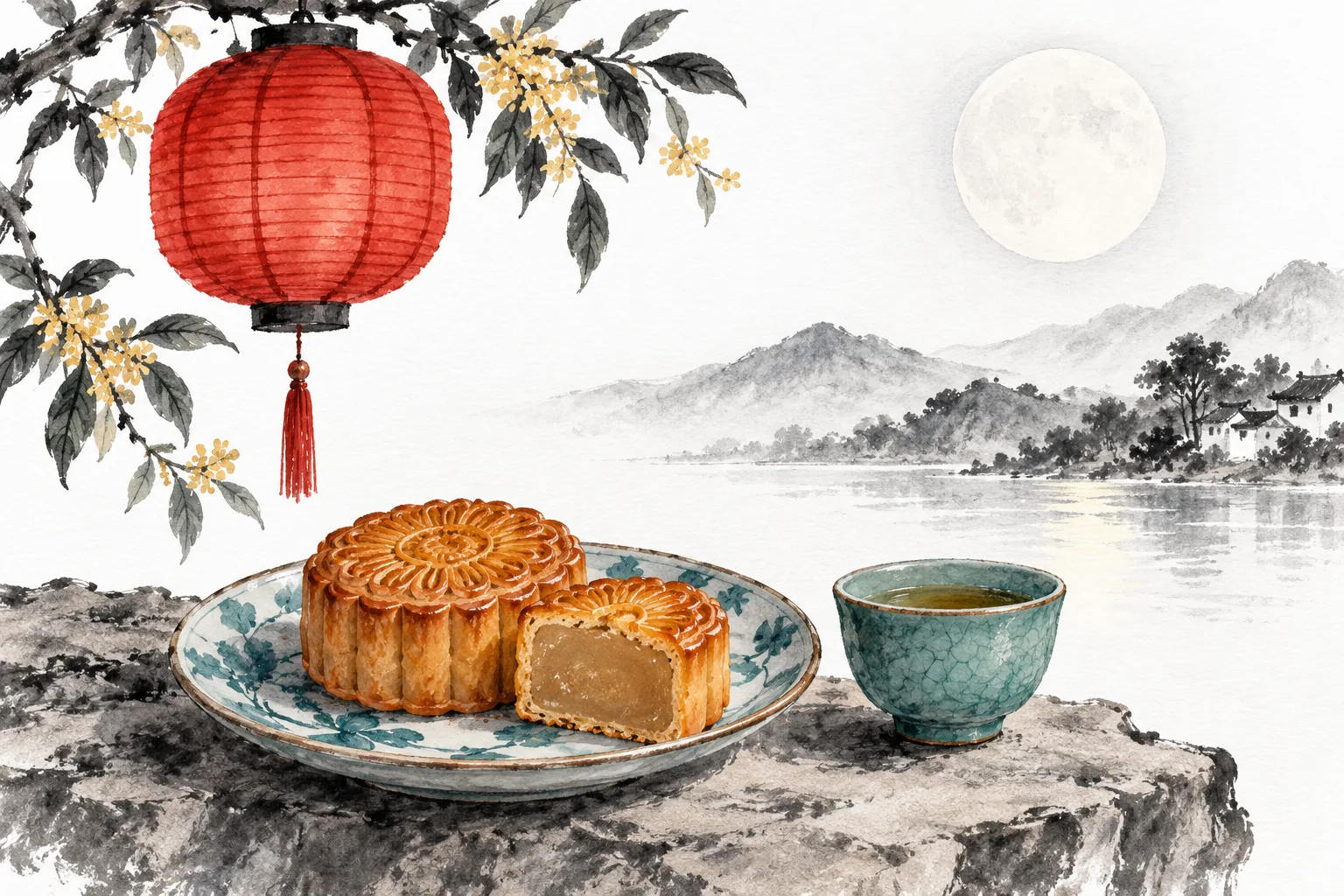
Chinese festivals include family reunions, remembrance of ancestors, public performances and seasonal foods. Spring Festival, Lantern Festival, Qingming, Dragon Boat Festival and Mid-Autumn Festival are the five a traveller is most likely to plan around, and this page is the hub for them: for each one, the rule that sets its date, what actually happens, and the article on this site that goes deeper.
Begin with a warning about dates, because it is where most published guides are vague. A traditional festival date, a public holiday and an event’s opening night are three different things, set by three different bodies, and they regularly disagree. Our guide to when Chinese New Year falls works through the calendar mechanism for the largest example and carries a date table to 2035; this page covers the rest of the year.
How do Chinese festival dates work?
Several major festivals are dated by a month and day in the traditional Chinese calendar, so their Gregorian dates move from year to year. A calendar listing “the fifth day of the fifth month” does not mean May 5.
A second, older layer runs on the sun rather than the moon. UNESCO’s record of the twenty-four solar terms — inscribed on its Representative List in 2016 — describes the mechanism: “The ancient Chinese divided the sun’s annual circular motion into 24 segments. Each segment was called a specific ‘Solar Term’.” It adds that “Some rituals and festivities in China are closely associated with the Solar Terms”. Qingming is the festival most often named alongside them, and Singapore’s National Heritage Board puts it the other way round in its own inventory entry: “The lunar calendar divides the year into 24 solar terms, and Qing Ming takes place at the start of the fifth solar term, marking a change from winter to spring.” Two heritage bodies, two different descriptions of which calendar owns the terms. We print both because neither page says the other is wrong, and because the practical consequence is the same: solar-term dates hold still in the Gregorian year while lunar dates wander.
The 2027 dates, as the State Council published them
China’s holiday calendar is a document, and it is searchable. The General Office of the State Council issued Notice on the Arrangement of Public Holidays for 2027 (国办发明电〔2026〕10号) on 5 November 2026 — two months before the year it arranges begins. It opens by naming exactly seven holidays: 经国务院批准,现将2027年元旦、春节、清明节、劳动节、端午节、中秋节和国庆节放假调休日期的具体安排通知如下 — New Year’s Day, Spring Festival, Qingming, Labour Day, Dragon Boat, Mid-Autumn and National Day.
| Festival | How the date is set | 2027 | In the state notice? |
|---|---|---|---|
| Spring Festival | First day of the first lunar month | 6 February (day 1). The notice’s range opens on 5 February, which it labels 农历除夕 — New Year’s Eve — and closes on 13 February, which it labels 农历正月初八 | Yes: 5–13 February, nine days |
| Lantern Festival | Fifteenth day of the first lunar month | 20 February, derived here: day 1 is 6 February, so day 15 is fourteen days later. The notice prints no such date | No |
| Qingming | The Qingming solar term | The notice’s holiday is 3–5 April; it does not say which of those days the term itself falls on | Yes: 3–5 April, three days |
| Dragon Boat Festival | Fifth day of the fifth lunar month | 9 June | Yes: 9 June, one day |
| Mid-Autumn Festival | Fifteenth day of the eighth lunar month | 15 September | Yes: 15 September, one day |
| Laba, 二月二, Qixi, Zhongyuan, Chongyang, winter solstice | Lunar month and day, or a solar term | Not printed on this page — no source we can read publishes them as official dates | No: the notice never mentions any of them |
Read the Spring Festival row carefully, because the notice is precise in a way that most English summaries are not. It gives 2月5日(农历除夕、周五)至13日(农历正月初八、周六)放假调休,共9天 — 5 to 13 February, nine days — and it labels both ends with the lunar date. 除夕 is the Eve, so day 1 of the new year is 6 February; that arithmetic is ours, performed on the notice’s own labels, and it matches the date in our Spring Festival guide.
Nine days is also not nine free days. The same line ends with two working Sundays: 1月31日(周日)、2月14日(周日)上班 — 31 January and 14 February are working days. That swap is what 放假调休 in the notice’s wording means, and it is worth knowing before you book: a long Chinese holiday is often a weekend moved, not a weekend added. The notice itself suggests the workaround it cannot legislate, “encouraging units and individuals to combine it with the paid annual leave system” (鼓励单位和个人结合落实带薪年休假等制度) to build a real break.
Which festivals get a day off — and which do not
Four of the seven holidays in the notice are traditional lunisolar festivals; the other three — New Year’s Day, Labour Day and National Day — are civil dates with no lunar component. That leaves the rest of the festival year with no statutory holiday at all. The Lantern Festival, the eighth-day Laba congee, the second day of the second month, Qixi on the seventh of the seventh, Zhongyuan on the fifteenth, Chongyang on the ninth of the ninth and the winter solstice are all absent from the document. We searched the full Chinese text of the notice, including its navigation and metadata, for each of their Chinese names, and not one of them occurs in it: the seven in the opening sentence are the whole list.
That is not the same as saying they are ignored. It means the observance is private or commercial rather than statutory, so transport, ticket and opening-hour questions behave differently: a public holiday moves domestic travel demand, a festival date does not. Elsewhere the same festival can be a holiday with local rules of its own — Hong Kong’s Tourism Board notes that for Mid-Autumn, “Most celebrations occur at night, with the following day observed as a public holiday. If it falls on a Sunday, the following Monday is designated as a holiday.”
Spring Festival: welcoming the new year
Spring Festival marks the start of the traditional new year. Families prepare food and clean their homes beforehand, gather for dinner on New Year’s Eve, and exchange visits and greetings during the celebrations. UNESCO’s record of the festival — inscribed in 2024 at the 19th session of the committee, on China’s own nomination — is the plainest statement of the sequence available from any official body: “In the days preceding the festival, people clean their homes, stock provisions and prepare food. On New Year’s Eve, families dine together and stay up late to welcome the new year.” It gathers the whole season under one word: “This process of celebration is known as ‘guonian’ (crossing the year).” And it adds that “Public festivities are held by communities, cultural institutions, social groups and art troupes”.
The Chinese New Year food guide here covers the reunion table dish by dish; the taboos article covers what people avoid and why. One familiar New Year gift is a red packet of money — see red envelopes, their meanings and giving etiquette — and the twelve zodiac animals explains which year is which, including 2027.
The clearest first-hand account of what a Beijing New Year actually involved is a short book written about one: 《燕京岁时记》 (Yanjing Suishiji) by 富察敦崇, whose postscript dates itself to 光绪二十六年 (1900). It is usefully unromantic. New Year’s Day itself: 京师谓元旦为大年初一 — the capital calls it “the first day of the big year”. The food is the one thing the book says everyone shares, whatever their station: 无论贫富贵贱,皆以白面作角而食之,谓之煮饽饽,举国皆然,无不同也 — rich and poor alike eat wheat-flour dumplings boiled in water, and the book insists the whole country does the same. It never uses the word 饺子 for the dumpling. And the first week has its own rules: 初五日谓之破五,破五之内不得以生米为炊,妇女不得出门 — the fifth day is called 破五, no raw grain is cooked before it, and women do not go out.
If you are invited to a reunion meal, ask the host when to arrive and whether to bring something. Avoid assuming that a public celebration represents every family’s observance. Food, greetings and religious practices can differ.
Lantern Festival: the first month’s full moon celebration
Lantern Festival falls on the fifteenth day of the first month and marks the final major occasion of the Spring Festival season. Shanghai’s municipal government portal, in its English-language guide to the day, lists exactly three customs: “Today, the festival is best known for three beloved customs across folk traditions: viewing lanterns, solving riddles written on them, and enjoying glutinous rice balls.” It dates the riddle tradition carefully — “By the Song Dynasty, Lantern Festival had taken on the character of an ‘intellectual festival’, marked by the emergence of lantern riddles” — and notes that under the Ming, the official lantern period “lasted 10 days, making it the longest lantern festival in Chinese history”.
The 1900 Beijing record is more granular than either, and it disagrees with the one-day framing that most English guides use: 自十三以至十七均谓之灯节,惟十五日谓之正灯耳 — from the thirteenth to the seventeenth all count as the lantern festival, and only the fifteenth is the main lamp. On food it is dryly commercial: 市卖食物,干鲜俱备,而以元宵为大宗 — the market sells dried and fresh alike, but the volume item is 元宵. So a “Lantern Festival night” in a programme is one night inside a five-day season, and the fifteenth is not necessarily the night with the best display.
For visitors, a lantern fair can be an accessible way to take part. Check whether entry is ticketed and whether the display runs on several nights. The festival’s calendar date alone does not tell you the operating hours of a particular venue.
Qingming: remembering ancestors
Qingming (清明) is an occasion to honor deceased relatives. The name is a description of the season rather than a saint’s day: its two characters mean clear and bright, which is how Singapore’s National Heritage Board renders them in its own inventory entry. The Board dates the festival more precisely than any guide we can read: “Qing Ming Festival (清明节) is a traditional Chinese festival for the worshipping of ancestors, usually occurring on the fourth to sixth day of April of the Gregorian calendar and the early part of the third lunar month in the lunar calendar.” Its entry was included in April 2018 and last updated in March 2019, and it also publishes the practical window that explains why cemetery traffic lasts weeks: “Visits to the cemeteries and columbaria can take place either on the actual day of Qing Ming or 10 days before or after the actual day.”
The same entry is candid about the practice changing under pressure, and it starts the paragraph with the problem: “An increasing challenge to the observance of Qing Ming in Singapore is land scarcity.” It continues that “the practice of visiting cemeteries during Qing Ming has been rapidly replaced with visits to columbaria and temples that house ancestral tablets”, and the next paragraph records “the gradual loss of knowledge about Qing Ming rituals”. That is a heritage board describing its own record as a moving target, and it is the reason this page cites editions and dates rather than treating any one description as final.
The 1900 Beijing book has a Qingming line worth quoting because it is the opposite of reassuring: 清明即寒食,又曰禁烟节。古人最重之,今人不为节,但儿童戴柳祭扫坟茔而已 — it equates Qingming with the Cold Food festival, then says the ancients prized it, people of the author’s day do not treat it as a festival, and children wear willow and sweep graves. The sentence ends with 而已, the two characters that mean “that is all”. Read as what one writer said about one city in 1900, it is evidence that these observances thin and thicken over time.
Treat a family’s observance as a private act of remembrance. If you are accompanying someone, let them explain what participation is welcome. Ask before photographing people, graves or offerings, and avoid blocking a ritual to get a picture.
Dragon Boat Festival: racing, food and local traditions
Dragon Boat Festival begins on the fifth day of the fifth month. Boat races and wrapped rice dumplings are widely recognized, but the people commemorated and the associated practices differ by region. UNESCO inscribed the festival in 2009, at the fourth session of the committee, and its description is unusually explicit about plural origins: “The festivities vary from region to region, but they usually share several features.” Then it names the heroes: “The hero who is celebrated varies by region: the romantic poet Qu Yuan is venerated in Hubei and Hunan Provinces, Wu Zixu (an old man said to have died while slaying a dragon in Guizhou Province) in South China, and Yan Hongwo in Yunnan Province among the Dai community.” Any article that says the festival “commemorates Qu Yuan” is reporting one region’s answer.
The same record lists the protective customs — “bathing in flower-scented water, wearing five-colour silk, hanging plants such as moxa and calamus over their doors, and pasting paper cut-outs in their windows” — and the 1900 Beijing book agrees on the plants while adding a local name and a local pronunciation: 京师谓端阳为五月节,初五日为五月单五,盖端字之转音也. On the realgar wine, the book is more specific than the tourist guides, and it is about children: 每至端阳,自初一日起,取雄黄合酒晒之,用涂小儿额及鼻耳间,以避毒物 — from the first day of the month the wine is prepared and painted on children’s foreheads and between their nose and ears.
If you want to watch a race, look up the named event and its viewing arrangements. A community’s race may take place on a weekend near the festival instead of on the exact traditional date. Keep the race course and boat launch areas clear.
Traditional foods can contain different fillings. Ask what is inside a rice dumpling before choosing it, especially if you avoid meat, seafood or particular nuts.
Mid-Autumn Festival: reunion meals and moon viewing
Mid-Autumn Festival falls on the fifteenth day of the eighth month. Family gatherings, mooncakes and moon viewing are familiar parts of the celebration. The Hong Kong Tourism Board’s guide gives the date rule — the festival is “celebrated on the full moon (15th day) of the eighth lunar month” — and it describes one territory-specific custom in detail: the Tai Hang Fire Dragon Dance, a dragon “adorned with 12,000 burning sticks of incense” which the board traces to a ceremony against plague, records as “preserved by the Hakka community” and notes is “listed on Hong Kong’s and the National Intangible Cultural Heritage lists”.
Beijing in 1900 called the day something simpler — 京师之曰八月节者,即中秋也, the eighth-month festival — and recorded a household rule that still surprises visitors: 惟供月时男子多不叩拜, men largely do not kowtow to the moon offering, which the book glosses with a proverb it quotes as current, 男不拜月,女不祭灶. On the cakes it is a food writer: the best mooncakes came from one named shop, they could be “大者尺馀” (over a third of a metre across), printed with the moon palace and the toad, and some were kept, not eaten — 有祭毕而食者,有留至除夕而食者,谓之团圆饼, those saved until New Year’s Eve are called reunion cakes. The same chapter documents the paper moon-god prints sold for the occasion, 长者七八尺, up to two metres tall, and the clay rabbit figurines — 兔儿爷 — that were the festival’s toy.
Lanterns therefore appear in more than one festival season. Mid-Autumn is a separate occasion from Lantern Festival, which takes place in the first month. Check the name and location of the event when arranging a visit.
Mooncakes come in different sizes and fillings, and are easy to share in small portions. Ask about ingredients instead of assuming that every mooncake contains the same paste or salted egg yolk. For a Vietnamese story connected with the Mid-Autumn season, read Cuội and the banyan tree; the article explains how this moon figure differs from Chang’e. For the terms themselves, our note on how to read traditional stories separates myths, legends and folktales.
Six more dates you will meet in an almanac
None of these is a public holiday in the State Council notice, and none is a big event for a visitor. They matter because they are the reason a festival calendar looks crowded, and because each still shapes what shops sell on the day.
Laba, eighth day of the twelfth month
The congee that names the day. The 1900 book lists what goes in it — and what must stay out, and by what hour the pot must be done — in a section headed 腊八粥; our food guide quotes the recipe and its exclusions.
The second day of the second month: the dragon raises its head
二月二日,古之中和节也。今人呼为龙抬头, the book says: the second of the second, anciently the Zhonghe festival, now called the day the dragon lifts its head, when households eat things renamed after parts of a dragon and, in the book’s version, women put away their needlework for the day 恐伤龙目 — for fear of injuring the dragon’s eyes.
Qixi, seventh day of the seventh month
The book records two observances and never mentions a romance as a custom. Both are dated 七月七日. In 鹊填桥 it notes only that crows and magpies are unusually quiet that morning, 俗谓之填桥去 — said to be away building the bridge — and its note cites 《日下旧闻考》 on 穿鹊桥补子, the magpie-bridge emblem worn at court in the Jin and Yuan palaces. In 丢针 it describes the girls’ test: a needle floated in a bowl of water left out in the sun, its shadow on the bottom read as flower, cloud, thread or pestle, and from that a hand’s skill was judged. Neither entry names the weaver and the herdboy that most modern write-ups put at the centre of the day.
Zhongyuan, fifteenth day of the seventh month
The almanac calls this Chinese festival Ghost Festival, and it is the clearest case of a date with no holiday behind it: 中元不为节,惟祭扫坟茔而已, it is not treated as a festival, graves are swept, that is the end. The evening lanterns were the visible part — children carried lotus-leaf lamps and the book records their street cry, 荷叶灯,荷叶灯,今日点了明日扔 — and 放河灯, floating lamps down the river, marked the season’s end: 中元以后,则游船歇业矣.
Chongyang, ninth day of the ninth month
Every ninth of the ninth, the book says, people of the capital 提壶携榼,出郭登高 — carried flasks and baskets out of the gates and climbed. It names the hills, and it describes the double-layer or triple-layer nut-and-sugar cake (花糕) that bakeries made in advance for the day. The winter solstice, recorded under 冬至, got the blunter verdict — 民间不为节,惟食馄饨而已, common people do not treat it as a festival, they eat wontons — followed by the proverb 冬至馄饨,夏至面.
The stove, the twenty-third of the twelfth month
Not a festival on most lists, but the hinge of the New Year season: 二十三日祭灶, the stove sacrifice on the twenty-third, which the book says the capital marks with candy and a great deal of firecracker noise, 是日鞭炮极多,俗谓之小年下 — “the little New Year”. Its date is contested between north and south, and our taboos article covers that split with the source that settles it.
Do all Chinese communities celebrate in the same way?
No. The traditions in this overview are a starting point for asking better questions. The Singapore heritage entry documents local Qingming practices at a moment when they were changing; the Hong Kong tourism guide describes specific Mid-Autumn customs; the 1900 book describes one city’s calendar year and names that city in its title. Those local details should not be turned into rules for every Chinese household — and a solar-term date printed by a Singapore board and a lunar rule printed by a Chinese notice are two different kinds of fact.
Planning a visit around a festival
- Get the holiday notice, not the festival list. For travel in mainland China, the State Council General Office notice for the year — published the previous November — is the document that tells you when trains and hotels actually tighten.
- Then confirm the date for the destination you are visiting, and check the event organizer’s schedule separately.
- Ask your hotel or host about transport and opening hours before committing to a tightly timed itinerary.
- Book a specific public event when possible instead of assuming a private family observance is open to visitors.
- Ask before photographing ceremonies or joining an activity. Follow staff instructions at busy viewing areas.
- Check food ingredients and choose portions you can finish, particularly when sampling several festival foods.
Food and table manners
For reunion meals, our chopstick etiquette guide explains practical habits and differences between dining settings. The dining etiquette page covers seating and hosting, and family culture explains why so many of these occasions are organized around elders. To explore a regional Chinese cooking tradition, start with Huaiyang cuisine.
The festival cluster on this site
- When is Chinese New Year? — the calendar mechanism and a date table.
- The twelve zodiac animals — signs, years and the 2027 animal.
- What not to do during Chinese New Year — fifteen taboos and the reasoning behind them.
- Chinese New Year food — the reunion dinner dish by dish.
- Chinese New Year red envelopes — who gives, what goes in, what it means.
Sources and method
Every dated claim on this page comes from one of eight documents, each read on 20 November 2026 and kept on file:
- 国务院办公厅关于2027年部分节假日安排的通知 (国办发明电〔2026〕10号), State Council General Office, 5 November 2026 — the only source here that fixes official 2027 dates.
- Spring festival, social practices of the Chinese people in celebration of traditional new year, UNESCO Representative List element 02126, inscribed 2024 (19.COM); the text is China’s own nomination.
- Dragon Boat Festival, UNESCO element 00225, inscribed 2009 (4.COM).
- The Twenty-Four Solar Terms, UNESCO element 00647, inscribed 2016 (11.COM).
- Lantern Festival, english.shanghai.gov.cn, credited on the page to the General Office of the Shanghai Municipal People’s Government, posted 22 January 2026.
- Qing Ming Festival, National Heritage Board Singapore intangible cultural heritage inventory, reference ICH-032, included April 2018, updated March 2019.
- How to Celebrate Mid-Autumn Festival in Hong Kong, Hong Kong Tourism Board.
- 《燕京岁时记》 (Yanjing Suishiji) by 富察敦崇 of the Qing, read in the full Wikisource text. Its postscript dates itself: 光绪二十六年岁次庚子三月十六日敦崇自记. One city’s calendar year, written by a man living in it.
What we could not source. Five things this page deliberately does not say. It gives no Gregorian dates for Laba, Qixi, Zhongyuan, Chongyang, the winter solstice or the second of the second month, because the notice that publishes official dates does not cover them and we found no comparable document to put in its place. It does not say which day of 3–5 April 2027 the Qingming term falls on; the notice gives a holiday range and stops there. It does not print the twenty-four solar terms as a list; the UNESCO record describes the system without naming all twenty-four, and we did not find a readable official page that lists them. It does not resolve whether the terms belong to the lunar calendar or to the solar layer of a lunisolar one, because UNESCO and the Singapore board describe it differently and we print both descriptions rather than picking one. And it does not date any of the folk figures attached to these days: the 1900 book records practices, not origins, and the origin stories you will find on most festival pages appear in no document we could read.
What we could not read. roots.gov.sg is a National Heritage Board host that answers no plain client: our fetch returned HTTP 202 with an empty body. The Qingming quotations above were taken from the rendered page in a browser on 20 November 2026, and each run was then re-checked against the page text mechanically. The other seven documents were fetched directly and are quoted from those captures. A translation into English inside quotation marks is ours unless the source is itself in English.
