
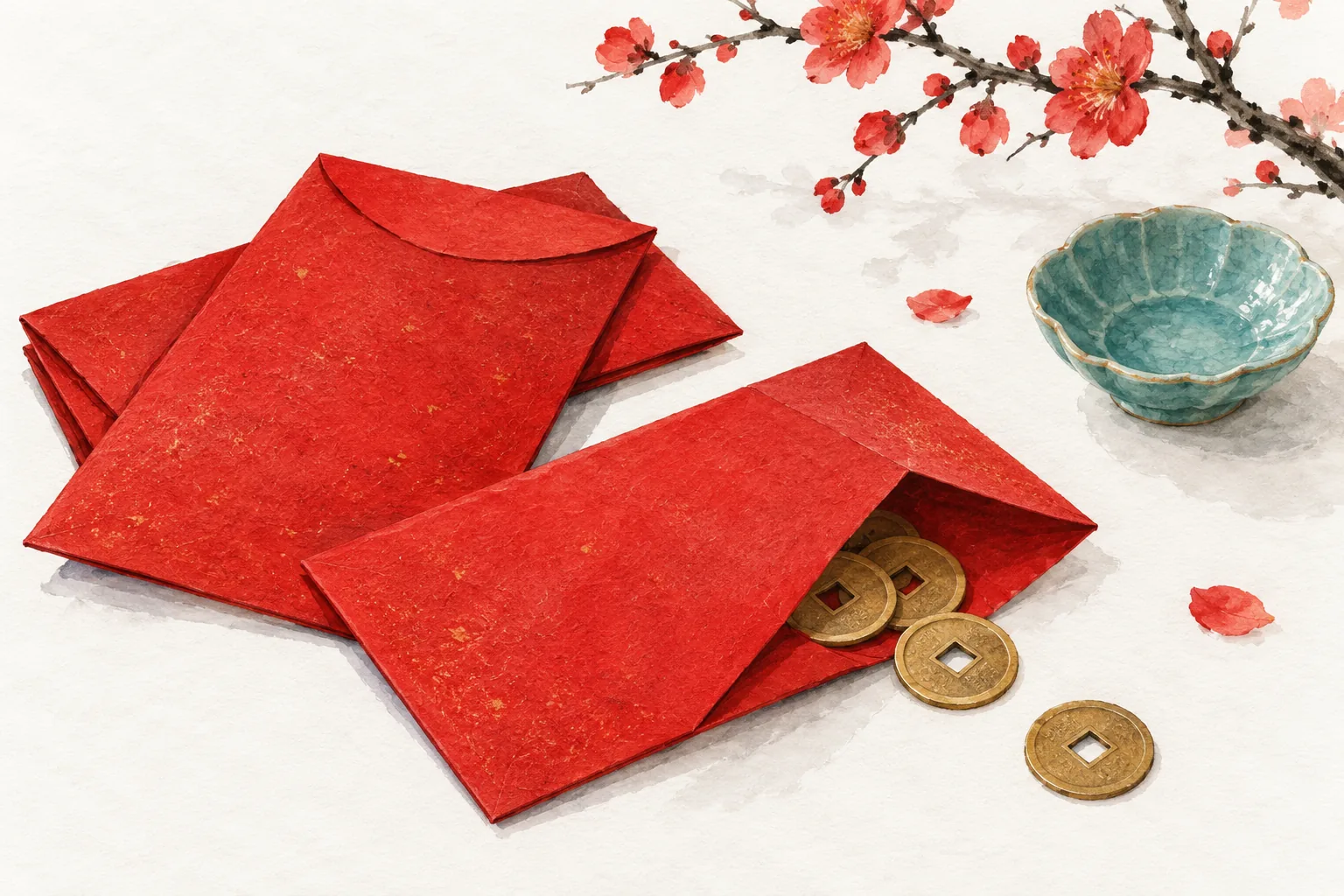
Chinese New Year red envelopes are gifts of money presented with good wishes. They are called hóngbāo in Mandarin and lai see in Cantonese; angbao or ang pow are familiar names in Singapore’s Hokkien context. The occasion, relationship and local custom shape who gives them and how.
Almost everyone searching for this wants one number: how much. Every official source we could reach declines to give one. That is not evasion — it turns out the interesting rules are about the digits, the direction and, for public servants in Hong Kong, whether a red envelope may be accepted at all. We found governments in three jurisdictions that answer those questions instead, and a tax authority that answers one nobody asks.
What does a red envelope mean?
The Sun Yat Sen Nanyang Memorial Hall’s account of red packets describes them as representing “blessings from the giver to the receiver” at auspicious occasions. It also places them beyond New Year: the same page lists childbirth, birthdays, weddings, moving house and starting a business. The envelope is therefore part of a wider practice of giving good wishes, not a holiday-only object.
UNESCO’s own description of the festival puts the greeting at the centre. The element inscribed on the Representative List of the Intangible Cultural Heritage of Humanity in 2024 records that during the festival people “wear new clothes, make offerings to heaven, earth and ancestors, and extend greetings to elders, relatives, friends and neighbours”. The red packet is the object that travels with exactly those greetings. The description does not name the packet, and a short inscription abstract is not an inventory of a festival, so that silence proves nothing on its own; what it does show is a formal account of these days written entirely in terms of visiting and greeting.
The legend of Sui
One popular story tells of Sui, a demon that frightened or harmed children on New Year’s Eve. In the memorial hall’s telling, an elderly couple of the surname Guan give their late-born son “eight copper coins wrapped in red paper” to play with; the coins fall beside him, and when Sui arrives they “emitted a bright light which scared Sui off”. Singapore’s SG101 heritage account tells a variation in which the Eight Immortals disguise themselves as the coins. Our guide to myths, legends and folktales explains why a legend attached to an object does not date the custom.
The name yāsuìqián is connected with suppressing Sui in the legend. The memorial hall notes that the word for “age” is also pronounced sui, so the character for the demon was replaced by the character for age, and the money became a New Year blessing. Its own chronology is two separate claims, not one: the hall traces the packet’s “origins” to “coin-like charms that were used in China since the Han dynasty (202 BCE–220) to ward off evil and bad luck”, and the envelope form separately “to the Tang dynasty (618–807), where the social elites used small handwoven bags to hold cash gifts”.
What the oldest record actually says
The text that Chinese dictionaries cite for 压岁钱 is 《燕京岁时记》, a record of Beijing seasonal customs by 富察敦崇, self-dated in its postface to 光绪二十六年 — 1900. Its 压岁钱 section reads, in full:
以彩绳穿钱,编作龙形,置于床脚,谓之压岁钱。尊长之赐小儿者,亦谓之压岁钱。
《燕京岁时记·压岁钱》
Translated: “Money threaded on a coloured cord and plaited into the shape of a dragon, placed at the foot of the bed — that is called 压岁钱. Money given by an elder to a small child is also called 压岁钱.” Note what is absent. There is no red paper in that sentence, no envelope, no demon and no amount. The absence is not a hole in the book’s vocabulary. Two sections after 压岁钱 comes 挂千, and there the author is explicit about paper: auspicious words cut on 红纸 and pasted at the door, with a smaller version in yellow paper for shops. When this text means a piece of red paper, it says so. Here it does not. The dictionary entry built on it keeps the same order: 汉典 defines 压岁钱 first as “旧时除夕用彩绳穿钱放在床脚的习俗” — the old New Year’s Eve practice of stringing coins and putting them at the bed foot — and only second as the money elders give children.
The same book has a section one heading later that a careless reader will mistake for the red envelope. It is headed 红票儿: “钱肆取钱之帖谓之票子。每届岁除,凡富贵之家以银易钱者,皆用彩笺书写,谓之红票儿。” Those are red slips used by money shops when a wealthy household exchanged silver for cash at year end. They are drawn on coloured paper and they are about money and they are red, and they are still not red envelopes. It is worth knowing where the trail stops.
Who gives red envelopes at Chinese New Year?
In Hong Kong, the Hong Kong Tourism Board says “it’s customary for elders, bosses and married individuals to give lai see (red envelopes) filled with lucky money”. Beijing’s official tourism guide to red envelopes adds the reverse direction: “Besides children and unmarried juniors, New Year’s red envelopes can also be given to the elderly by adults with income to show their respect and best wishes.” Singapore’s SG101 says the same for employed or married adult children and grandchildren.
The memorial hall is the only one of these sources that tries to fix when you become a giver, and it does so by refusing to: “Although there are no hard and fast rule as to when one should start giving red packets during Chinese New Year, typical milestones would be earning one’s first pay check or after the first year of marriage.” It adds that “Newlyweds in their first year of marriage are often excused from giving red packets”. If you are visiting a family, ask your host what is usual in that household; a workplace exchange may follow different expectations from a reunion dinner.
How should you receive a red envelope?
Hong Kong Talent Engage’s New Year etiquette guide is explicit: “it is considered impolite to open red envelopes in front of the giver”. The Singapore heritage sources agree on the manner of receiving as well as the manner of opening. The memorial hall: “The receiver should receive the red packets with both hands as a form of respect”, and “If the receiver is the child or grandchild of the giver, some families require them to kneel down to receive the red packets”. SG101 compresses the same rule to “Red packets are given and received with both hands”.
How much money should you put in a red envelope?
No source in our set names an amount to put in a packet. That is a finding, not a shortfall, and it holds across government, museum and platform documents from three jurisdictions — the only currency figures any source attaches to a red packet sit inside Tencent’s worked example of how a group packet splits. What the sources do specify is the condition of the cash:
- New notes. The memorial hall: “When giving cash notes, these notes should ideally be fresh from the press, clean and unwrinkled.”
- The queue is the custom. SG101 records that “part of the CNY ‘tradition’ here involves joining long queues at banks to get new or fit-for-gifting notes to fill the red packets.”
- Even denominations. Both Singapore sources state it; see the next section.
- Discretion. Prepare envelopes before the visit so you are not sorting cash at the table, organise different amounts so you can tell them apart quietly, and do not compare gifts in front of other recipients.
Two anti-corruption bodies answer the amount question by rejecting its premise. The Hong Kong ICAC publishes the question “Can a public servant accept an advantage under HK$500?” and answers that “the key factors for consideration are the purpose, motive and the circumstances of the offering and acceptance of the advantage, regardless of its value.” Its next question is about festive red packets by name, and the answer is stricter still: “Red packets and gifts are regarded as advantages under the POBO”, both the giver and the receiver commit an offence where they are accepted in connection with public capacity without written permission, and “It shall not be a defence that the gifts offered are customary in any profession, trade, vocation or calling.”
Singapore’s CPIB reaches the opposite conclusion by the same route, because it starts from intent rather than office: “The act of giving a genuine gift (such as red packets) in itself without any corrupt intention is not considered corruption.” So the honest answer to “how much” is that the number is private and the reason for giving is not. If a red envelope is addressed to someone who decides your business, ask a different question.
Which numbers are lucky, and which are not
This is where the sources do get specific, and the itemised list is the Singapore museum’s:
| Rule | Stated reason |
|---|---|
| Use an even denomination | “good things come in pairs” |
| Do not include the digit four | “four is homophonous with death in Chinese” |
| Eight is favoured | “it sounds similar to the word for prosperity in Chinese” |
| Nine is accepted despite being odd | “nine is homophonous with longevity in Chinese” |
Two things are worth noticing. First, the fourth row is the source telling you its own rule has an exception: nine is odd, and it is still fine. A site that flattened this into one even-number rule would be tidier and less true. Second, the source of the most explicit list of Chinese New Year number taboos we could find is a museum in Singapore run by Singapore’s National Heritage Board — not a Chinese government body. We looked.
Digital red envelopes
Beijing’s tourism board dates this precisely for a state source: “2014 Chinese New Year marked the innovation of digital red envelopes on WeChat.” Tencent’s own account gives the mechanism and the scale, and starts from an internal problem — “Weixin Red Packets are inspired by Tencent’s tradition of distributing red packets to employees during the Spring Festival every year”, with co-founder Tony Zhang suggesting the Weixin team improve it. Tencent also makes the naming distinction most coverage skips: the mainland service is Weixin, “the sister app of WeChat used outside of the Chinese mainland”.
The group packet is the part that actually changed the custom. Tencent’s worked example: “you can send red packets worth RMB100 in total to a group of 10 people and specify that you want the money, in random amounts, to go to the first five people to open the packet. One might receive RMB65, another RMB6.5, while others receive amounts as small as RMB0.01.” The scramble for a randomly-sized packet, among strangers, is a gift logic no household version of this custom contained. It scaled fast: Tencent says that in 2015 Weixin became the exclusive partner of the CCTV Spring Festival Gala, that “Hundreds of millions of viewers shared RMB500 million in prize money simply by shaking their phones at their TV sets”, and that “users shook their phones an astounding 11 billion times on Spring Festival Eve that year”.
Singapore went the same way for a different reason. SG101 reports that “digital disruption to tradition became more apparent as electronic red packets rose in popularity in Singapore, especially when the COVID-19 pandemic restricted physical gatherings”, and records the objection in the same breath: “some may feel that paper red packets show more respect and sincerity”. The museum’s verdict is blunter than either side would like — “the local Chinese community generally prefers traditional red packets to digital ones.”
Is a red envelope taxable?
China’s Ministry of Finance and State Taxation Administration jointly issued 财政部 税务总局公告2019年第74号, which reallocated several categories of personal income. It contains exactly one sentence about red packets, and it is not about families. Clause 3 taxes gifts — “包括网络红包” (including online red packets) — that a business hands out at random to people outside it, and gifts given at annual meetings, forums and celebrations, as “偶然所得” (incidental income).
What the instrument does not do is say anything about a grandparent. Its scope is the payer: clause 3 names businesses distributing gifts at random to people outside them, and gifts handed out at annual meetings, forums and celebrations. Whether a packet inside a family creates any liability is a question the announcement does not put. The interpretation pages that would normally be read beside it never reached us in readable form, so we print the announcement’s actual reach — company to consumer — and leave the family question where the document leaves it, rather than settle it on a text we could not open.
Red envelopes outside Chinese New Year
The same object travels. Singapore’s National Heritage Board describes the wedding tea ceremony in terms of the packet: the bride and groom offer tea to senior relatives, who are “expected to give a ‘hongbao’ (red packet) or jewellery to the couple” — the gift that answers the tea is described in our guide to Chinese family culture. The memorial hall lists further uses: money in a red packet to family and friends who visit you in hospital, which it identifies as a Cantonese practice for dispelling bad luck; and lottery tickets in a packet, which it calls “a widely accepted practice” in Singapore, with a rule attached — “Receivers who win the lottery should return a token sum to the giver.”
And the packet left Chinese homes altogether. The hall records that “During the 1980s, banks also started producing red packets during the Hari Raya season but replaced the colour with green instead as it was the colour associated with Islam”. Those packets “would usually feature floral and ethnic motifs as well as calligraphic inscriptions of Quranic verses”, it writes, and “During Deepavali, Indians of the Hindu faith also distribute similar cash gifts in packets which are decorated with images of Hindu deities, peacocks, elephants, and oil lamps”.
Red packets as designed objects
The paper itself became a seasonal industry. By the 1970s and 1980s, the hall says, printing and distributing packets “had become a Chinese New Year tradition for many major firms, particularly banks and department stores”, with foil-stamping and even scented designs, and the packets grew physically larger as notes replaced coins. By the turn of the 21st century, it says, “banks alone printing and distributing tens of millions of red packets each year” in Singapore.
They are also collected now. Singapore’s National Heritage Board runs an annual Museum Roundtable hongbao campaign; the 2026 edition was, in the board’s words, “Now in its 12th edition”, with designs “based on the Zodiac Year of the Horse” distributed from 23 January to 15 February 2026 at “49 participating museums, heritage institutions and galleries”, one set of “six (6) pieces of red packets” per visitor while stocks lasted. Each venue set its own conditions — at one, a set required visiting an exhibition or programme and was limited to the first 18 visitors that day — so the packets are free in the sense that no fixed price is printed on them, not in the sense that you need do nothing.
What we could not source
Six claims that circulate widely are not in any document we could read, and none of them appears above:
- Any suggested amount. No figure in any currency is recommended for a red envelope by any government, museum or platform in our set — not for a child, not for a doorman, not for a boss.
- Odd amounts are for funerals. The even-number rule for celebrations is stated twice; the mirror-image rule for mourning is stated nowhere we could reach.
- Red envelopes are for unmarried people only. The sources describe who receives and who gives by life stage, and the museum explicitly declines to set a start line.
- A Chinese official body lists the number taboos. The itemised list is Singapore’s. We found no PRC government, ministry or central-bank page stating the 4/8 rules, and no PBOC page on red packets at all.
- The 1900 text records the red envelope. 《燕京岁时记》 records coins strung at the bed foot, and its 红票儿 is a money-shop slip.
- The legend of Sui is ancient. Both modern tellings we used are 21st-century heritage interpretations; the 1900 text names no demon.
Sources and method
Every sentence above that states a rule, a date or a figure was written against a copy of its source saved locally, and each quotation was matched byte-for-byte against that copy. The documents, all retrieved 20 November 2026:
- Sun Yat Sen Nanyang Memorial Hall, “Red packets (Hongbao)”, Culturepaedia Singapore (National Heritage Board, Singapore), last updated 16 December 2025; article contributed by Amanda Ho, Assistant Curator, adapted from the hall’s River Hongbao 2020 exhibition “Prosperity in Packets: Hongbao in Chinese Culture”. English and Chinese editions fetched separately; they carry the same modification timestamp.
- SG101 (People’s Association, Government of Singapore), “The Gifting of Red Packets in Singapore”, 18 January 2023.
- 《燕京岁时记》 (富察敦崇), section 压岁钱 and neighbouring sections — via the free-text Wikisource edition, postface self-dated 光绪二十六年 (1900). 汉典 dictionary entry 压岁钱, which cites the same passage as its proof text.
- Independent Commission Against Corruption (Hong Kong), Prevention Branch legal FAQ, questions 03–05, English and Traditional Chinese editions.
- Corrupt Practices Investigation Bureau (Singapore), corruption-related FAQ.
- 财政部 税务总局公告2019年第74号, clause 3, from the State Taxation Administration policy database.
- Tencent, “Old Traditions Meet New Technology: The Spring Festival Celebration Goes Virtual”, 26 February 2021.
- Hong Kong Tourism Board, “The Ultimate Guide to Chinese New Year in Hong Kong”; Hong Kong Talent Engage (HKSAR Government), Lunar New Year customs and etiquette guide; Beijing Municipal Bureau of Culture and Tourism (english.visitbeijing.com.cn), “Spring Festival Custom: Giving Red Envelopes”, 5 February 2021.
- UNESCO Intangible Cultural Heritage, element 02126, “Spring festival, social practices of the Chinese people in celebration of traditional new year”, inscribed 2024 (19.COM); the inscription’s own description of the element.
- National Heritage Board (Singapore), “2026 Museum Roundtable Lunar New Year Hongbao Campaign”; and the board’s published account of the wedding tea ceremony.
What we could not read. The two National Heritage Board pages cited here — the 2026 campaign announcement and the collection listing behind the wedding tea-ceremony quotation — return HTTP 202 with an empty body to a plain client; both were read in a browser instead, and the wording above is quoted from the rendered pages. The interpretation pages that would normally be read beside the 2019 announcement never handed over an article: across repeated attempts on 20 November 2026, one Beijing tax host refused the connection every time, a Qingdao host answered HTTP 412 on one attempt and refused the connection on the others, the Ministry of Finance address returned 404 on its desktop host and 502 on its mobile one, and an Inner Mongolia knowledge-base page returned 200 with a five-kilobyte script shell and no text. That is why the taxation section above stays inside the announcement we did obtain. UNESCO’s element page does serve its inscription description to a plain client, but the fuller nomination dossier sits behind a browser-only interface, so only the description is quoted here. None of these is cited above except where it was actually read.
Related reading
Place the custom in context with our Chinese festivals guide, and see when Chinese New Year falls, what not to do during it and the foods that carry the wishes. For the wider idea of a gift that must not look like a payment, read our guide to Chinese customs, and for the reverse case — money you are supposed to refuse — dining etiquette across Asia. For a Vietnamese moon legend associated with another festival season, read Cuội and the banyan tree.
