
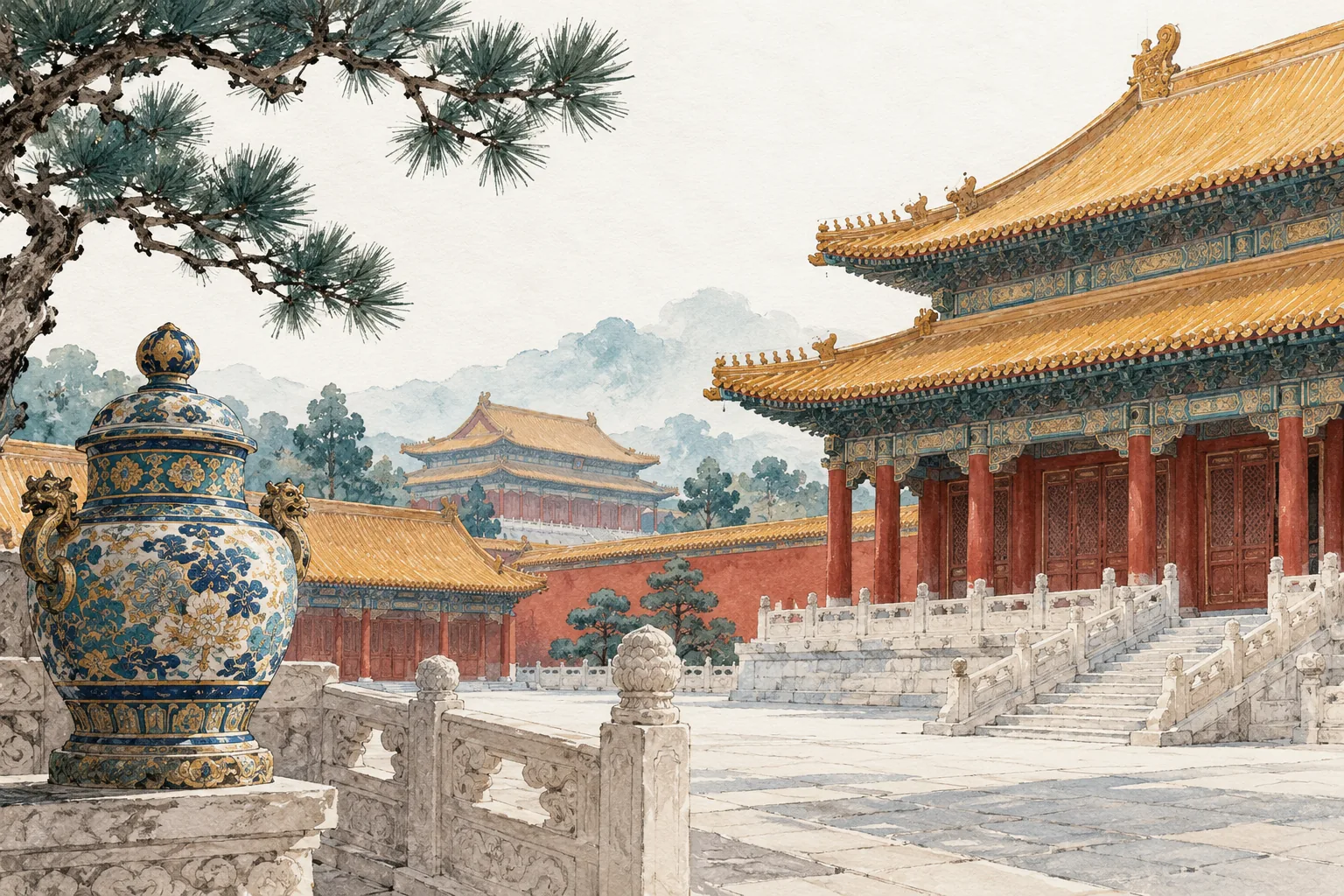
The Qing was China’s last imperial dynasty. It is also called the Manchu dynasty because its ruling house was Manchu. Qing rule in Beijing began in 1644, and the last emperor abdicated in 1912. The name appears throughout the interpretation of Chinese palaces, paintings and decorative arts.
Why is it called the Manchu dynasty?
The Smithsonian’s Qing dynasty overview explains that its founders came from the northeast and maintained a distinct Manchu language and identity. They governed a multiethnic empire, preserving some Manchu practices while adapting institutions used under the Ming.
The court continued a civil service examination system to recruit Chinese officials. The Smithsonian also describes the emperors’ use of both Chinese and Manchu. Calling the period “Manchu” identifies the ruling group; it does not mean that everyone living under Qing rule belonged to that group.
What changed after the Ming?
Qing rulers retained and adapted parts of the earlier government and cultural life. At the same time, their court promoted its own traditions. Looking for both continuity and change is more useful than treating 1644 as a complete replacement of every institution and custom.
For the earlier period, see our Ming dynasty introduction. A museum object labelled Ming and one labelled Qing may be close in date while belonging to different political settings.
Emperors, gardens and cultural patronage
The National Library of Australia’s Celestial Empire material discusses the Kangxi, Yongzheng and Qianlong emperors and the development of imperial gardens northwest of Beijing. It also describes Manchu ritual traditions maintained at court. These sources show why Qing history cannot be reduced to a list of palace buildings.
The court was an important patron of art. The Metropolitan Museum of Art’s essay on Qing painting considers imperial support alongside artists working beyond the court. When viewing a painting, ask who made it and for whom, rather than assuming every Qing work expressed an emperor’s preferences.
Places that help explain Qing history
The UNESCO imperial palaces listing includes both the Forbidden City in Beijing and the Qing palace at Shenyang. The latter helps explain the court’s northeastern roots before Beijing became its main seat. Beijing’s palace, by contrast, carries the history of both Ming and Qing rule.
Choose a specific question for a visit: how the court used ceremonial space, how a collection was assembled, or which parts of a building survive from different periods. Check the museum’s current entry arrangements and the rooms open to visitors before planning around one display.
Did the Qing end in 1911 or 1912?
Both dates appear in references because they point to different events. The revolution began in 1911, and some museum period labels use that year as an endpoint. The abdication came afterward.
The National Museum of China’s abdication-edict record dates it to 12 February 1912. A diplomatic notice dated 14 February 1912 in the U.S. Office of the Historian’s documents independently reports the decree of 12 February. If you need a precise event date, distinguish the uprising from the formal abdication.
Reading Qing objects and labels
- Check the specific reign or date instead of treating the entire dynasty as one moment.
- Keep Manchu identity, imperial government and the cultures of the wider population distinct.
- Read descriptions of a palace alongside information about later alterations and conservation.
- Use an illustration to orient yourself, while relying on collection records and historical documents for evidence.
Related reading
Compare the Ming dynasty’s art and history, or explore the customs behind Chinese New Year red envelopes. A living festival tradition should not automatically be dated to a particular dynasty without evidence.
