
Myths, legends and folktales are names used for different kinds of traditional story. Their boundaries can overlap, and a community’s own terms may not match an English classification. When reading a story from another place, begin with the teller, the language and the version you have in front of you.
What is the difference?
The New York Public Library’s folklore guide summarizes a scholarly distinction: myths often concern a sacred, remote past; legends are set in a recognizable world and may be treated as believable; folktales are generally told as fiction. The guide also cautions that cultural categories can differ from these library terms.
These labels help you find and compare material. They do not decide what a living community must believe. A reader should keep a religious account’s meaning for its participants in view, and avoid treating “myth” as a casual synonym for something foolish.
Why does one story have several versions?
A storyteller makes choices about audience and length. A children’s retelling may simplify events; a stage performance may expand dialogue or change the emphasis. The Library of Congress’s guide to narrative collections describes folklore carried in recordings and manuscripts, ranging from ancient stories to personal narratives and contemporary legends.
Compare versions by recording the teller or author, publication, language and date. Then note the actual difference: a character’s name, a motive, an ending or the reason an event happens. “In this telling” is useful when a detail is not shared by every version.
Start with Cuội and the banyan tree
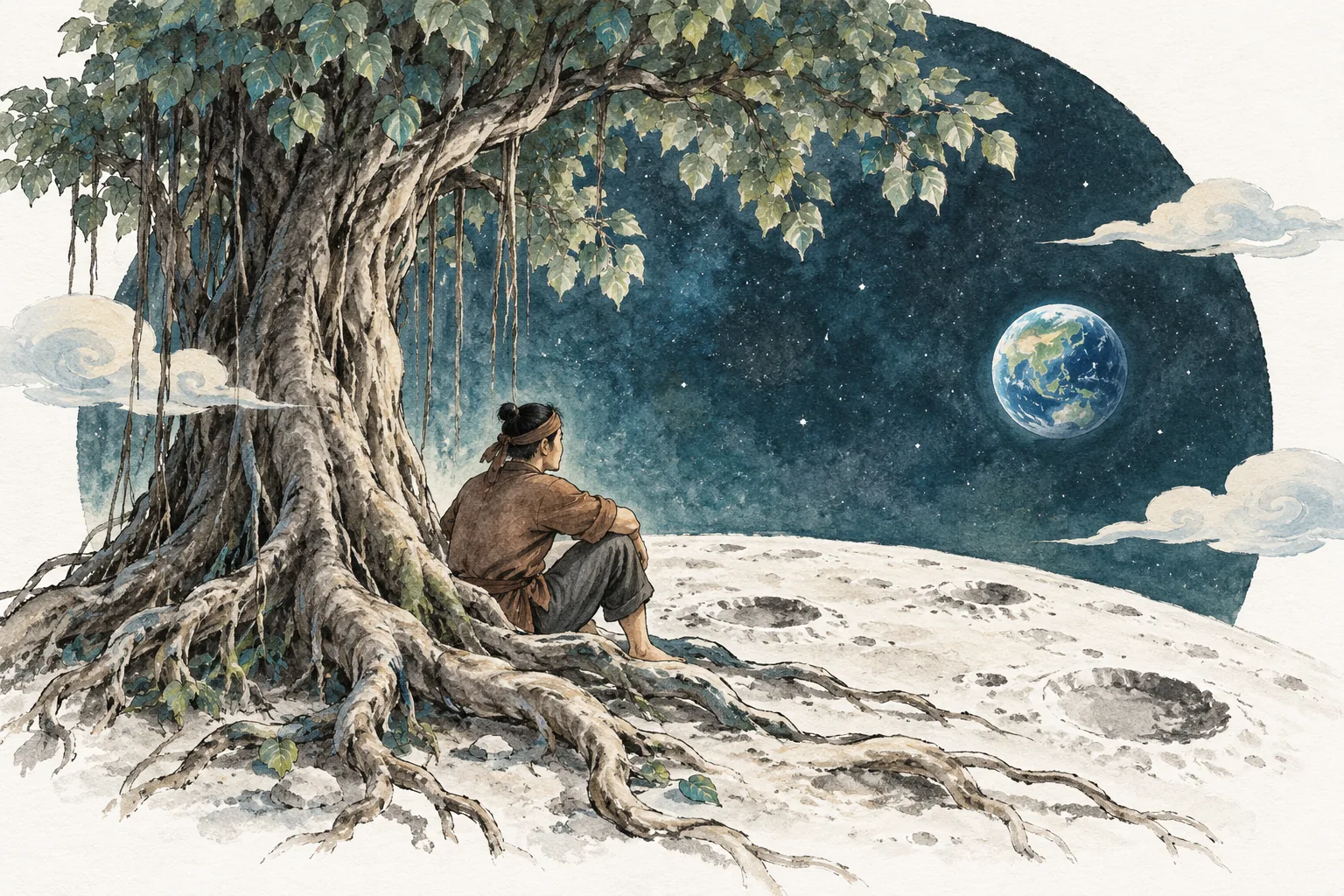
Our guide to Cuội, the Vietnamese moon figure compares accounts of the banyan tree’s journey to the moon. The tale also gives context to Mid-Autumn celebrations. Keep the story’s magical events separate from historical or botanical claims.
Our red-envelope guide includes the Sui legend alongside gift customs. A legend associated with an object does not, on its own, establish when that object or custom first appeared.
Reading a traditional story with children
- Name the place and version you are reading.
- Ask which details belong to the imaginary world of the story.
- Compare another telling without ranking a whole culture by one adaptation.
- Explain unfamiliar terms and keep the teller’s name or source attached to the account.
Stories and festival visits
A performance can introduce a character before a visit to a festival. Check the programme to learn whether you are seeing an adaptation, a traditional performance or a new work. Our festival guide provides context for several celebrations without treating all moon stories as the same tale.
